
Commercial disclosure: We may earn a commission if you purchase through certain links on this page.
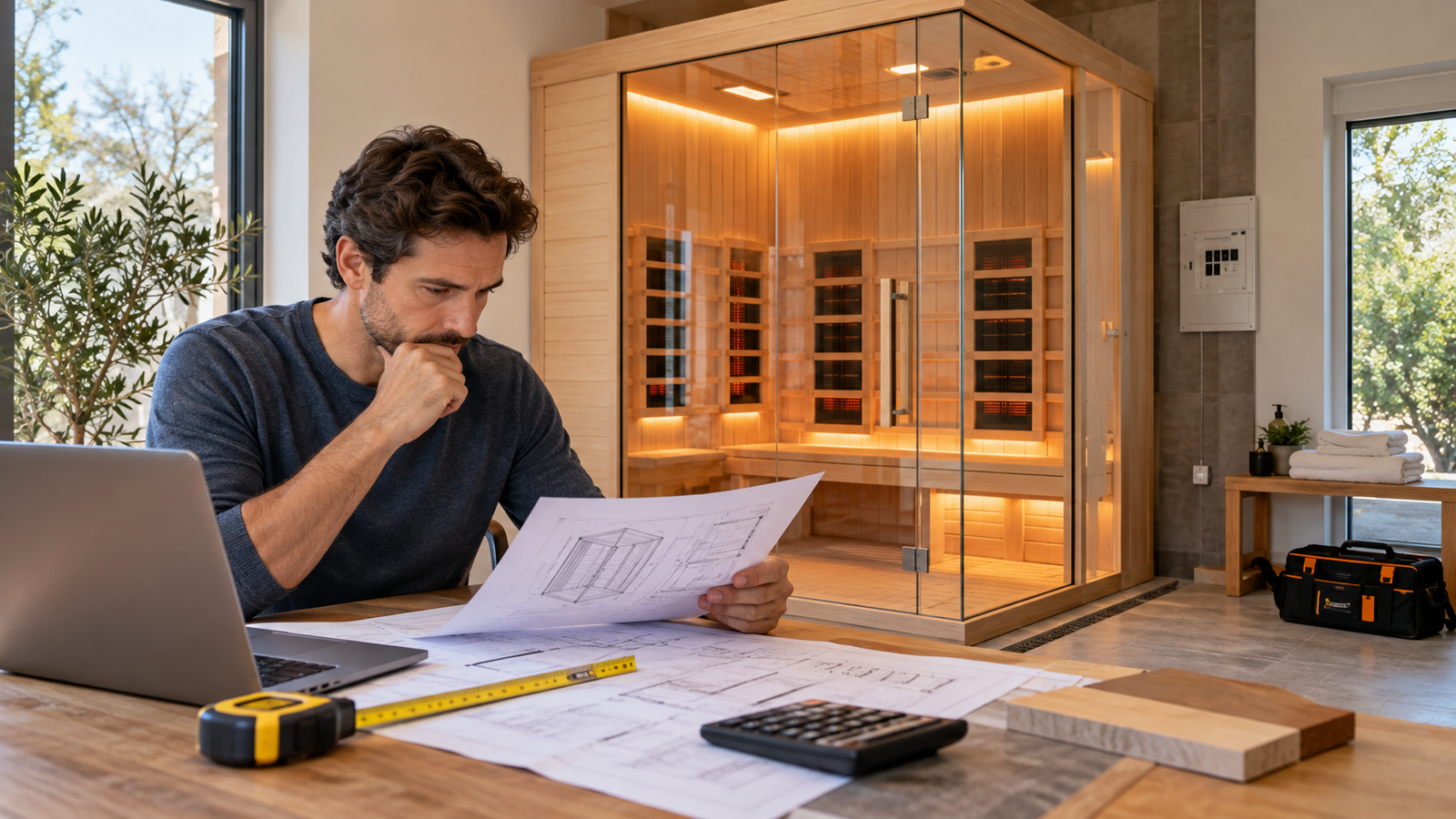
The headline price of an infrared sauna is not necessarily the amount required to use it at home. A self-contained cabin may have a relatively bounded product and assembly scope; a made-to-measure system can also require a room, glass, dedicated wiring, trades and freight. The useful question behind infrared sauna cost is: what will it take to reach an installed, functioning sauna—and what will ownership cost afterward?
Budget the full project, not just the box or manufacturer quote. Add the actual equipment, delivery, tax, site and glass work, electrical connection, labor and contingency, then estimate electricity from the specified wattage and your local rate. SaunaCloud publishes a flat $999 shipping charge for its custom kits, but a universal installed purchase price is not established by its product pages; request a written, dimension-specific proposal.
The complete installed-cost worksheet
The following is a worksheet, not a price list. Fill each blank with a vendor or contractor quote before treating the total as a budget.
| Line item | What the quote must say | Why it is missed |
|---|---|---|
| Equipment and options | Exact system, dimensions, benches, heating, lighting and controls | Illustrative configurations are mistaken for the final order |
| Freight and access | Shipping fee, delivery point, unloading and move-in labor | Curbside service is mistaken for indoor placement |
| Structure and glass | Framing, backing, doors/windows, flooring, trim and finishing | A custom sauna component kit may exclude the room itself |
| Electrical work | Panel capacity check, specified circuit and professional hookup | A photo or model name does not define local electrical work |
| Assembly / permits | Local labor, inspections, permissions and site prep where needed | Not every seller installs or pulls permits |
| Taxes and contingency | Actual applicable tax plus a separately approved change-order allowance | Early estimates are treated as fixed-price commitments |
Installed total = documented equipment quote + shipping/handling + site and glass work + electrical work + assembly/permits + applicable tax + approved contingency. Do not invent a nationwide electrician rate or assume a permit is always needed; those costs depend on the actual property and jurisdiction.
SaunaCloud versus a packaged cabin: compare the same scope
SaunaCloud’s Atlas One page says it provides a wood system, heaters, controls, plans and specified components while the buyer/trades provide the surrounding structure, glass, labor, permits and electrical work. It lists a $999 flat shipping charge per order and a custom price proposal rather than one universal size/price. The company’s shipping policy confirms the wood is delivered curbside on a pallet.
By contrast, Sunlighten Signature I is an identifiable fixed-format alternative whose manufacturer publishes 37.8 × 39.8 × 77.7-inch external dimensions, a dedicated 120 V / 20 A electrical requirement and assembly/delivery instructions. That is a useful reference for a different procurement scope, not a like-for-like cost verdict: the capacity, integrated technology, glazing, construction work and terms can differ considerably. Request a current dated price from both sellers, then normalize the line items above.
SaunaCloud’s policy checked October 20, 2026 states that custom orders cannot be cancelled once placed and are final sale. An incorrectly measured opening or unready electrical service therefore has a different financial downside from a product with an eligible return option. Confirm final plans and installation quotes before authorizing the order.
How much electricity does an infrared sauna use?
Electricity spending depends on the system’s actual input power, its duty cycle, warm-up time, session length and your utility tariff. Use the label or final project electrical schedule; heater surface temperature and sauna air temperature are not wattage measurements.
Estimated energy (kWh) = rated input (kW) × equivalent hours at full input. Multiply the kWh by your actual electricity price. If a controller cycles or reduces draw, actual consumption can be lower than a continuous-at-nameplate calculation; an energy meter or verified controller data is needed for a real-world reading.
For a transparent upper-bound style example, SaunaCloud’s published Atlas One example specifies 6 kW total power. This is one example project, not the wattage of every infrared sauna or every installed Atlas One. Suppose it draws the full 6 kW for 75 minutes on 12 days:
- 6 kW × 1.25 hours × 12 sessions = 90 kWh.
- At an illustrative $0.15/kWh, that is $13.50.
- At an illustrative $0.25/kWh, that is $22.50.
These are arithmetic scenarios, not actual usage predictions or current local tariffs. The US Energy Information Administration’s state residential electricity price tables show why a national generic rate cannot replace your own utility bill. Check peak/off-peak and marginal energy charges where relevant; do not treat a tariff average as your complete household bill.
Is a dedicated electrical circuit included in the price?
Do not assume so. The illustrative Atlas One specification lists 240 V, a hardwired connection and a dedicated circuit; the page expressly says the real circuit is project-specific and requires a licensed electrician. Separately, Clearlight’s electrical requirements show that even within one prefab brand the circuit rating can change with the sauna model and red-light or heater upgrades. Before choosing either route, give an electrician the exact final configuration and ask whether the existing panel and route are suitable.
Ownership costs that can outlast the purchase
- Cleaning and upkeep: follow the applicable manual and allow for wood care, inspections and ordinary wear; no universal annual cost is established here.
- Replacement and service: distinguish the cost of a replacement part from the labor to diagnose and fit it.
- Light and controls: confirm the failure path for optional or complimentary electronics, not just heater coverage.
- Energy: track actual session frequency and usage rather than multiplying marketing temperature figures.
- Alterations: a built-in sauna can create future costs if walls, glass or access panels must be changed.
SaunaCloud’s published warranty defines its “limited lifetime” for residential products as seven years from final delivery, but only specified components qualify: covered heaters seven years, power/controls three, and certain lighting/audio accessories one. Wood and complimentary red-light components are excluded. Labor, diagnostics, electrician charges and replacement freight are also excluded. This matters to lifetime cost even if every component works perfectly for years.
Three quotes to request before paying
- Manufacturer quote: exact drawing revision, delivered equipment, glass/wood responsibility, freight, taxes, lead-time assumptions, red-light inclusion and warranty exclusions.
- Installer quote: itemized site preparation, construction/assembly, glazing, removal/cleanup, permitted work and timeline dependencies.
- Electrician quote: required project circuit(s), available panel capacity, line routing, disconnect/protection, final hookup and inspection coordination as needed locally.
A budget decision is stronger when these three written scopes align. If one is missing, you do not yet know the installed cost. That is the appropriate point to defer the purchase rather than insert an unsupported “typical installation” figure.
Which buyer should spend more on custom?
Custom spending is easier to justify when a built-in look or unusual footprint has lasting value in the room, professional trades are already engaged, and you understand the irreversible work. A ready-made cabin deserves first consideration when you have a standard space, value simpler logistics and might move the sauna. If the primary goal is occasional use rather than a major home modification, compare the ongoing cost and commitment of a non-permanent option as well.
Bottom line: A trustworthy infrared sauna budget is a scope-matched installed total plus a measured-or-clearly-assumed energy estimate. Ask for documentation, not a universal sticker-price range masquerading as a quote.
Request a SaunaCloud quote for your actual dimensions
Research scope: US residential installation and billing. Manufacturer policies/specifications reviewed October 20, 2026. Electricity rates and hypothetical costs are explicitly distinguished. This guide is not an installation specification or an electrician’s estimate.
Keep researching
More decision guides from the same topic area.
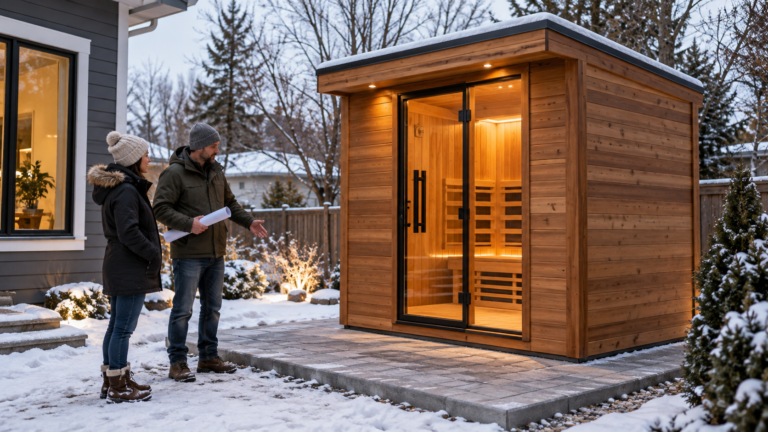
Outdoor Infrared Sauna: Site, Climate and Winter-Ready Buying Guide
An outdoor infrared sauna can make sense if you can provide a drainable, load-bearing site, weather-rated enclosure, correctly designed…
Read guide →
Infrared Sauna vs Traditional Sauna: Choose the Heat Before the Brand
Choose a traditional sauna if hot cabin air, heated stones and the option of steam are central to the…
Read guide →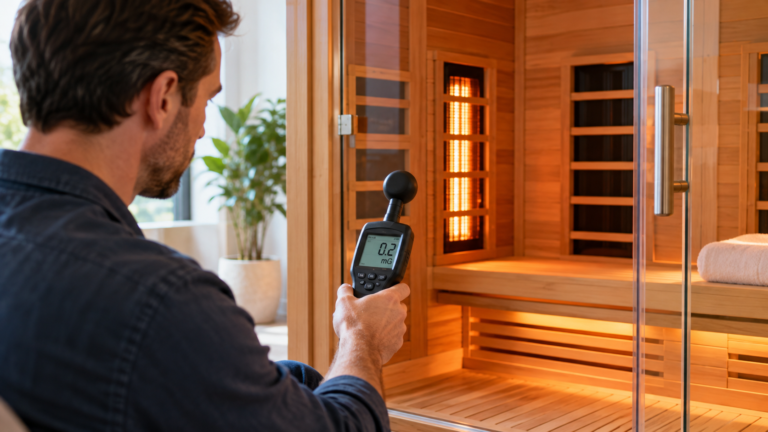
Low-EMF Infrared Sauna: How to Verify the Numbers Before Buying
A credible low-EMF infrared sauna claim should name the type of field measured, measurement unit, meter and frequency range,…
Read guide →