
Commercial disclosure: We may earn a commission if you purchase through certain links on this page.
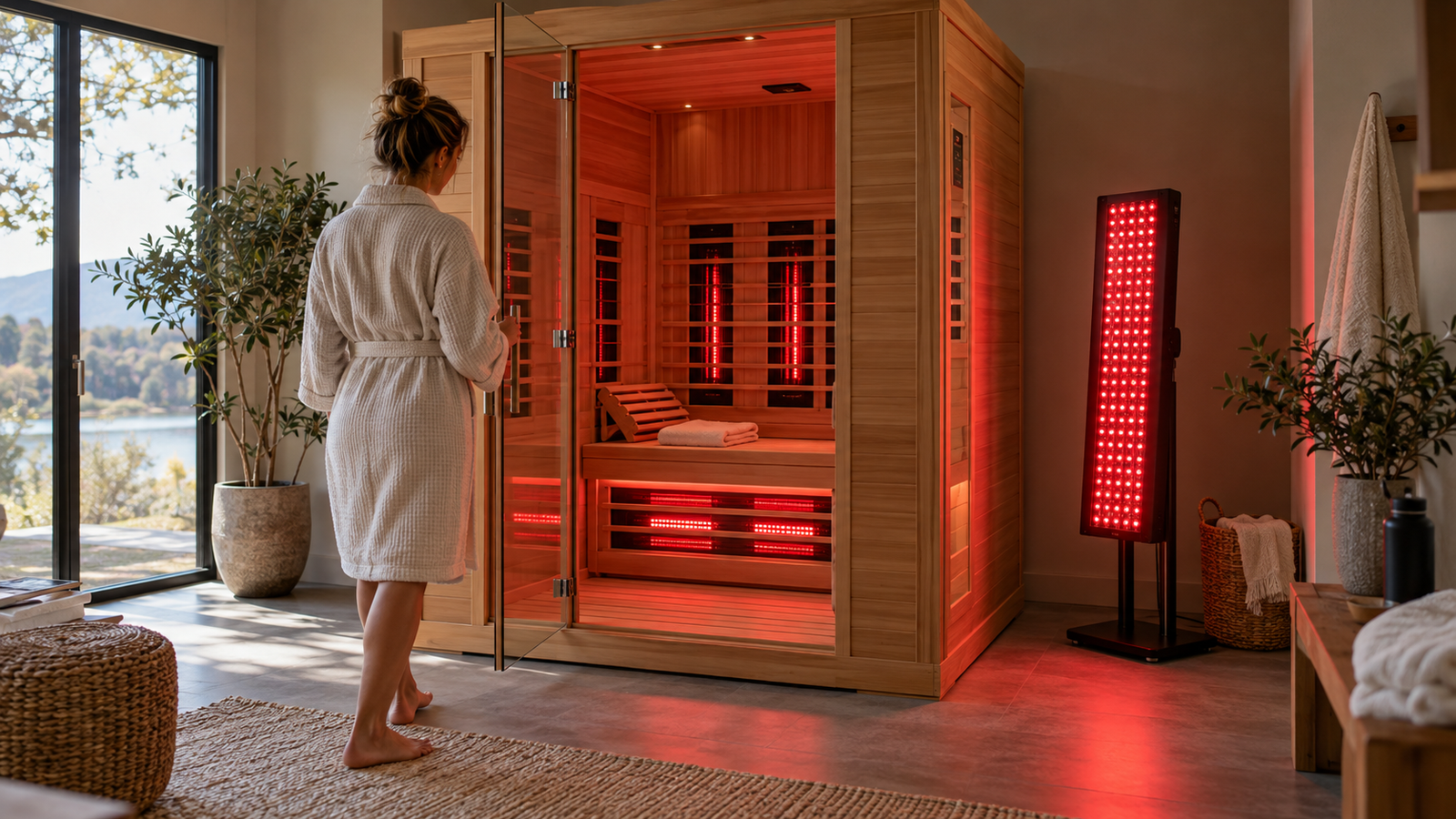
An infrared sauna with red light therapy combines two different things: infrared heaters that warm the sauna and a red/near-infrared light source that illuminates parts of the body. A warm cabin is not, by itself, a quantified red-light treatment. The real purchase decision is whether integrated light offers enough convenience and usable coverage to justify buying the systems together—or whether a separately positioned panel is the more flexible, serviceable purchase.
An integrated system is attractive when you want a simple, repeatable heat-and-light routine in one room and the designed LED position suits the body areas you intend to expose. A separate panel is better when adjustable placement, independent replacement and documented output at a specified distance matter more. Neither design establishes a medical outcome from wavelengths alone.
Infrared heating, red light and colored cabin lighting are not interchangeable
Infrared heating elements supply thermal energy for the sauna experience. Red-light devices emit particular bands of visible red and near-infrared light, for which exposure also depends on intensity, distance, coverage, time and the subject. Decorative red cabin lighting may look similar in a photograph without showing that the device delivers a measurable output for any claimed application.
Cleveland Clinic’s patient guide describes red-light therapy research as promising in some areas but limited by small studies and inconsistent quality, with no basis for many heavily marketed claims. The device in any given sauna should not be assumed to reproduce a clinical protocol. Likewise, the Cleveland Clinic’s sauna safety guidance emphasizes dehydration risk, cautious session duration and medical consultation in relevant health circumstances. Heat tolerance is not evidence of phototherapy dosage.
What SaunaCloud actually integrates
In SaunaCloud’s published red-light range, the company describes nominal 660 nm red and 850 nm near-infrared LEDs installed between bench slats, with controls that can run heat, light or both. The Atlas One page identifies a one-person custom layout and notes that posture changes how far the light is from different body areas. The stated wavelengths and controller modes are product descriptions, not independently measured whole-body exposure.
The manufacturer also describes a measured low magnetic-field level for its system under stated conditions, but that is not a measure of light intensity or therapeutic effectiveness. A responsible comparison keeps EMF, electrical safety, optical output and clinical evidence in separate categories.
Integrated bench light or a separate panel?
| Decision factor | Bench-integrated light | Separate panel |
|---|---|---|
| Daily setup | Always located at the designed bench position; fewer setup steps | Requires separate positioning but can be used apart from sauna heat |
| Which areas receive light | Governed by seat/bench geometry, body position and the final design | Position and target area can often be changed within device instructions |
| Evidence to request | Bench-level output map, test distance, operating temperature and repair path | Panel’s published irradiance method and distance, coverage map and stand arrangement |
| Replacement flexibility | Tied to bench integration, matching parts and provider service terms | Can generally be upgraded independently of the sauna if used in its approved environment |
For a real separate-device comparison, the Mito Red Light MitoPRO X panel range publishes panel sizes and power draws as well as irradiance figures measured at a stated six-inch distance, and provides an independent-test-data page describing laboratory method and test distance. Those published measurements are for that panel under its conditions; they cannot be compared numerically with an unspecified SaunaCloud bench irradiance, and they do not prove clinical equivalence. A room-use panel must not be presumed safe for installation inside a hot sauna enclosure: follow its stated temperature, moisture and mounting limits.
The five questions that turn “red light included” into a usable specification
- Wavelength: Which peak wavelengths are actually emitted, and do delivered hardware and optional modes match the proposal? The 660/850 nm pairing is informative but not a dose.
- Exposure distance: Where will the user’s skin be relative to each emitting surface when sitting normally, and what happens when their posture changes?
- Irradiance and measurement: Is there a measured optical output (such as mW/cm²) for the actual configuration at a specified position, with method and test conditions? A bright photo or LED count is not a substitute.
- Coverage: Which anatomical areas receive direct light in the intended posture? “Full body sauna heat” is not necessarily “full body red-light illumination.”
- Controls, environment and service: Can light run without heaters? How are components protected from heat/moisture, and who replaces a failed light module?
SaunaCloud describes its integrated red light as a complimentary inclusion, but its written warranty expressly excludes coverage for the dedicated red-light components. The heater warranty does not change that. Ask for the price, availability and owner responsibility for a future replacement before valuing the bundled light as a long-term benefit.
What about evidence for skin, muscle recovery and other health claims?
Clinical red-light studies often use specific devices, doses, distances, schedules and target populations. That evidence cannot be transferred wholesale to an integrated sauna bench from nominal wavelength alone. Cleveland Clinic notes limits in the quality and scope of many studies and advises following device instructions and protecting the eyes. A sauna is a hot environment with its own safety considerations. If someone is purchasing for a medical condition, the right first step is a clinician’s advice about appropriateness—not a claim made by an equipment marketer.
This guide does not conclude that the SaunaCloud integration has been clinically tested against an external panel. The manufacturer’s product information is useful for layout and functionality; comparative effectiveness remains unestablished by the sources inspected.
Who should buy integrated light, and who should keep it separate?
Integrated could fit: a homeowner planning a permanent custom sauna, prioritizing minimal setup, comfortable seated proximity and the ability to turn on heat or LEDs separately. Confirm the final bench design and replacement policy first.
Separate may fit better: someone who already owns an infrared cabin; wants to use red light in another room; needs adjustable targeting; prefers a device with a clearly published optical measurement protocol; or wants to replace one system without modifying the other. Buy a panel for the environmental conditions it is actually rated for, not merely because its red light appears compatible with the cabin.
Neither should be purchased on a treatment promise alone. Readers primarily seeking a verified clinical outcome should discuss evidence, contraindications and alternatives with an appropriately qualified healthcare professional.
Before agreeing to a custom red-light sauna quote
- Ask for the final bench/LED drawing and areas exposed in the normal seated posture.
- Request any available optical output report with wavelength, test distance, instrument and date—and do not infer an outcome if it is unavailable.
- Confirm whether light and heat have independent controls on the delivered configuration.
- Get written replacement-parts pricing and an explanation of what is explicitly excluded from warranty.
- Confirm the room, glass, assembly and professional electrical work not included in the equipment order.
- Review the non-cancellable, final-sale custom-order policy before paying.
Bottom line: Integrated red light solves a convenience and physical-layout problem. A separate panel solves a flexibility and independently replaceable-device problem. Choose on verifiable placement, output information, serviceability and total ownership terms—not on a blanket claim that one delivers better therapy.
Ask SaunaCloud about the actual LED and bench configuration
Research scope: US residential equipment selection. Merchant terms and representative device pages reviewed October 20, 2026. No firsthand or head-to-head optical testing was performed; medical benefits for this specific combination were not established.
Keep researching
More decision guides from the same topic area.

Outdoor Infrared Sauna: Site, Climate and Winter-Ready Buying Guide
An outdoor infrared sauna can make sense if you can provide a drainable, load-bearing site, weather-rated enclosure, correctly designed…
Read guide →
Infrared Sauna vs Traditional Sauna: Choose the Heat Before the Brand
Choose a traditional sauna if hot cabin air, heated stones and the option of steam are central to the…
Read guide →
Low-EMF Infrared Sauna: How to Verify the Numbers Before Buying
A credible low-EMF infrared sauna claim should name the type of field measured, measurement unit, meter and frequency range,…
Read guide →