
Commercial disclosure: HomeChoiceWorks may earn a commission if you purchase through certain links on this page.
This V·Nella review examines the hardest question behind FitBiomics’ endurance supplement: does a bacterium capable of using lactate in the gut translate into better human performance or less fatigue? The answer requires separating a plausible microbiology mechanism from experiments in mice and a very small study in adults. It also requires checking whether an ongoing charge makes sense for an uncertain outcome. HomeChoiceWorks did not personally test this product.
Short answer: Does V·Nella justify the price?
The Veillonella atypica FB0054 concept is scientifically interesting, but the directly inspected human pilot had only seven participants and did not show a significant improvement in time to exhaustion between conditions. The original endurance mechanism includes mouse evidence. V·Nella is therefore a speculative, discretionary choice—not a verified shortcut to higher VO₂max, faster races or reduced fatigue. If you need reliable performance gains, prioritize established training, fueling and recovery practices rather than this supplement.
What is V·Nella, and is it the same as Nella?
On its current V·Nella product page, FitBiomics positions the formula for lactate metabolism, fatigue and endurance. Its name resembles Nella, but the underlying proposition is different. Nella’s published research centers on a three-strain Lactobacillus consortium and self-reported wellness endpoints; V·Nella’s central published human pilot tests Veillonella atypica FB0054 in an exercise setting (iScience pilot study).
The distinction matters because scientific support cannot simply be transferred between different microbes and outcomes. A small study of sleep scores for Nella is not a V·Nella endurance trial; a lactate-metabolism mechanism does not establish that the current V·Nella retail package improves running times.
Evidence ladder: how far does the research reach?
| Evidence layer | What it supports | What it cannot establish |
|---|---|---|
| Microbial mechanism | Certain gut Veillonella can metabolize lactate into propionate | A predictable improvement in a customer’s muscles, VO₂max or race performance |
| Earlier marathoner/mouse research | The hypothesis that gut bacteria may influence endurance; performance effects were observed in mice | A demonstrated human endurance effect from the retail capsule |
| Seven-adult human pilot | A limited 14-day controlled evaluation of FB0054 in active volunteers | A significant between-condition gain in time to exhaustion, or long-term real-world safety |
The mechanism and original mouse findings are described in the introduction of the 2023/2024 open-access human pilot paper, which cites the earlier marathoner work. Lactate usage by bacteria in the gut does not mean a capsule automatically removes lactate from exercising muscles, or that all fatigue is caused by lactate. The paper’s physiology provides a rationale to test the idea, not a consumer-ready performance guarantee.
What happened in the human pilot?
The peer-reviewed iScience study recruited seven healthy, physically active adults (three men and four women). Each completed 14-day periods receiving placebo or V. atypica FB0054 at 10 billion CFU in a randomized crossover design. Investigators examined exercise time to exhaustion, lactate measurements and other outcomes.
Time to exhaustion did not differ significantly between the probiotic and placebo conditions. A within-condition tendency toward poorer performance during placebo is not the same as proof the supplement improved endurance. Blood lactate results were not meaningfully different between groups. A study with seven people, short exposure and exploratory measures cannot establish who might respond over months of training. The study included multiple people with FitBiomics affiliations; its interpretation should be weighed alongside those competing interests (full study: summary, methods and author affiliations).
Safety reporting nuance: The pilot’s short summary uses reassuring language about tolerance, but its detailed results enumerate nine mild or mild-to-moderate adverse-event reports across placebo and probiotic periods, including upset stomach and cramping. No serious safety conclusion can be drawn from seven participants. Read the full adverse-events section, not just the product’s headline.
Does V·Nella raise VO₂max or reduce fatigue?
These are separate outcomes requiring separate human evidence. VO₂max is a measure of aerobic capacity, not a synonym for subjective tiredness. Time to exhaustion during a short laboratory test is not the same as finishing a marathon faster. Feeling less fatigued while working out is not necessarily evidence of improved physiological capacity. A plausible short-chain-fatty-acid pathway is not a measurement of any of these outcomes in a paying customer.
FitBiomics’ product copy uses strong phrases about endurance and energy conversion. The directly inspected seven-person trial does not substantiate a quantified consumer VO₂max increase or a guaranteed reduction in fatigue. Even a study using the same bacterial species would require confirmation of exact strain, dose, viability at expiry, trial population, outcome measure and comparison group before its findings could be responsibly mapped to a current retail lot.
What does V·Nella cost compared with buying both formulas?
For a US consumer, the V·Nella product page displayed one-time prices of $85 for 30 days and $225 for 90 days. The homepage advertised a $64/30-day subscription and a $105/30-day subscription for the combined Health Bundle. The bundle page showed a $135 one-time 30-day purchase. These were checked November 7, 2026, not guaranteed future checkout prices.
| 30-day purchase | Listed price | What you’re paying for |
|---|---|---|
| V·Nella, one-time | $85 | One target formula; avoids automatic subscription by design |
| V·Nella subscription | $64 per cycle | Lower stated charge, renewal administration |
| Nella + V·Nella, one-time individually | $150 combined | Two 30-day individual packs, separately priced |
| Health Bundle, one-time | $135 | $15 less than the two listed one-time packs |
| Health Bundle subscription | $105 per cycle | $8 less than the separately listed $49 + $64 subscriptions |
A buyer who only wants to assess V·Nella still spends $41 more per listed subscription cycle on the bundle than on V·Nella alone. The bundle’s discount is not a reason to purchase a second formula without a second evidence-based goal. At an unchanged $64 across twelve charges, V·Nella alone would cost $768; a year is not necessarily twelve equal 30-day cycles. Tax, promotions and checkout terms can change those totals.
Returns, labeling and sport certification: the pre-order questions
FitBiomics’ refund policy says its 30-day satisfaction guarantee covers the initial trial of a new product rather than recurring orders. Multi-month and bundle orders carry special unopened-box conditions. Other returns may incur restocking charges; the page’s broad 15% fee language should be clarified in writing before a purchase. Do not buy three months on the assumption all three months are fully refundable after use.
The product page describes third-party testing, but this review did not independently verify a current sport-specific banned-substance certification listing or a matching lot for V·Nella. Generic “third-party tested” wording is not interchangeable with NSF Certified for Sport or another recognized program. Athletes subject to testing should use a certifier’s own live directory to verify a product and its batch; USADA explains why supplemental risk remains even with testing.
We also could not independently match a currently shipped V·Nella label’s exact bacterial viability, CFU guarantee at expiration and storage requirements to the study product. Request the full current Supplement Facts, strain designation and quality documents if those details determine your purchase. The NIH probiotic fact sheet explains why strain and viability details matter more than broad genus-level marketing.
Better-fit alternatives—and the no-product option
- Training and recovery first: If your goal is faster times, a coherent training plan, adequate carbohydrate intake during prolonged exercise, sleep and appropriate recovery address known performance fundamentals without committing to an uncertain probiotic benefit.
- Certification-first probiotic: If you have a digestive reason to use a probiotic and compete under anti-doping rules, a certifier-listed product such as Klean Probiotic on NSF’s site may be easier to document for a listed lot. Its multi-strain formula is not a replacement for Veillonella research, and certification is not evidence of improved endurance.
- No supplement: If you want a proven VO₂max or fatigue benefit for your next event, the V·Nella-specific evidence described above is not strong enough to justify treating the purchase as essential.
Probiotic side effects and more serious complications can matter particularly in people with serious illnesses or weakened immune defenses. The NIH NCCIH overview recommends care about individual risks; discuss suitability with a qualified healthcare professional rather than using a performance supplement as a medical treatment.
A practical V·Nella buying decision
- Define the endpoint: endurance time, perceived fatigue, GI symptoms and VO₂max cannot be treated as interchangeable.
- Check the actual evidence: the seven-adult pilot reported no significant between-condition time-to-exhaustion advantage.
- Match the bottle: confirm strain FB0054, dose, live CFU at expiry and storage; don’t assume the published research capsule equals the current box.
- Calculate the downside: decide whether a single $85 purchase is more appropriate than repeated $64 charges or an unnecessary bundle.
- Verify refund and certification conditions: both depend on exact order type or batch, not just a homepage badge.
Readers who understand those limits can inspect the FitBiomics storefront and current plan terms. This affiliate destination is a store-level link rather than a verified product-specific deep link; check that you actually selected V·Nella before paying.
Editorial verdict: V·Nella has a specific scientific hypothesis, but hypothesis, early human feasibility and demonstrated consumer performance benefit are different levels of evidence. For most buyers seeking dependable endurance gains, the evidence gap and recurring cost argue for caution. This assessment reflects sources and US-facing prices reviewed November 7, 2026, not personal testing or a guarantee of outcomes.
Keep researching
More decision guides from the same topic area.

FitBiomics Reviews: Is Nella Worth the Recurring Cost?
FitBiomics reviews deserve more than a star rating. Nella is marketed for gut comfort, sleep and daily energy, but…
Read guide →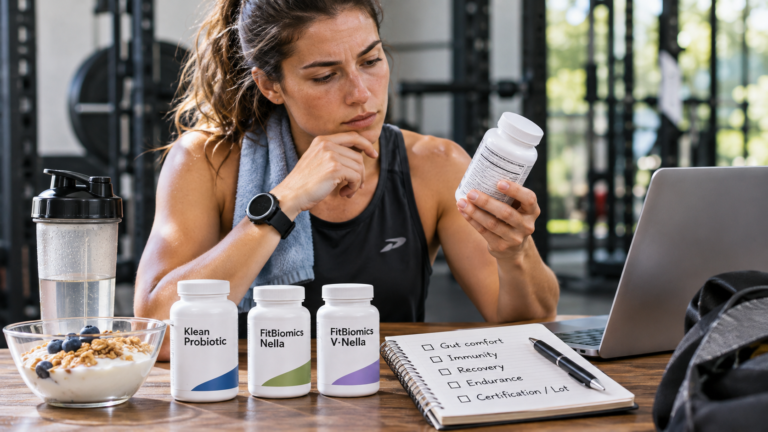
Probiotics for Athletes: How to Choose by Evidence and Goal
Probiotics for athletes are often marketed as a way to support gut health, immunity, recovery or endurance. But an…
Read guide →
Outdoor Infrared Sauna: Site, Climate and Winter-Ready Buying Guide
An outdoor infrared sauna can make sense if you can provide a drainable, load-bearing site, weather-rated enclosure, correctly designed…
Read guide →