
Commercial disclosure: HomeChoiceWorks may earn a commission if you purchase through certain links on this page.
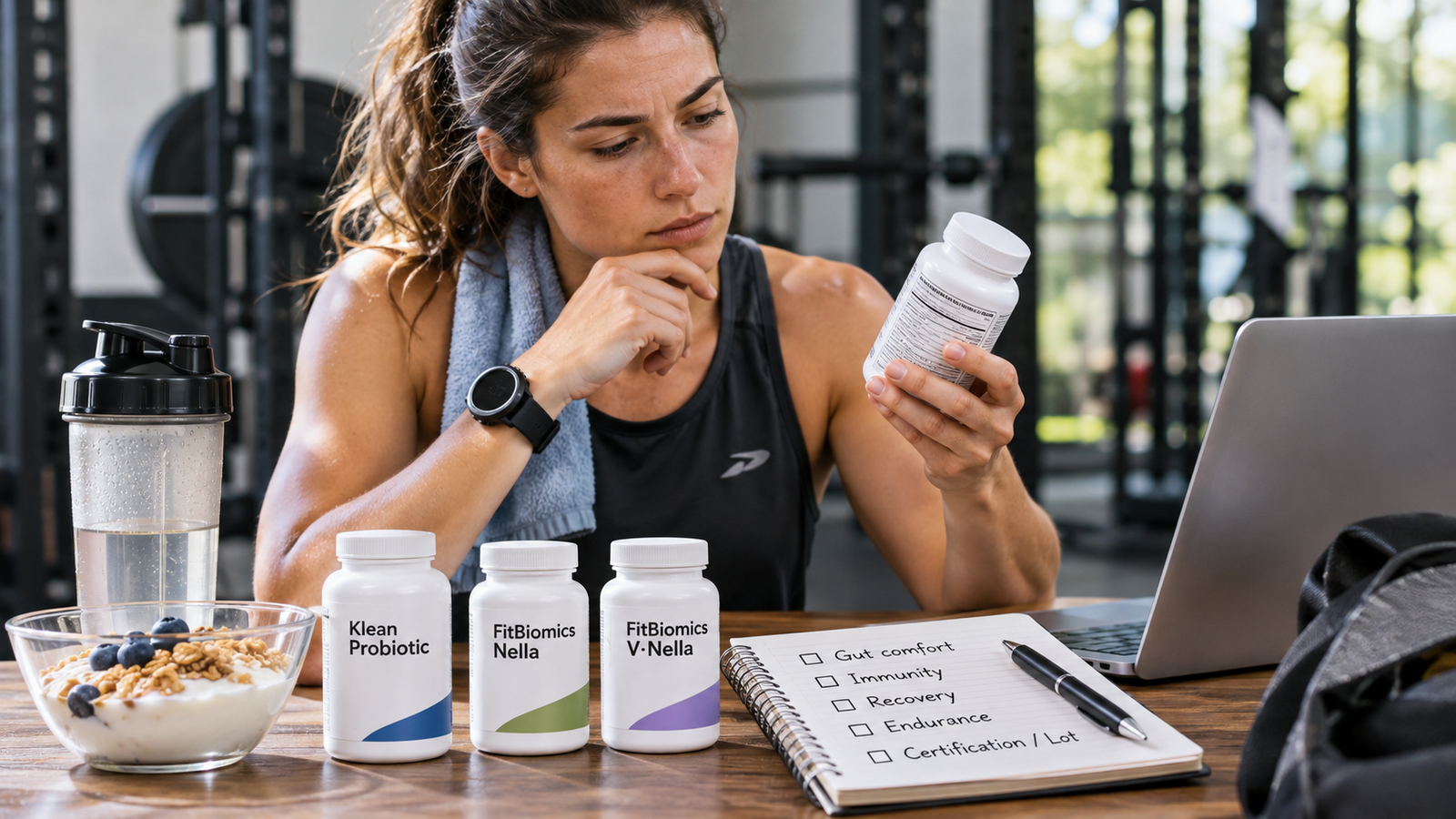
Probiotics for athletes are often marketed as a way to support gut health, immunity, recovery or endurance. But an athlete choosing a supplement faces at least three different questions: is a probiotic needed at all, is there evidence for the specific strain and outcome, and can the exact product be verified against sports-supplement contamination risks? A claim about better digestion is not the same as a claim about faster running.
Quick answer: Which probiotic should an athlete choose?
Start with the goal, not a brand. For a healthy adult with no clear problem, buying nothing is reasonable. For a targeted digestive concern, prioritize identifiable strains supported by human studies for a relevant endpoint. For tested competitors, independently verify current sport certification and the exact lot before purchase. Research suggests some probiotic interventions may affect athletic outcomes, but those findings do not establish that any given commercial capsule improves performance.
Choose your actual reason for taking a probiotic
A distance runner reporting gastrointestinal distress is making a different decision from a strength athlete chasing a higher squat total or a cyclist hoping to raise VO₂max. The US NIH Office of Dietary Supplements explains that effects depend on the organisms and their specific strains; more CFUs or more species do not automatically indicate a superior product.
| Your objective | Evidence to demand | Common buying mistake |
|---|---|---|
| Digestive comfort during training | Studies measuring GI symptoms in comparable active adults, with the same strain and appropriate dose | Buying a “performance probiotic” tested only for unrelated outcomes |
| Fewer training interruptions | Well-controlled trials tracking illness incidence/severity or missed sessions, not just immune biomarkers | Equating an immune marker with fewer infections |
| Endurance or recovery | Human performance outcomes such as time trials, power or clearly defined fatigue scores | Treating a mouse result or theoretical lactate pathway as a guaranteed racing benefit |
| Banned-substance risk management | Verified product and matching batch in a respected independent sport-certification directory | Assuming “third-party tested” proves a product’s current lot is certified |
What does the research say about performance?
A January 2026 systematic review and Bayesian meta-analysis combined 21 randomized trials involving 685 people. Across diverse interventions and tests, it estimated a small-to-moderate average advantage in athletic-performance outcomes (standardized mean difference 0.38, 95% credible interval 0.17–0.60), with stronger signals in some endurance measures. These are pooled estimates across different products, populations, doses and tests—not the effect expected from one branded bottle.
The same review rated the athlete-population evidence low certainty, and noted small trials, short follow-up and inconsistent outcome definitions. Even its broad positive result should not be turned into “any probiotic makes runners faster.” The most honest interpretation is that strain-specific research is worth reading, and the choice of endpoint matters greatly (review: evidence certainty and limitations).
Consider two instructive product-linked investigations. A 2025 Microbiome paper on FitBiomics’ Nella strains included 257 people in an uncontrolled two-week survey study and 11 male soccer players in a sequential placebo-then-probiotic study. Its prominent sleep result was self-reported and the design had major limitations. A separate iScience pilot of Veillonella atypica FB0054 in seven active adults did not find a significant between-condition time-to-exhaustion improvement. Neither study justifies a category-wide promise of improved racing performance.
Four realistic choices to compare
This is a decision matrix, not a ranking by effectiveness. The prices are published US-facing merchant listings inspected November 7, 2026. Clinical evidence and certification are distinct axes; one does not replace the other.
| Option | What can be verified | Cost / key limit | Best fit by criteria |
|---|---|---|---|
| No supplement | No claim of probiotic-specific benefit | $0 supplement cost; no purchase or renewal risk | Healthy person without a specific strain-led need |
| Klean Probiotic | NSF Certified for Sport listing names the product and specific lots; the manufacturer label identifies multiple strains and 15 billion CFU per capsule | Listed $46.50 for 60 capsules, suggested 1–2/day; certification is not proof of performance effectiveness | Competition-related third-party product verification, if the purchased lot matches |
| FitBiomics Nella | Published study of defined Lactobacillus strains, with major limitations | $65 one-time / 30 days; current sport-certification lot not independently verified | A reader specifically evaluating its studied wellness formulation, not one demanding proven endurance gains |
| FitBiomics V·Nella | Published seven-adult FB0054 pilot with no significant time-to-exhaustion advantage | $85 one-time / 30 days; sport-certification lot not independently verified | Research-interest purchase with substantial uncertainty, not an essential performance aid |
Klean Probiotic’s 60 capsules at $46.50 equal about $0.78 per day if taking one capsule daily, or $1.55/day at two; the label’s suggested range changes duration and cost. That rate is not comparable to Nella or V·Nella unless you also compare the precise strains, dose, target outcomes and actual supply duration. The Klean Athlete product page lists the suggested dosage and price; the independent NSF record provides separately verifiable lot listings.
For a tested athlete, certification is its own gate
The US Anti-Doping Agency warns that dietary supplements can carry contamination or labeling risks. Its guidance recommends independent third-party certification as a risk-reduction measure, not a guarantee. A badge on a brand page is not enough: verify the exact product, certifier, and lot where available in the certifier’s directory, and check with your governing body’s rules.
We could independently confirm a current NSF listing for specified Klean Probiotic lots. We could not independently confirm an equivalent current sport-certification listing for the FitBiomics products in this research. That is a verification gap, not a claim that those products have never been tested, nor proof that a competitor improves digestion or endurance. If a manufacturer asserts certification, ask for the certifier name, product entry and exact lot.
Do not confuse three labels: “third-party tested” may mean a company’s selected lab test; “sport-certified” should be traceable to an independent program and listed product/lot; “clinically effective” requires relevant human outcome evidence. A product can meet one standard without meeting the other two.
How to read the probiotic label rather than the marketing copy
- Exact organism and strain: “Lactobacillus” alone is not enough. Look for species and strain IDs such as FB0012 or La-14; outcomes from one strain may not transfer to another.
- Live CFU and shelf life: Verify whether the count is guaranteed through expiry, and follow the stated storage requirements. A high headline number does not prove efficacy.
- Supporting formula: Check other ingredients, prebiotics, allergens and capsule format. A mix containing fermentable ingredients may have different tolerability than a single strain.
- Human endpoints: Look for a placebo comparison and measurements that resemble your actual goal. A study reporting questionnaire changes is not automatically a measured speed increase.
- Independent quality evidence: Prioritize accessible product-level documentation and verifiable sport certification when subject to anti-doping rules.
These are aligned with the NIH guidance on probiotic selection. In the United States, the FDA does not pre-approve dietary supplements for safety and effectiveness before marketing. “Sold in the US” therefore is not itself a clinical evidence seal.
A runner-specific decision plan
Runners sometimes encounter GI problems around long sessions, but the reason may involve meal timing, fiber intake, drink concentration, heat, pacing or other factors rather than a lack of probiotics. Separate training-day patterns from a chronic medical symptom and seek professional evaluation when necessary. If you and a clinician decide a probiotic trial is appropriate, avoid changing several products and routines simultaneously: you will otherwise struggle to tell what mattered.
Decide in advance what counts as a meaningful improvement in your stated goal, whether the product’s studies used comparable training loads, and what financial or tolerance condition would make you stop. A supplement cannot compensate for inadequate fueling or rest, and it should not replace indicated medical care. For persistent or severe symptoms, testing and individualized medical advice matter more than a performance-product shopping list.
Cost, tolerability and the option to walk away
Beyond a bottle’s front-label price, consider how many doses it contains at your intended serving, the need for refrigeration or careful storage, subscription frequency, return restrictions and whether a trial actually fits your budget. FitBiomics, for example, advertises discounted subscriptions, but its refund policy limits the trial guarantee to initial qualifying purchases and imposes special restrictions on multi-month or recurring orders. Lower per-day cost means little if you end up with unused inventory or surprise renewals.
Probiotics are often tolerated by healthy people, but adverse effects and occasional serious complications can occur, particularly in people with severe illness or weakened immune systems. NIH NCCIH’s safety overview is a better starting point for risk assessment than sports marketing. The decision to buy nothing is not a failure; it is often the most proportional choice when the proposed outcome is weakly demonstrated.
Final six-question buying checklist
- Am I targeting an outcome actually measured in a relevant human trial?
- Can I match the study’s strain and dose to the current retail label?
- If anti-doping rules apply, can I independently verify the exact product and lot?
- Have I compared the full cost at the suggested daily serving, not just the advertised package price?
- Can I tolerate a null result financially and practically?
- Would addressing sleep, training, nutrition or a medical issue first serve the goal more reliably?
For readers whose needs genuinely align with FitBiomics’ formulations, here is the FitBiomics storefront affiliate link for reviewing current labels and terms. It is not a verified deep link to either product, and neither product is presented here as the best probiotic for every athlete.
Bottom line: The strongest purchase is the one linked to a defined outcome, an identifiable formulation and—when relevant—independently verified sport-certification details. Existing research makes probiotics a plausible area to investigate, not a universal training upgrade. US-facing product prices and policy notes were checked November 7, 2026; review them again before ordering.
Keep researching
More decision guides from the same topic area.

FitBiomics Reviews: Is Nella Worth the Recurring Cost?
FitBiomics reviews deserve more than a star rating. Nella is marketed for gut comfort, sleep and daily energy, but…
Read guide →
V·Nella Review: Veillonella Evidence, Cost and Limitations
This V·Nella review examines the hardest question behind FitBiomics' endurance supplement: does a bacterium capable of using lactate in…
Read guide →
Outdoor Infrared Sauna: Site, Climate and Winter-Ready Buying Guide
An outdoor infrared sauna can make sense if you can provide a drainable, load-bearing site, weather-rated enclosure, correctly designed…
Read guide →