
Commercial disclosure: We may earn a commission if you purchase through certain links on this page.
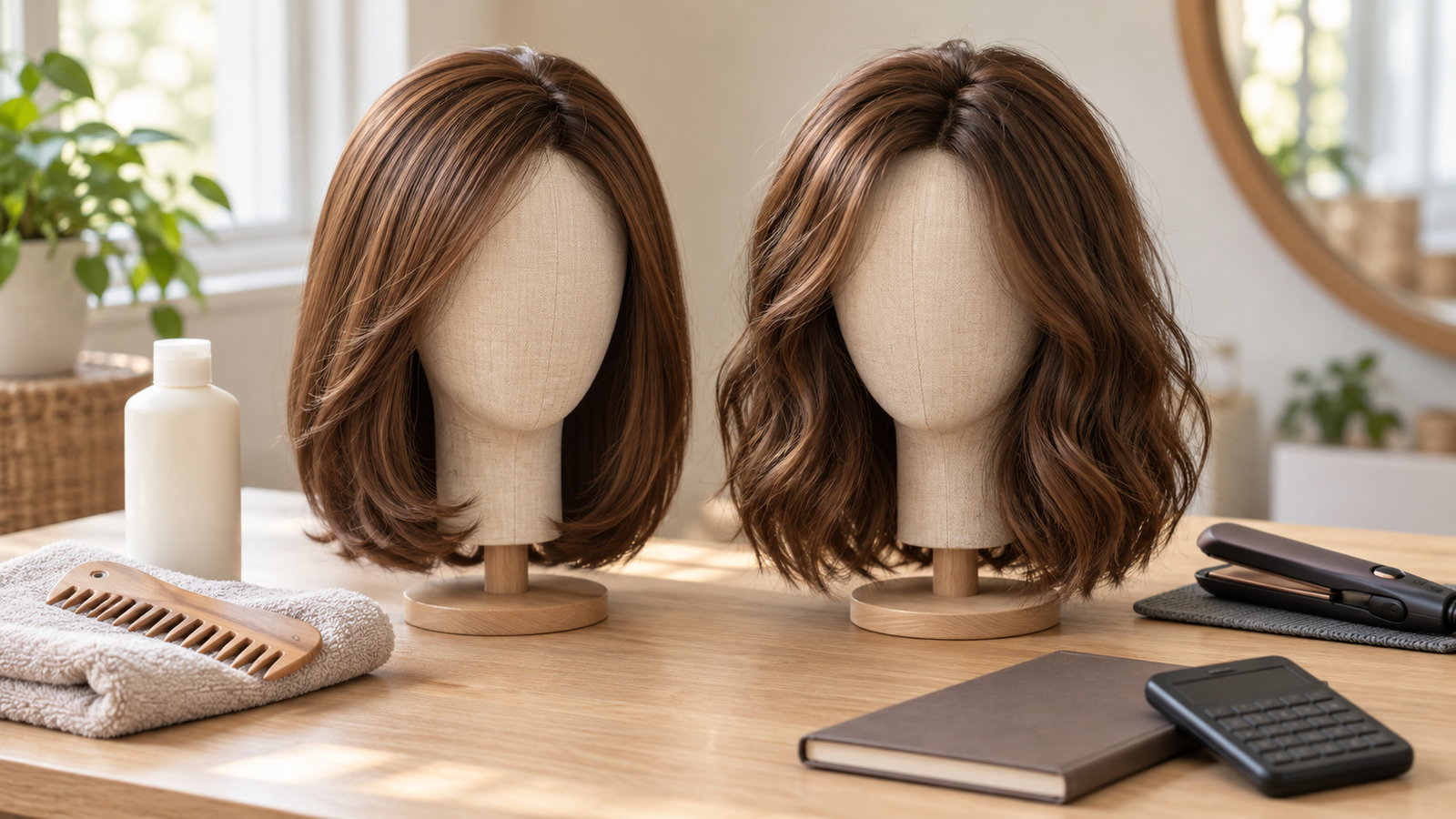
Traditional synthetic is a useful starting point when you want to keep a chosen style with limited restyling. Human hair deserves consideration when changing the style matters enough to justify the upkeep. Heat-friendly synthetic is a third option with its own tool limits and maintenance requirements. Compare actual models and total costs before declaring one fiber better value.
Synthetic vs human hair wigs is a choice about what you want to do with the hair after purchase. Fiber alone cannot tell you whether the cap fits, the hairline suits your preferred style or the piece will look right on you. This comparison focuses on styling freedom, recurring effort and the uncertainty behind cost-per-wear claims.
Godiva’s Secret sells synthetic wigs and toppers. That can fit a buyer who wants a ready-made style, but it does not make the brand a substitute for a human-hair option. The comparison below also uses current Jon Renau documentation. It is a source-based guide, not a wear test or a market-wide price survey; sources were checked October 15, 2026.
Separate three fiber choices
| Fiber route | Reason to shortlist it | Work or restriction to investigate |
|---|---|---|
| Traditional synthetic | You want a pre-styled look and are happy to keep that general style. | Check the approved care method and avoid assuming ordinary hot tools are permitted. |
| Heat-friendly synthetic | You want some heat-restyling flexibility in a synthetic piece. | Read the exact temperature and tool instructions; allow for detangling and fiber maintenance. |
| Human hair | You value the ability to reshape the hair and are willing to maintain it. | Allow for styling after washing and changes with humidity; obtain the model’s care instructions. |
These distinctions follow Jon Renau’s fiber and blending explanation, its human-hair care guidance and the model-specific instructions below. They describe trade-offs, not universal appearance scores. A human-hair wig with the wrong cut or cap is still the wrong purchase. A synthetic wig in a suitable style does not need to imitate every styling possibility of human hair to serve its wearer well.
Read heat permission at the model level
Godiva’s care guide warns against intense heat from blow dryers, flat irons and curling irons. It also describes limited hot-roller and hot-air-brush exceptions, with a damage-responsibility warning. That is not a general heat-friendly specification or a transferable temperature rating. Ask which tool and procedure are approved for the selected piece; do not borrow another manufacturer’s instructions.
For a documented heat-friendly alternative, Jon Renau Morgan has instructions recommending 270–280°F (132–138°C) for heat styling, although the page also lists a higher maximum tolerance. Use the recommended working range in the full instructions rather than treating the maximum as a target. The same page calls for regular detangling and warns that heat-friendly fiber can frizz with wear. Added styling freedom comes with a maintenance commitment.
For a human-hair alternative, Jon Renau Carrie, item 708/708A is listed as human hair with a lace front and single monofilament construction. It illustrates an option outside Godiva’s synthetic range. Check the exact cap variant, retailer quote and care directions before comparing it with a synthetic model. These are category examples, not equivalent designs or a claim that either one lasts longer.
Godiva’s care guide says its synthetic hair cannot be dyed or bleached. If your plan depends on changing a purchased shade, resolve that before checkout. Human hair also needs a product-specific assessment before chemical work; its fiber label is not permission for every coloring process.
Compare a normal week, not just an unboxing
Write down what you actually want to do: keep one shape, alternate straight and curled looks, wear the piece occasionally, or use it most days. Then ask which parts of that routine you will do yourself and which require paid help. A low purchase price can be a poor fit if the required routine is one you will not follow.
Jon Renau’s human-hair guidance notes that humidity can affect the hair. Its synthetic-care guidance discusses tangling and the need for appropriate maintenance. Neither route eliminates care. When comparing quotes, ask for the required products, the drying and storage arrangement, and any regular salon service the seller expects for that exact style.
- Ask the seller to show the piece after its normal wash-and-dry routine, so you understand the starting point before styling.
- Request a care demonstration you could repeat at home, including detangling and storage. Do not assume a polished sales video shows all the work.
- Keep a separate time budget. Fifteen hypothetical minutes of styling on each of five days would be 75 minutes a week; replace that example with your own realistic routine.
- Compare caps, lengths and required customization alongside fiber. Otherwise you may attribute a price or comfort difference to the wrong feature.
Use a break-even calculation instead of a lifespan promise
Both Jon Renau’s synthetic-care article and its human-hair article give lifespan estimates. They do not provide an independent, controlled comparison that predicts your usable wears. Godiva’s returns page also gives a care-dependent estimate while stating that wigs and hairpieces have no merchant guarantee or warranty. Do not turn those statements into a guaranteed replacement schedule.
Cost per usable wear = (purchase price + care, services and accessories allocated to that piece + other unrecovered costs) ÷ actual usable wears. Before purchase, use several hypothetical wear counts. After use, replace them with records. Keep time spent separate unless you deliberately assign it a value.
The following numbers are deliberately hypothetical US-dollar inputs, not current product prices or predicted lifespans. Suppose one option costs $300 plus $60 in allocated upkeep, while another costs $900 plus $180. The second starts at three times the total cash cost.
| Scenario | Total cash cost / usable wears | Cost per wear |
|---|---|---|
| Synthetic example | $360 / 150 | $2.40 |
| Human-hair example, 300 wears | $1,080 / 300 | $3.60 |
| Same human-hair example, 450 wears | $1,080 / 450 | $2.40 |
With those fixed totals, the second option needs 450 usable wears to match the first option’s cost per wear at 150. More services or care costs would move the break-even point. Nothing here establishes that either piece will reach those wear counts. The purpose is to reveal how much extra use your financial argument assumes.
A buyer may still prefer the higher-cost option for styling freedom. That is a valid preference without claiming savings. Conversely, an occasional wearer may never accumulate the extra wears needed to offset a larger purchase. Compare quoted totals in the currency and market where you will buy; this worksheet does not estimate international duties or delivery costs.
Make the choice your habits support
Shortlist traditional synthetic if you like the intended style and want limited restyling. Investigate heat-friendly synthetic if you will follow its detailed tool and upkeep rules. Choose to explore human hair when versatility is central and you accept the associated work and price. If physical comfort or appearance is still uncertain, a fitting is more useful than another generic fiber comparison.
Ask the selling retailer about return eligibility before any cut, heat styling or chemical service. The manufacturer supplies fiber-care instructions; the retailer applies its sales terms; an outside stylist cannot promise that a modified item remains returnable. Confirm those boundaries before committing money to customization.
Browse Godiva’s Secret synthetic styles
Documentation checked October 15, 2026. Product links identify examples, not tested winners. The shopping button is an affiliate link. Current retailer prices, selected variants and terms must be checked for your order.
Keep researching
More decision guides from the same topic area.
Dermalogica Daily Microfoliant Review: Fit, Risks and Cost
The purchase decisionDaily Microfoliant is worth considering if you want a rinse-off powder exfoliant and your routine leaves room…
Read guide →
Best Shampoo for Color-Treated Hair: 5 Fits Compared
The best shampoo for color-treated hair is the one that meets your non-negotiable needs before it wins a marketing…
Read guide →
Pureology Hydrate Shampoo Review: Hydrate or Sheer?
Pureology Hydrate is the richer starting point for dry hair that benefits from a more conditioned finish. Hydrate Sheer…
Read guide →