
Commercial disclosure: We may earn a commission if you subscribe through certain links on this page.
Yes—especially handbuilding. You can practice pinch, coil and slab techniques with clay, a stable cleanable surface and basic tools, without owning a pottery wheel. But learning to shape clay, producing fired ceramics and making food-contact-safe ware are different goals. If you want durable kiln-fired pieces, establish acceptable clay and local firing access before buying supplies or choosing a course.
Many beginner guides ask which wheel or kiln to buy first. A more useful first question is: What do you want to make, and what can your space support? If you are starting in an apartment or shared home, the answer may be a small handbuilding practice area and occasional access to a community studio—not a full private ceramics workshop. You can learn quite a lot at a table, but an online class cannot provide safe workspace, fire your pieces or correct every physical technique on its own.
Choose your at-home pottery route before choosing equipment
| Your goal | A practical starting route | What could stop you |
|---|---|---|
| Explore shapes and make decorative practice pieces | Handbuilding projects on a wipeable table; decide whether your clay is air-dry or kiln-fired. | Confusing decorative, unfired material with a ceramic piece intended for food or liquid. |
| Make permanent fired pottery without owning a kiln | Find a studio or firing service, confirm its accepted clay and glaze, then handbuild at home. | No outside-firing option, unsuitable clay body, drying/transport constraints or extra firing costs. |
| Learn wheel throwing | Try supervised wheel access first; later arrange reliable wheel practice and firing. | No wheel, insufficient practice access or lack of corrective instruction. |
| Use glazes and make food-contact ware | Work within a known clay/glaze/firing system under competent studio guidance. | Unknown materials, incompatible firing or unsupported safety assumptions. |
The distinction between air-dry and kiln-fired clay is not just a matter of convenience. Domestika’s beginner ceramics curriculum explicitly separates unfired decorative projects from fired work and says the latter needs an artisan kiln or a ceramic workshop. A household oven is not a replacement for a ceramics firing service. If your intention is to make functional dishes or mugs, do not treat an unfired craft project as equivalent.
What do you need to begin handbuilding?
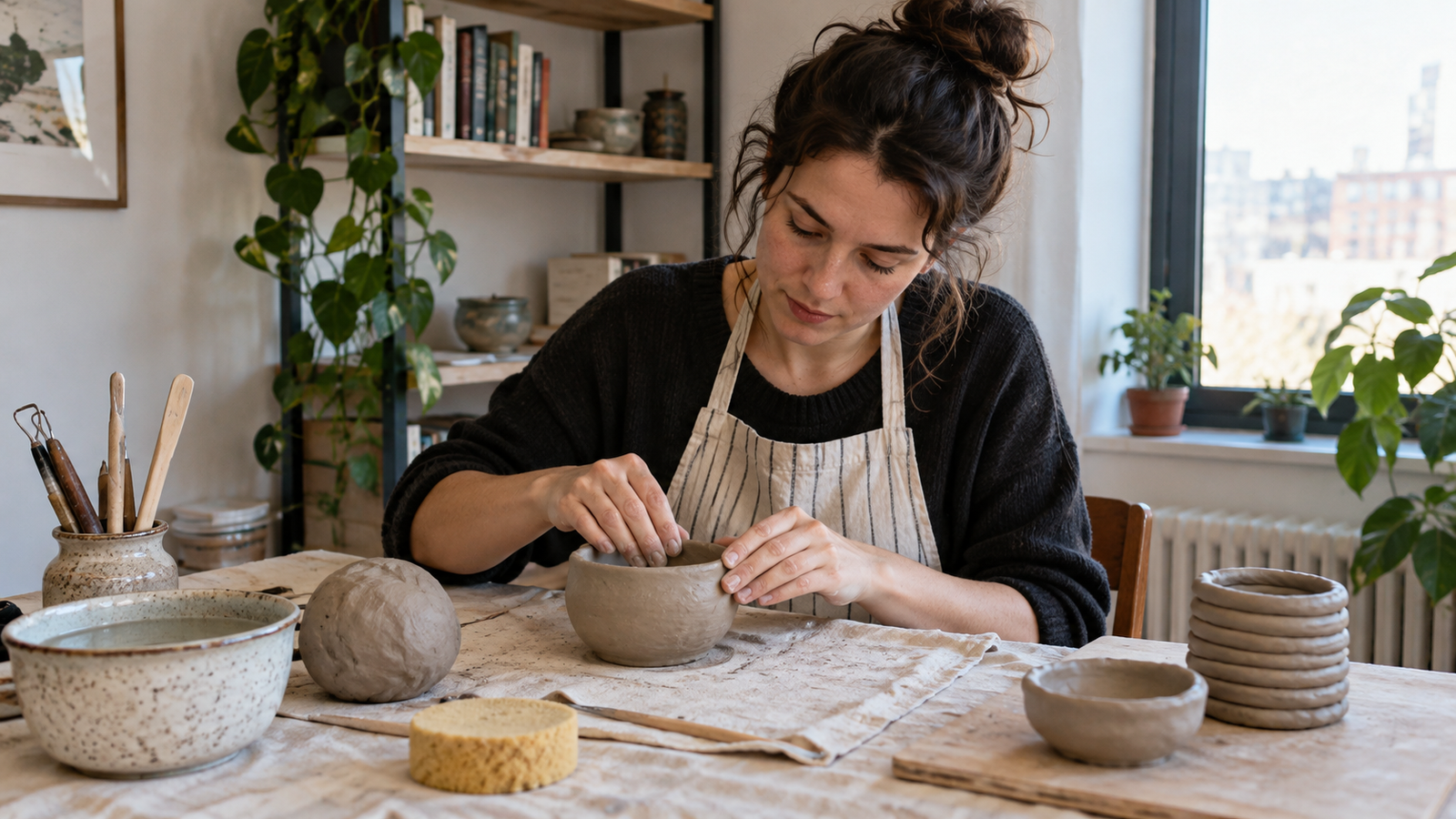
Start with a modest project rather than an expensive equipment list. A small quantity of the right kind of clay, a smooth wipeable work surface, water, a sponge and a few suitable shaping/cutting tools can support basic pinch, coil and slab exercises. Ceramic Arts Network’s handbuilding resources demonstrate why these three approaches are enough to explore many forms without a wheel.
Choose the clay only after deciding whether the finished piece needs firing. If you plan to take your piece to a studio, ask what clay bodies and firing temperatures it accepts. Otherwise, a beginner may spend hours on a vessel that no local studio will put in its kiln. Leave specialized glazes, powdered additives and kiln operations out of the initial setup until you understand the applicable material and safety requirements.
A workable practice corner
- A dedicated cleanable area: use a stable work table away from food preparation, soft furnishings and heavy household traffic. Contain clay fragments and splashes rather than allowing them to dry across the room.
- Wet-cleaning supplies: keep a sponge, water containers and a way to collect sludge. Do not rely on ordinary dry sweeping or dry sanding to remove clay residue.
- Space to dry and store pieces: a safe, protected area reduces accidental damage while work is soft or drying; follow the clay and instructor’s drying guidance rather than assuming every object dries at the same rate.
- A cleanup plan for plumbing: collect clay-laden water for settling or use a suitable clay-trap solution instead of routinely sending clay residue into a household drain.
These are practical safeguards, not a guarantee that every room is suitable. Australia’s Asbestos and Silica Safety and Eradication Agency advises avoiding dry sanding, using damp cleaning methods and keeping home ceramics work in a dedicated area to limit dust spread. Ceramic Arts Network also documents how clay residue can harm drains and why studios use traps. These are general controls, not a substitute for evaluating your own material safety data sheets or local conditions.
How can you fire pieces without owning a kiln?
Look for a local community ceramics studio, teaching workshop or specialist outside-firing service. Contact the operator before buying clay or finishing a project. Outside firing is not necessarily a drop-off-anything service: the kiln operator must protect other people’s work and equipment from incompatible materials and damage.
For a concrete US example, Clay Art Space’s outside-firing page describes per-piece pricing, explains that many ceramic pieces require separate bisque and glaze firings, and requests the manufacturer, name and firing cone of unfamiliar clay and glazes. Another example, Merritt Ceramics in Oakland, publicly describes its own cone 5/6 acceptance rules, drying/turnaround conditions and separate service charges. These are examples of how two businesses operate, not national averages or availability guarantees.
- Do you accept work made outside your studio or only clay purchased from you?
- Which clay bodies and firing-cone ranges can you accept? May I use my own glazes?
- What are the thickness, drying, labeling and transport requirements?
- What do bisque and glaze firings cost separately, and how are breakage or kiln damage handled?
- Can a complete beginner receive help understanding safe finishing and food-contact limitations?
A kiln is a high-temperature appliance with burn, fire and electrical hazards. The University of Oregon’s studio-safety guidance calls for following manufacturer instructions and appropriate safeguards. Operating or installing a home kiln is a separate technical decision, outside the scope of this beginner learning guide; a short online demonstration should not be treated as qualification to do it yourself.
What about dust, glazes and food safety?
Clay work is often presented as a gentle hobby, but dried clay and powdered glazes can generate airborne particulates. The Australian agency’s ceramics guidance identifies silica exposure and recommends moisture-based controls, cleaning practices and a separate workspace. The University of Oregon also identifies glaze metals and kiln-related hazards. For a novice, working with prepared materials and avoiding dry powder mixing, grinding and spray glazing reduces the number of hazards you must manage; the suitability of protective equipment and ventilation depends on the process.
If you intend to use a finished object for food or drinks, appearance alone cannot establish safety. The US Food and Drug Administration’s advice on lead-glazed traditional pottery explains that lead can migrate from improperly glazed or fired ware and recommends avoiding food use when safety cannot be established. Do not assume an untested home glaze or a decorative craft finish is food-safe simply because it looks like a mug.
These safety references are from US university/FDA and Australian public guidance. They describe general risks and controls, not a single legal rule applicable to every country. Check the actual SDS and supplier instructions for the clay and glaze you use, and seek a qualified instructor for processes you do not understand.
Where do online pottery lessons help most?
Video is useful when you can pause, replay and apply a demonstration to your own project. For a home beginner, prioritize one sequenced handbuilding project over several unrelated advanced artist sessions. The Domestika beginner course publicly lays out a multi-lesson progression through pinch, coil, slab and decorating. If you only need a free technique example, Ceramic Arts Daily publishes accessible technique material without requiring a library subscription.
The Ceramic School membership may become more relevant as you learn what excites you: the provider advertises a large library of artist workshops, recordings, live sessions and a community. That breadth can help a maker explore surface treatment, personal style and particular techniques, but it does not replace the local clay, equipment or kiln services you still need. The advertised $29/month or $290/year is a learning-access price, not a full home-pottery budget.
A realistic first-month learning sequence
- Week 1 — choose the outcome: decide whether you want unfired decorative experiments or kiln-fired pottery. If firing is the goal, check local service acceptance and clay requirements before buying a bag of clay.
- Week 2 — learn three fundamental shapes: practice a pinch bowl, a coiled form and a small slab-built object. Focus on control and consistency, not producing perfect finished pieces.
- Week 3 — repeat one form: make several versions of a single shape, document where joints crack or proportions become uneven, and use a targeted demonstration or a knowledgeable instructor to address that problem.
- Week 4 — assess the next bottleneck: if shaping is the problem, seek targeted feedback; if finishing is the problem, consult a local studio about firing; if you need fresh artistic ideas, explore a wider artist-workshop library.
This is an editorial practice plan, not a claimed instructor-tested curriculum or a promise that every learner will reach a particular standard in four weeks. It deliberately delays equipment and subscription commitments until you can identify the problem each would solve.
When is in-person instruction the better choice?
Choose direct guidance when you need to judge clay moisture, correct wheel hand pressure, handle unfamiliar glaze materials, or learn a kiln process safely. A local beginner class may also provide tools and firing access that you cannot reproduce in a small home. Online lessons make the most sense when they extend repeated physical practice rather than replace it entirely.
If you can work safely at home, have a viable firing arrangement and want more demonstrations after the basics, browse the actual topics in The Ceramic School library before deciding whether a monthly subscription fits your practice.
Explore online ceramic-artist workshops
Evidence and geography: Sources were reviewed October 13, 2026 for an English-language guide aimed at US searchers. Examples from US firing studios are local operating policies, not interchangeable global services or prices; Australian dust guidance is presented as safety context, not US law. Online membership does not establish availability of physical facilities in the reader’s area. No equipment, kiln installation, or product safety was independently tested.
Keep researching
More decision guides from the same topic area.

Ham Radio License Cost in 2026: FCC Fees, Exam Fees and Real Budgets
In the US, the government application, exam session, and study materials are separate costs. As checked in October 2026,…
Read guide →
Ham Radio License Online: How Remote Exams Actually Work in 2026
Yes, you can take a US amateur-radio license exam online, but it must be a remote, video-supervised examination run…
Read guide →
Ham Radio Study Guide for 2026: Books, Free Tests or Video Courses?
For US Technician preparation in October 2026, start with materials explicitly aligned to the 2026–2030 Technician question pool. A…
Read guide →