
Commercial disclosure: We may earn a commission if you purchase through certain links on this page. Free and non-affiliate options are also included.
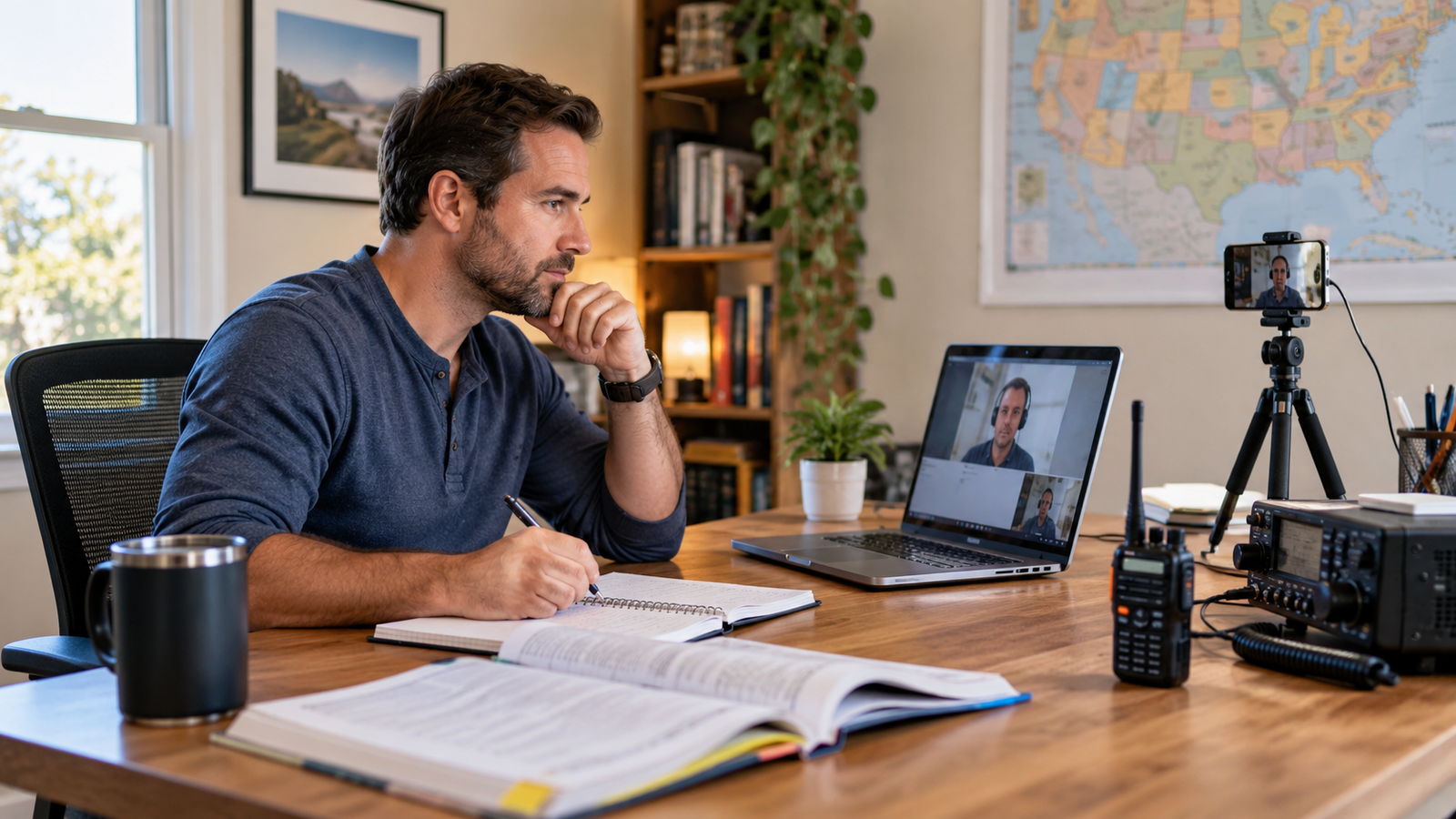
Yes, you can take a US amateur-radio license exam online, but it must be a remote, video-supervised examination run by an authorized volunteer exam team—not a self-grading practice test or a course-completion certificate. Remote testing makes sense only if you can meet that team’s ID, scheduling, room, internet and camera rules.
“Online license” is often used to mean either studying on the internet or sitting an official exam at home. This guide separates those paths, identifies who is responsible for each step, and helps you decide whether a supervised remote appointment is easier than visiting a local VE session. It concerns US FCC amateur radio licenses only.
Online study and online licensing are two different things
You can learn from home through free websites, an online class, or recorded video lessons. But completing lessons—even scoring perfectly on private practice tests—does not itself grant an FCC amateur-radio license. The actual exam is administered by volunteer examiners under a recognized Volunteer Examiner Coordinator (VEC), and the FCC ultimately issues the license. ARRL’s official session finder lists both physical appointments and remote video-supervised exam options.
Ham Radio Prep describes online lessons and links readers to ways to schedule a separate examination. That distinction matters: do not interpret an online course checkout, course-completion screen or seller guarantee as a reservation with an exam team or proof of a license.
What actually happens when you choose a remote exam?
- Confirm the license element: new applicants normally begin with Technician, which has a current 2026–2030 question pool. Check which elements the chosen exam team offers at your appointment.
- Get an FCC Registration Number: ARRL requires an FRN before exam day; register through the FCC CORES system.
- Book the VE team—not merely a course: use a VEC-backed online exam listing, check available dates, and read the particular team’s published exam policy before paying.
- Prepare the room and devices: follow the team’s computer, camera, microphone, identity, room-scan, internet and software requirements. These are set by the exam team and can differ.
- Take the supervised exam: the exam is proctored remotely and submitted through the VEC process, not scored by your commercial study provider.
- Finish the FCC payment/grant: for a new application, the FCC’s current $35 application fee is separate from study and exam charges; do not assume a pass alone means the license has already been issued.
Is your home setup suitable for remote supervision?
| Your situation | Remote exam may be practical when… | Prefer in-person if… |
|---|---|---|
| Room and privacy | You have a quiet, private area for the full session and can complete any requested room check. | Shared spaces, interruptions or policies make a compliant private room hard to provide. |
| Camera and microphone | Your devices and permissions match the chosen team’s stated proctoring instructions. | You lack compatible devices or cannot use required camera angles. |
| Connection and software | Reliable internet, suitable browser/meeting tools, and a tested device are available. | Internet access or software permissions are unreliable. |
| Scheduling | Your time zone, appointment time and pre-registration steps are manageable. | A local club has a simpler available session. |
| Identity and accessibility | You can present accepted ID and arrange any accessibility-related accommodations with the team ahead of time. | The team cannot confirm your needed accommodations before booking. |
These are selection criteria, not a claim that every VEC imposes identical hardware rules. ARRL’s remote-session guidance describes video-conferencing with a web-based exam system and notes that teams establish specific procedures. Review your team’s actual instructions in writing, especially where more than one camera, a phone, or an uninterrupted room scan is expected. Do not buy a second webcam merely because another team once required it.
Do not schedule a remote exam until the team confirms the exact device, room, identification and proctoring policy for your session. An unverified setup can lead to inconvenience or a missed session; purchasing a study course does not resolve those technical eligibility requirements.
What documents and fees should you prepare?
ARRL’s exam-day instructions identify a valid FCC Registration Number and accepted identification as core requirements; a valid email address is also essential to receive FCC notices. When registering for a remote appointment, use the instructions from your VEC/VE team rather than an unrelated exam checklist. For younger candidates, ask the team about its alternative ID rules in advance.
In 2026, the ARRL VEC adult session fee is $15 and an eligible under-18 applicant pays $5 at ARRL-sponsored sessions. Other VECs set their own permitted examination charges, and a remotely supervised appointment may have availability or administrative terms worth asking about. The FCC $35 new-license application fee is a separate transaction. If the candidate fails and retakes an element, an additional exam fee may apply.
Do the study materials have to be online, too?
No. A paper manual, in-person class, free web question bank, or paid video course can all prepare a candidate for an eligible remote or in-person exam. The testing channel does not force a particular study format. If your issue is understanding electronics concepts, a current-edition manual or explanations may help more than taking the same timed drill again. If the issue is booking or device access, buying more study content misses the real obstacle.
The ARRL question pool schedule confirms that Technician exams taken now use the 2026–2030 pool; the General pool lasts through June 30, 2027, and Extra through June 30, 2028. HamStudy offers a 2026 Technician study mode and practice tests. Ham Radio Prep’s course pages advertise stepwise videos, text lessons and unlimited practice exams. Those are choices about preparation quality and convenience, not about who administers the official exam.
How can you check readiness without confusing practice with certification?
Under FCC rule 97.503 as reproduced by ARRL, the Technician exam contains 35 questions and at least 26 correct answers are required to pass. Check that mock exams use the correct question pool. A practical self-check is to take several differently sampled practice exams and review every missed item until you can explain the underlying rule, not just recognize the correct letter. Aiming comfortably above the passing threshold in varied practice tests is an editorial study suggestion, not a guarantee or an official mandated practice score. The official ARRL pool list provides the source of question-version validity.
If you already study successfully with a current free question bank, focus on finding a workable VE appointment. If you need an organized, explained path, consider a current paid course—but budget the VEC exam and FCC fee separately.
Explore Ham Radio Prep study courses
When should you choose a local examination instead?
An in-person VE session can be a better choice when a shared home cannot be made private, two-camera policies conflict with your available equipment, your network is unstable, or accessibility accommodations are easier to arrange face to face. Check ARRL’s session finder for both routes rather than concluding you must test online because you studied online.
For either route, choose based on a concrete confirmed appointment, the fee and rules, not a generic promise of a faster license. Filing and grant times depend on the VEC and FCC process; commercial study-provider marketing cannot guarantee when the official call sign will appear. Before transmitting, verify that the applicable FCC license grant is active and the operating privileges apply.
A six-question remote-exam checklist
- Which VEC and VE team actually administer and file this exam?
- Is the session available on your date, and what is the actual exam fee?
- Do you already have the FCC FRN and accepted identity documentation?
- What exact camera, microphone, room and software requirements apply?
- Who should you contact if the connection or screen-sharing fails before or during the appointment?
- After passing, how will you see and pay any required FCC application charge and confirm the license grant?
Sources and scope: This US-only explanation relies on ARRL exam/VE guidance, FCC CORES and published course information reviewed October 27, 2026. Remote testing arrangements can vary significantly by VE team. This article does not reserve, conduct or certify an exam.
Keep researching
More decision guides from the same topic area.

Ham Radio License Cost in 2026: FCC Fees, Exam Fees and Real Budgets
In the US, the government application, exam session, and study materials are separate costs. As checked in October 2026,…
Read guide →
Ham Radio Study Guide for 2026: Books, Free Tests or Video Courses?
For US Technician preparation in October 2026, start with materials explicitly aligned to the 2026–2030 Technician question pool. A…
Read guide →
Ham Radio License Classes: Self-Paced, Live, Local or Free?
Choose the class format firstFor a US amateur-radio Technician license, choose self-paced lessons if your schedule is unpredictable; a…
Read guide →