
Commercial disclosure: We may earn a commission if you purchase through certain links on this page.
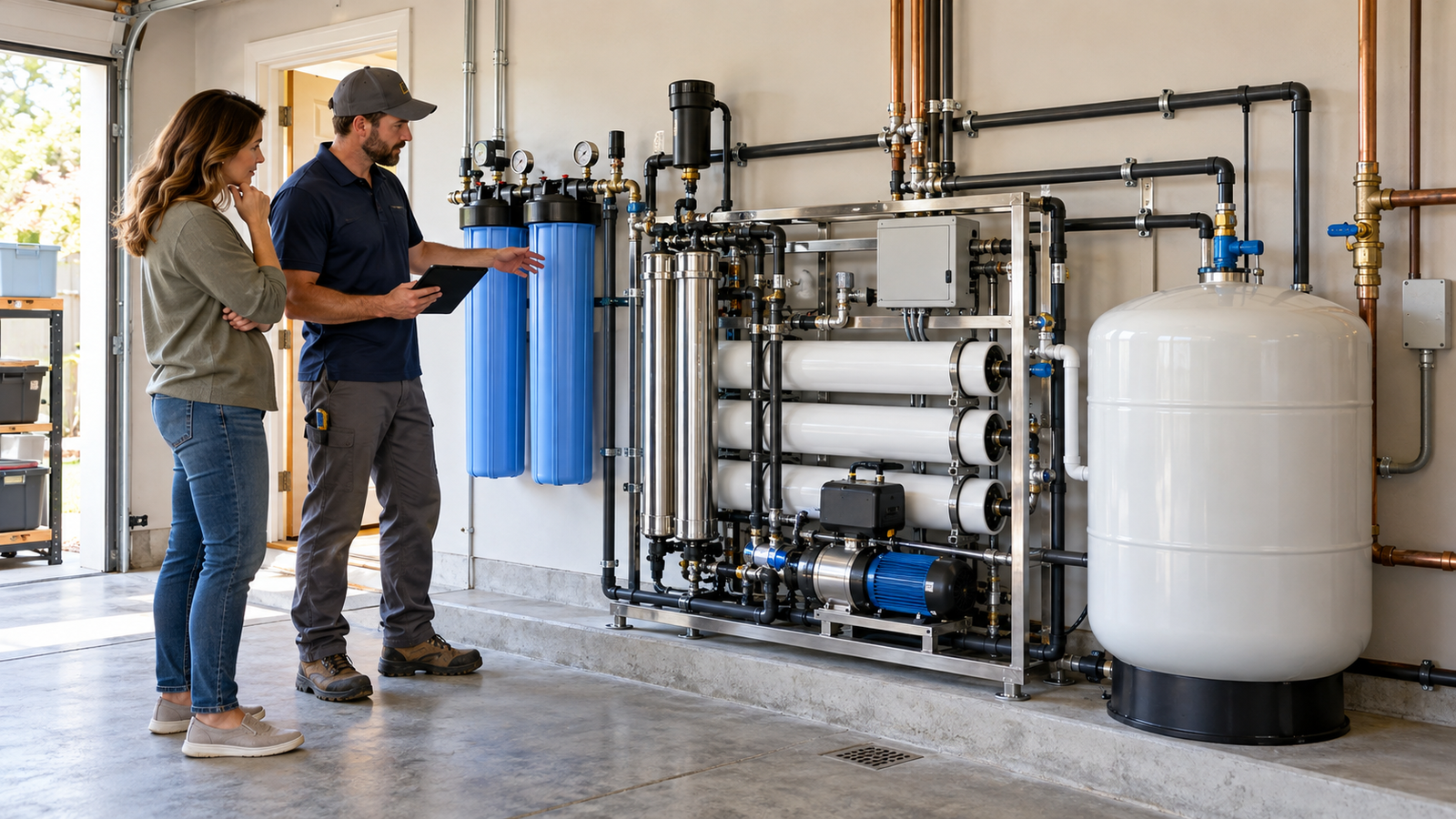
Whole house reverse osmosis system cost includes more than the RO machine. Budget for the treatment your water needs, storage and delivery equipment, installation, and continuing operation. The current equipment examples below are several thousand dollars apart because they have different capacities and inclusions. A complete, itemized quotation is the number to use for an affordability decision.
A low equipment price can be a sensible starting point if suitable tanks, pumps and pretreatment are already in place. It can also become the more expensive project once missing components and site work are added. The same problem continues after installation: a filter price does not describe the cost of all replacement parts, service visits and water sent to the drain.
This guide uses US residential examples in US dollars, with supplier prices and documents checked on October 19, 2026. It compares quoted scope and shows how to build an ownership budget. The worked scenarios are labeled assumptions, not national price estimates or quotations obtained from installers.
What do current equipment prices actually buy?
These are three specific configurations visible on the suppliers’ pages. They are price reference points, not equivalent systems or a market-wide installed-cost range. Installation labor is not priced in these listings.
| Exact example | Displayed price | What the price tells you |
|---|---|---|
| Crystal Quest whole-house RO 300 GPD, standalone, brass rotary pump CQE-CO-02023R |
$2,227 | The selected Crystal Quest configuration excludes the tank kit. The kit adds an atmospheric tank, float controls and a separate delivery pump. |
| US Water Systems Defender 4,000 GPD, tank: None, delivery pump: SCALA 1 |
$9,695 | The current Defender selector has no storage tank selected. Additional treatment choices and tank options change the order. |
| US Water Systems American Made under-sink RO 5-stage, brushed-chrome faucet 200-AARO-5100-BC |
$649 | This selected drinking-water system serves a different treatment scope. It does not provide RO water throughout the house. |
The price gap between the two whole-house examples does not establish which brand offers better value. First ask both suppliers to quote the same water analysis, required daily production, usable storage reserve and delivery flow. Then compare everything needed to put that design into service. Do not compare a standalone machine with a package photograph.
Save the configuration, part numbers and quotation date. A family’s “from” price can differ from the price of the faucet, pump, tank or treatment option selected when you return to the page. Recheck tax, freight and checkout totals for your address.
Build the installed price from a shared scope
Give each supplier and installer the same brief. Ask for each line below to be marked included, separately priced, already suitable, or not required—with a reason. This prevents a blank line from quietly becoming your responsibility after delivery.
| Budget line | What to have specified | Who should confirm it? |
|---|---|---|
| RO equipment and design | Exact model, actual feed-water conditions used in the projection, required output and controls. | System supplier |
| Pretreatment | Treatment required by the water analysis; any existing equipment accepted for reuse; media, dosing or regeneration supplies. | Supplier and water-treatment professional |
| Storage and delivery | Tank, usable reserve, delivery pump, level controls and connections. Separate the pump feeding the membranes from the pump supplying the house. | Supplier and installer |
| Treatment after RO | Any specified pH adjustment, disinfection or other finishing treatment, including its consumables and service access. | Treatment designer |
| Site preparation and labor | Plumbing, electrical work, drain connections, equipment access, isolation/leak provisions and any locally required permits. | Installer and relevant local trades |
| Delivery and purchase charges | Tax, freight, unloading and moving equipment into position; responsibility if an item arrives damaged. | Seller, carrier and installer |
| Commissioning and ownership | Startup, flushing/sanitation, agreed water testing, documented settings, training and the first service visit. | Supplier, installer and homeowner |
The worksheet is a request for a project-specific quotation, not a claim that every home needs every component. For example, the Defender installation requirements specify a 220-volt circuit plus 110-volt connections and air-gapped drainage. Those requirements can make electrical and drain work material to the price. An installer should verify the exact equipment and local conditions before committing to a labor figure.
The cheapest useful bid is the lowest complete price for a design that meets your needs. A bid without pretreatment approval, a clear drain arrangement or a commissioning plan is still incomplete, however attractive the equipment subtotal looks.
What belongs in the maintenance budget?
Break whole house reverse osmosis maintenance cost into replacement events and recurring operation. A membrane may be replaced in a different year from the prefilters; service labor may be charged separately; optional treatment equipment creates additional bills.
These inspected prices illustrate the scale of individual parts. They are not a universal shopping list or a claim that these components fit every version of the named system.
| Parts example | Parts-only amount | Budget boundary |
|---|---|---|
| Three cartridges shown for the current Crystal Quest 300 GPD selection | $31.50 + $158 + $31.50 = $221 | CQE-RC-04015, CQE-RC-04016 and CQE-RC-04014 in the current parts section. Confirm your serial-number-specific list before ordering. |
| Crystal Quest CQE-RC-04111 membrane | $153.75 each | The 2.5 × 14-inch membrane page lists this as the one-time price; its subscription price is lower. |
| US Water Magna 5-micron cartridge, 222 seal | $56.95 each | Use the exact 361-USP-MF-4520-05-222 part, rather than assuming every 20-inch cartridge is interchangeable. |
| US Water WX-T-4040 membranes | $199 each; $398 for two | The 255-WX-T-4040 listing supplies the unit price. Use your equipment’s required quantity. |
| US Water 20 GPM replacement UV lamp | $119.25 each | Relevant only to a compatible UV installation: verify the chamber against the 406-PUV-LM-20 listing. |
For the Crystal Quest example, buying those three cartridges and that one membrane together would total $374.75 before any additional charges. That is a replacement-event sum, not an annual maintenance allowance. Older equipment may use a different membrane, and a delivery subscription is not evidence of the correct service interval.
The linked Defender manual, operation and maintenance section, lists a 6–12-month prefilter interval and 3–5 years for membranes, with more frequent prefilter changes possible under heavier loading. Use the manual and service plan for the actual supplied revision; do not turn either interval into a guaranteed lifespan.
For your own annual budget, divide each scheduled replacement’s full cost by the expected interval in years, then add electricity, treatment supplies, testing and service visits. Keep a separate cash reserve for unscheduled repairs. Annualizing smooths the budget; the actual bill still arrives when the work is needed.
Ask for the cost of salt or dosing chemicals when specified, replacement media, UV servicing, membranes, seals and labor. For electricity, use expected or measured power consumption and operating time for each component: kilowatts × operating hours × your electricity tariff. A pump’s horsepower label alone is not an annual electricity bill.
Calculate reject water before comparing operating costs
Water recovery means the share of incoming feed water that becomes usable RO product water. It is different from a contaminant-rejection percentage. The Defender manual’s recovery calculation divides product flow by feed flow. This distinction matters whenever a sales page uses a percentage without explaining what it measures.
Feed water = required RO product water ÷ recovery expressed as a decimal.
Reject water = feed water − RO product water.
For example, enter 0.50 for 50% recovery. Keep all quantities in the same units.
Suppose a household needs 200 US gallons of RO product water daily, or 73,000 gallons over 365 days. Assume a combined marginal water-and-sewer charge of $15 per 1,000 gallons of incoming water, with sewer billing following metered water use. These are illustrative assumptions; use your bill and the recovery approved for your system.
| Annual quantity or charge | 50% recovery | 75% recovery |
|---|---|---|
| RO product water | 73,000 gal | 73,000 gal |
| Incoming feed water | 146,000 gal | About 97,333 gal |
| Reject water | 73,000 gal | About 24,333 gal |
| Extra water/sewer charge attributable to reject water | $1,095 | $365 |
The table counts the additional water charge caused by RO, so it does not charge your normal 73,000 gallons twice. Total charges for the incoming feed water under the same assumptions would be $2,190 and $1,460 respectively. Flushing, cleaning, pretreatment backwashing and other losses are outside this simplified calculation and must be added when applicable.
A private-well owner should replace the assumed utility tariff with the relevant pumping and water-supply costs. A septic installation also needs a site-specific drainage assessment. Neither free source water nor a low utility rate establishes that the available well yield and discharge arrangement can support the system.
Do not assume 75% recovery is available on any water source. The Defender 2.0 specification brochure describes recovery up to 75% with concentrate recycle and warns that recycle is not always appropriate, including a requirement to consult technical support for well-water suitability. Get a design projection and commissioning target from the supplier rather than changing operating settings to match a budget.
The EPA’s WaterSense RO guidance concerns point-of-use equipment. Its water-waste examples should not be substituted for the projected recovery of a whole-house installation.
A five-year example: when can a higher price pay back?
Assume two hypothetical installed quotations meet the same water-treatment and demand requirements. Quote A totals $8,000 and is designed for 50% recovery. Quote B totals $11,000 and is designed for 75%. Both are assumed to need a $600 annual allowance for all non-water ownership costs. The installed sums include the assumed equipment, site work, delivery, tax and commissioning.
These figures are scenario inputs, not prices offered by Crystal Quest or US Water Systems. The $600 allowance is also an assumption, not a maintenance estimate for either brand. Their purpose is to show how to compare actual quotations once you obtain them.
| Budget item | Quote A | Quote B |
|---|---|---|
| Assumed installed price | $8,000 | $11,000 |
| Five years of extra water/sewer | $5,475 | $1,825 |
| Five years of assumed non-water allowance | $3,000 | $3,000 |
| Illustrative five-year budget | $16,475 | $15,825 |
Under those assumptions, Quote B costs $3,000 more initially but reduces the extra water charge by $730 a year. Simple payback is about 4.1 years ($3,000 ÷ $730), and its five-year budget is $650 lower. That result changes if demand, tariffs, actual recovery or other running costs change. Financing, price increases, major repair overruns and residual value are excluded.
Use the example to test a premium, not to justify one automatically. If better recovery needs more pretreatment, chemicals or service, add those costs to that quotation. Compare documented operating targets and actual scope before treating a claimed efficiency saving as money you can spend elsewhere.
Budget for the costs a warranty may leave with you
A replacement component does not necessarily pay for the visit needed to fit it. In the Defender manual’s warranty section, the two-year component warranty excludes consumables, and the stated exclusions include labor, shipping, service charges and removal or reinstallation costs. Obtain the terms for the equipment on your quotation.
Crystal Quest’s one-year limited warranty concerns material and workmanship defects under its use conditions. Its ordinary refund policy explicitly excludes reverse osmosis systems from returns and exchanges and does not reimburse installation or professional-service expenses. Do not budget on being able to return an unsuitable system as a normal trial purchase.
The separate Guaranteed Performance program is conditional: it requires the company’s recommendation, prescribed installation and operation, and an independent lab test at the customer’s expense. Remedial changes can also be at the customer’s expense; an eligible refund follows unsuccessful efforts and deducts shipping and handling. Ask for written confirmation of how this program applies to your exact order before relying on it.
Ask who pays when a problem originates in the equipment, installation, feed-water conditions or shipping. Also ask which local company will attend a failure, how visits are charged and what you should do while the system is unavailable. These answers determine the repair reserve more usefully than a warranty headline.
When a smaller project is the better budget decision
If the goal is treatment only for drinking and cooking, price a suitable point-of-use option before committing to whole-house RO. CDC guidance distinguishes treatment at a single outlet from treatment throughout a home and recommends choosing around the substances actually present in the water. The $649 under-sink example above belongs to that smaller scope; its price is not evidence that it meets your particular reduction requirements.
A whole-home design deserves further consideration when the documented treatment need extends beyond the kitchen and the proposed system addresses it. A lower-cost filter, targeted treatment or point-of-use system may be preferable when it solves the actual problem. Ask each provider to explain why RO is needed throughout the house and what a narrower alternative would leave untreated.
Whole-home treatment also creates an ongoing care commitment. The same CDC guidance notes that removing disinfectant throughout the home can allow more germs to grow in plumbing. Have the provider define an appropriate maintenance and water-management plan instead of treating purchase of the equipment as the end of the project.
- Confirm the tested water problem and why the proposed treatment location is necessary.
- Obtain an itemized, delivered and installed total with responsibility for every omitted line.
- Get projected recovery, yearly consumables and a service plan for the exact configuration.
- Recalculate the water bill and a multi-year budget using your own demand and tariffs.
- Read the applicable return, performance and warranty terms before paying.
If Crystal Quest remains on your shortlist, use its team to confirm a configuration against your water report and ask for the same complete scope you request from other suppliers.
Visit Crystal Quest’s homepage to discuss a quotation
Sources and method: This is a document-based budgeting guide using the linked manufacturer listings, manuals and policies, plus CDC and EPA guidance. HomeChoiceWorks did not install or performance-test these systems. Listed prices were checked October 19, 2026; current configurations, parts, availability and delivered totals require confirmation. Calculations are editorial examples with stated assumptions, not predictions for a particular home.
Keep researching
More decision guides from the same topic area.
Eskiin Shower Head Installation: Fit Checks, Steps and Leak Fixes
Installation verdictAn Eskiin wall-mounted head is a reasonable DIY swap if your shower has an accessible standard male 1/2-inch…
Read guide →
Best Filtered Shower Heads: Evidence, Fit and Filter Costs Compared
Best filtered showerhead: a conditional shortlistStart with Aquasana AQ-4105 if you want a handheld option with a published model-family…
Read guide →
Eskiin Shower Head Reviews: Filtration Evidence, Costs and Who Should Buy
The short answerEskiin is worth considering when you want a wall-mounted showerhead with a replaceable cartridge and are comfortable…
Read guide →