
Commercial disclosure: We may earn a commission if you purchase through certain links on this page.
A hanging bath filter is an appealing idea when you want to treat water at the tub without changing the plumbing. The important question is whether the Crystal Quest Bath Ball filter can meet your particular water-treatment goal, stay correctly positioned under your faucet, and justify its replacement cost.
We would defer a purchase if you need documented chlorine reduction over repeated baths. The manufacturer’s linked laboratory report does not substantiate its advertised long service life at normal advertised flow. Faucet compatibility also needs checking, and the published operating limits disagree. A removable design is useful only after those questions are answered for the unit you would receive.
This is a document-based review for US households. HomeChoiceWorks has not used or tested the Bath Ball. The evidence behind this assessment is explained below.
What the Bath Ball’s linked chlorine test actually shows
The most consequential source is the IAPMO R&T Lab report 3592-25003, issued June 24, 2025, linked from the Bath Ball product page. It covers two samples described as Bath Ball #1 – Shower Filter under a modified NSF/ANSI 177 chlorine-reduction test.
On page 2, the test used a restricted 0.5-gallon-per-minute flow and a planned rated capacity of 250 gallons. The compliance requirement was at least 50% free available chlorine reduction at every sampling point. At 50 gallons, one sample showed 40% reduction and the other 50%. The report states that testing was suspended after failing effluent samples.
That result does not establish the advertised 2,000–2,500-gallon service claim. Nor does it prove that every current Bath Ball will perform like those samples: the report expressly limits its conclusions to the tested samples, and it does not identify the current retail SKU or revision. Ask Crystal Quest for the current unit’s mapping to that report and any subsequent complete test.
A result from a fresh cartridge, an average reduction figure, or a reference to a test standard cannot by itself tell you how much treatment remains after many baths. Request a complete report for the actual cartridge, contaminant, flow and operating conditions you intend to use. A new report could change this assessment.
Testing and certification also need to be distinguished. NSF’s explanation of water-treatment standards says NSF/ANSI 177 concerns free available chlorine reduction in shower filtration; it does not establish reduction of every contaminant. If certification is part of the sales claim, ask for the certifying body’s current listing of the exact product and its approved reduction claims.
Start with the water problem you want to solve
Chlorine and chloramine need separate evidence
Ask your utility which disinfectant it currently uses. The EPA’s Consumer Confidence Report resources can help you find the local water-quality report. The EPA explains that chloramines are commonly formed by adding ammonia to chlorine and provide longer-lasting disinfection in distribution pipes.
The Bath Ball laboratory report above evaluates free available chlorine; it is not a chloramine challenge test. A buyer on chloraminated water therefore needs separate, product-specific evidence. Do not accept a chlorine result as the answer to a chloramine question. Likewise, a noticeable improvement in smell would not demonstrate a specified reduction percentage or verify unrelated contaminants.
Hardness requires a different treatment decision
USGS defines hardness principally in terms of dissolved calcium and magnesium, which can contribute to soap residue and scale. Crystal Quest’s Bath Ball replacement-cartridge page explicitly says the cartridge does not remove those hardness minerals.
If your goal is measurable hardness reduction, obtain the home’s hardness result and compare an appropriately sized water softener. NSF identifies hardness reduction as the role of ion-exchange softeners under NSF/ANSI 44. Buying a bath cartridge because the water is described as feeling softer does not answer that equipment-selection question.
Skin symptoms and unsafe source water are outside this review’s evidence
A chlorine-reduction report provides no clinical evidence that the Bath Ball treats eczema or another skin condition. This review establishes no such benefit. The manufacturer’s cartridge description also excludes bacteria and viruses, fluoride, nitrate and total dissolved solids from its intended treatment scope. Choose treatment for a documented water problem using evidence that addresses that problem; do not rely on a bathing accessory to establish that unsafe water is safe.
Will it stay under your bathtub faucet?
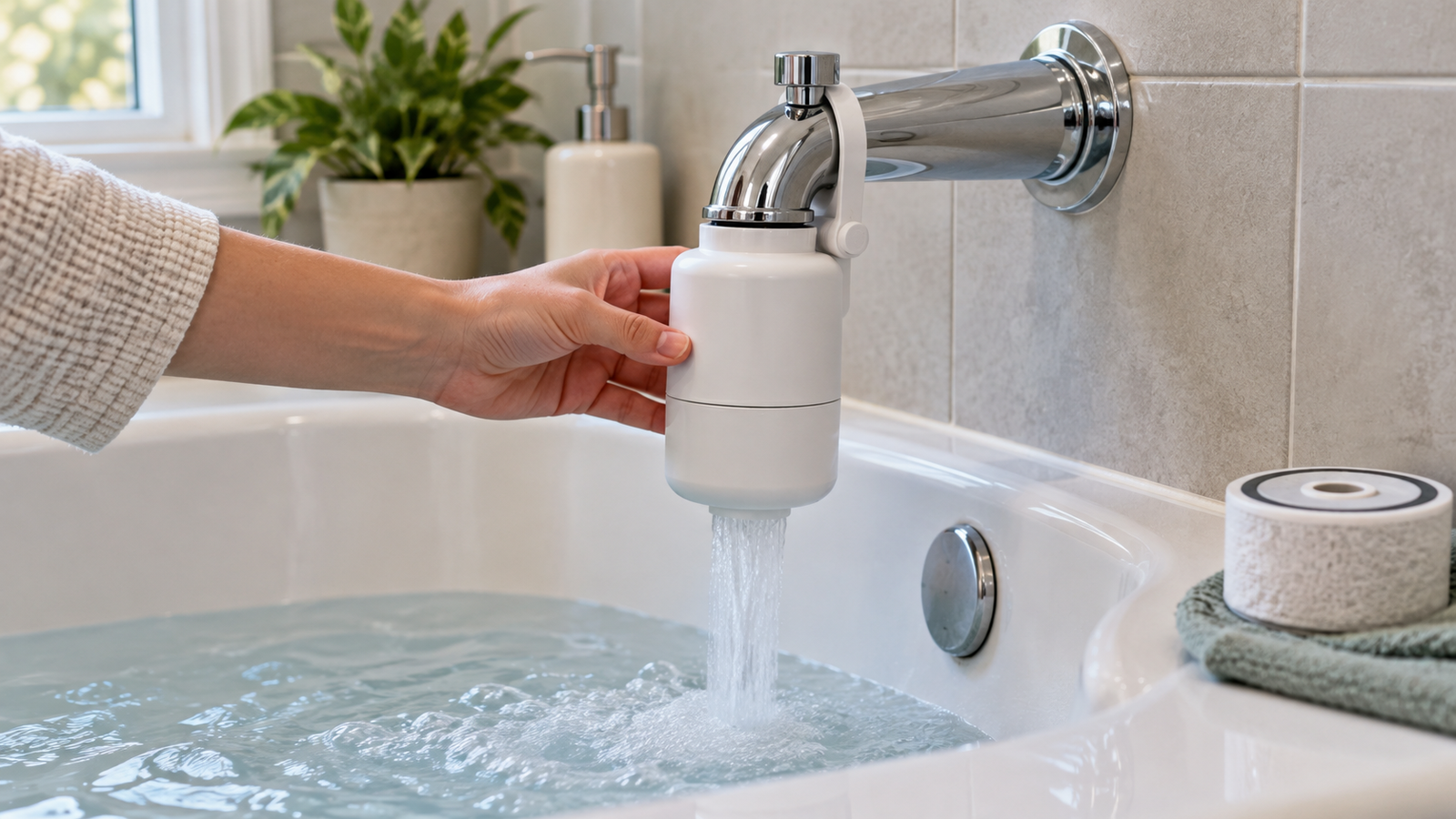
Crystal Quest lists a housing approximately 5 by 5 inches and 2 pounds. Although its product page uses broad compatibility language, the same page acknowledges that the supplied handles may not work with every faucet. That exception matters more than a universal-fit headline.
The manufacturer’s installation guide describes a standard hanger, an included flex handle that wraps around the faucet, and a separately sold adhesive hook. The objective is to hold the filter directly under the incoming water throughout filling. The guide instructs users to reduce the flow if the housing overflows.
- Check the mounting point. Does your spout have a suitable top pull or shape for the hanger, or can the flex handle stay secured around it? An unusual waterfall outlet or smooth, short spout deserves a photo-based compatibility check with Crystal Quest before ordering.
- Check the stream path. The opening must intercept the faucet’s stream. Water spilling around the housing is not equivalent to water passing through the cartridge.
- Check clearance. Consider the housing dimensions, tub edge and normal fill level. A product photo taken with a different faucet cannot establish fit in your bathroom.
- Check the required accessory. Obtain confirmation that the supplied handle is sufficient or identify the exact hook needed. Avoid relying on an improvised attachment to rescue an unsuitable purchase.
The useful feature here is removable installation. For a renter or an occasional bath user, that may make the format worth investigating. It does not resolve treatment performance, and simply placing a filter in already-filled bathwater would not reproduce the documented flow-through setup.
Resolve the conflicting flow and temperature instructions
The documents checked on October 19, 2026 do not provide one consistent operating specification:
| Document | Flow statement | Temperature statement |
|---|---|---|
| Bath Ball product page | Recommended 4–5 GPM | Broad claim of effectiveness at any water temperature |
| Linked Bath Ball manual, copyright 2022 | Optimum 2–3 GPM at 60 psi | 40–110°F |
| Replacement-cartridge specifications | 4–5 GPM | 40–100°F operating range; a separate media rating extends to 212°F |
A media temperature rating cannot be substituted for the assembled product’s operating limit. Neither can the laboratory’s restricted test flow be treated as verification at the storefront’s faster rate. Ask for one current instruction covering the complete unit and cartridge you will receive. This table identifies a discrepancy; it is not a recommended operating range.
Purchase price, replacement disk and realistic budgeting
On the US storefront checked October 19, 2026, the white Bath Ball selection was $64.95, with a cartridge included. The single CQE-RC-04052 replacement disk was $39.50 as a one-time purchase. The lower $37.53 display related to a subscription selection. Check the purchase mode as well as the price before checkout.
At those one-time prices, one unit plus one later replacement would total $104.45 before shipping, tax or any mounting accessory. This is a purchase subtotal, not a promise of two years of adequate treatment. Recheck the selected color, delivery destination and actual order total.
Crystal Quest advertises 2,000–2,500 gallons or 12–18 months. As an arithmetic illustration only, a 30-gallon fill would use that volume in roughly 67–83 baths, or 22–28 weeks at three baths per week. Your fill volume may differ. More importantly, this calculation does not validate the advertised capacity or predict contaminant removal; the test limitation above remains.
For an existing owner, match the replacement to the cartridge identifier and your housing. The listed Bath Ball disk is CQE-RC-04052; a similarly named shower-filter cartridge is not interchangeable. If the part identification is unclear, get the merchant to match a photograph before purchasing a nonreturnable cartridge.
Maintenance and returns change the buying decision
The Bath Ball manual describes opening the housing for replacement and reversing the disk for back-flushing. It also warns that bacteria can grow in or on the housing, especially with infrequent use. The installation guide calls for drying between uses and storage in a cool, dry place. Treat the housing as something to maintain, not an accessory to leave wet indefinitely.
Obtain the current operating instructions before the initial flush, given the temperature discrepancy. Follow the manufacturer’s housing-care procedure; this review does not supply a chemical concentration or substitute disinfection method. Inspect the part and compatibility before putting water through it.
The Crystal Quest refund policy, checked October 19, 2026, allows ordinary refunds for new, unused items in original packaging, requires an RMA, and sets a 30-day delivery-based window. Return shipping is the customer’s responsibility; restocking fees can reach 30%. Filter cartridges are excluded from returns. Do not interpret the return window as permission to try the filter for several baths and then obtain a refund.
The one-year limited warranty addresses defects in materials and workmanship under compliant use and excludes replacement filters. A defect remedy does not establish the contaminant-reduction lifespan you need. If fit, instructions or a possible defect is unclear, contact Crystal Quest with the order details and product photographs before shipping anything back.
What should you choose instead—or verify before proceeding?
For hardness and scale, use a hardness result to assess a suitable softener. For documented chlorine or chloramine treatment at the tub, compare equipment whose exact model, temperature, flow and service-life evidence match that target. A system treating water before it reaches the bathroom may be worth investigating when faucet-mounted options cannot meet those requirements, but it brings a separate installation and ownership decision.
If you cannot define a problem or obtain adequate evidence, deferring the purchase is a reasonable outcome. The next useful step is a utility enquiry or appropriate water testing, rather than another accessory selected from broad purification claims.
If you still want this removable format, ask Crystal Quest to answer these questions together:
- Which current complete-unit and cartridge identifiers will be supplied, and will they fit photographs of your faucet?
- Which dated operating instructions govern their temperature and flow limits?
- What complete, current report supports reduction of your particular disinfectant at that flow through the intended service life?
- How does the supplied product relate to the samples in report 3592-25003, and is there subsequent evidence?
- What return eligibility, replacement cost and delivery total apply to your exact order?
Use the merchant’s product information and support channels to resolve the questions above. The commercial link below opens Crystal Quest’s homepage; it does not open a preselected Bath Ball product.
Sources and scope: Official product, cartridge, instructions and policy pages were checked October 19, 2026. The laboratory report is dated June 24, 2025 and applies to its stated samples and conditions. Prices are US storefront USD figures. This review assesses suitability and evidence; it does not establish clinical benefits or certify water quality in an individual home.
Keep researching
More decision guides from the same topic area.
Eskiin Shower Head Installation: Fit Checks, Steps and Leak Fixes
Installation verdictAn Eskiin wall-mounted head is a reasonable DIY swap if your shower has an accessible standard male 1/2-inch…
Read guide →
Best Filtered Shower Heads: Evidence, Fit and Filter Costs Compared
Best filtered showerhead: a conditional shortlistStart with Aquasana AQ-4105 if you want a handheld option with a published model-family…
Read guide →
Eskiin Shower Head Reviews: Filtration Evidence, Costs and Who Should Buy
The short answerEskiin is worth considering when you want a wall-mounted showerhead with a replaceable cartridge and are comfortable…
Read guide →