
Commercial disclosure: We may earn a commission if you purchase through certain links on this page.
Measure your head with your hair arranged as you intend to wear it, then use the chart for the exact brand and model. If your measurements sit between published ranges, ask the seller to confirm the fit. Adjustment straps are a fitting aid; they do not establish that every nearby size will work.
A size label is a starting point for choosing a cap. The useful outcome is a wig that sits where you want it without persistent pressure, slipping or repeated repositioning. This guide uses Godiva’s Secret’s published circumference chart and adds a three-measurement check from Jon Renau to help you ask more precise fit questions.
Measure the head you will actually fit
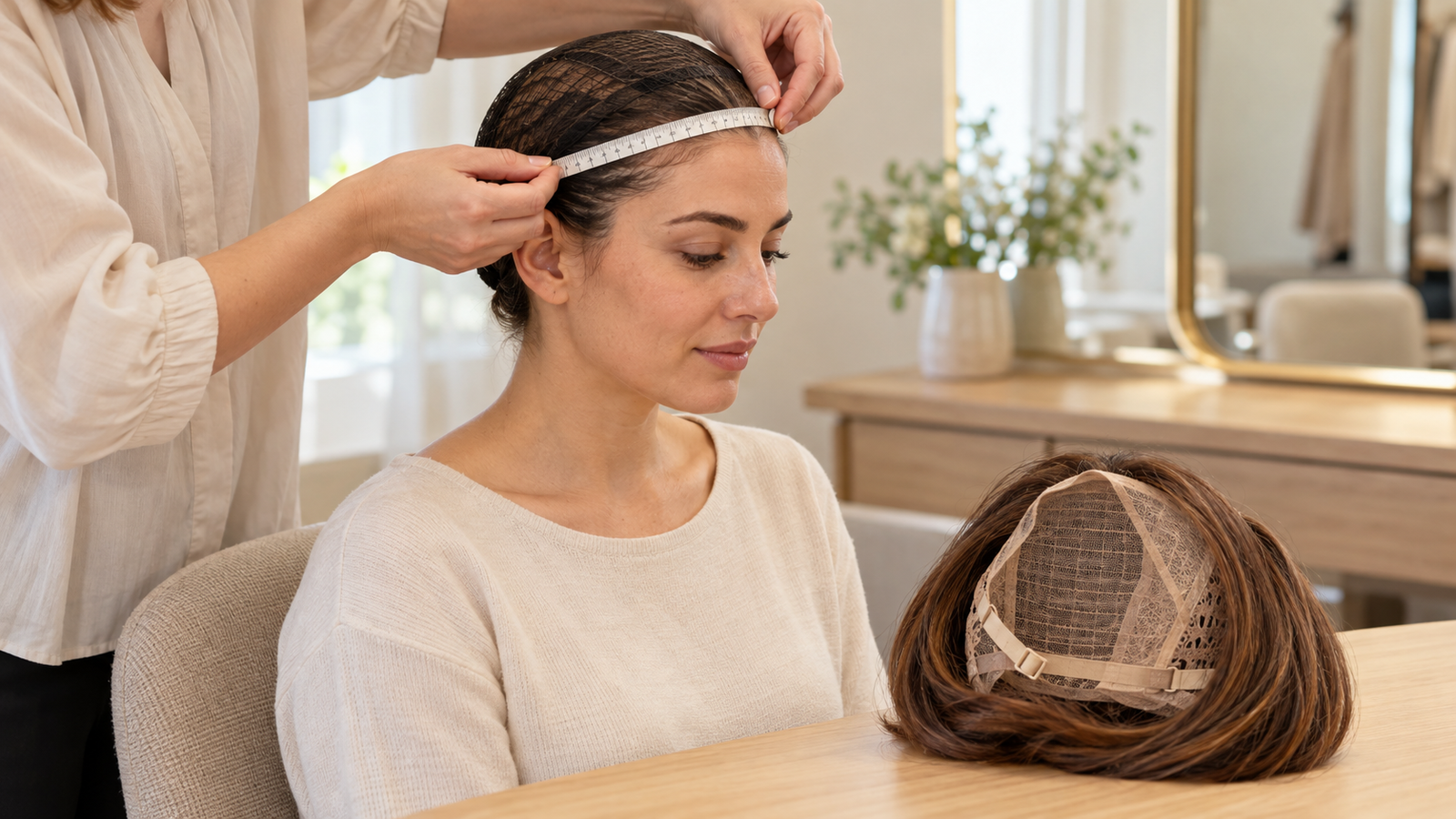
Jon Renau’s Wig Sizing 101 says to arrange or wrap your own hair before measuring when the wig will be worn over it. Use a flexible fabric tape and record the result instead of remembering a rounded number. If you plan to use a liner or grip, tell the seller what it is rather than inventing an allowance to add to the chart.
- Circumference: follow the intended hairline around the head and nape, returning to the starting point. Godiva’s method runs from the front hairline behind each ear.
- Ear to ear: record an over-the-top measurement. Jon Renau’s illustrated method establishes the top point 7 inches behind the front hairline; follow its diagram when using its chart.
- Front to back: measure along the center of the head from the front hairline to the nape hairline.
Repeat any measurement that changes substantially when you try again, and ask another person to help if the tape keeps shifting. Record your original inches or centimeters consistently. Do not silently round a boundary measurement into the size you hope to buy. These steps improve the information you can send the seller; they do not substitute for an actual fitting.
Godiva’s Secret’s published cap-size chart
The official Wig Sizes page gives the following circumference guidance, checked October 15, 2026. It does not provide ear-to-ear or front-to-back ranges. Centimeter values below are approximate conversions, rounded to one decimal, using 2.54 cm per inch.
| Label | Published inches | Approximate centimeters |
|---|---|---|
| Petite | 20–21 | 50.8–53.3 |
| Average | 21½–22½ | 54.6–57.2 |
| Large | 23 | 58.4 |
Keep the gaps visible. A 21¼-inch circumference falls between the published petite and average ranges; 22¾ inches falls between average and the large figure. Neither example has an explicit match in this chart. Send the measurement and exact style to support rather than creating an unofficial in-between range.
Godiva’s says its adjustment straps can tighten or loosen the cap by about an inch. It does not publish a model-by-model fit envelope or promise an additional inch in each direction. Do not extend every chart row by plus or minus one inch.
Check the model label, not only the collection filter
The current Tracy listing identifies an average cap. By comparison, Ellen Wille Risk is labelled petite/average. Those labels come from different manufacturers and are not a direct conversion. Check the selected model’s own chart and seller advice before substituting one for the other.
Jon Renau asks shoppers to compare three measurements and, within its sizing system, consider the size that accommodates the largest measurement. That is useful evidence that circumference alone may leave a fitting question unresolved. It is not a rule to apply automatically to Godiva’s or another brand whose chart uses different information.
If your circumference fits the average row but you have a previous wig that pulls at the nape or sits awkwardly around the ears, send those details too. Describe what happens and where, including the model and size of the old wig if known. “Average does not fit me” gives a seller less to work with than three measurements and a specific location of discomfort.
Use the first try-on to separate positioning from fit
During the seller-permitted try-on, keep the cap in its intended position and check whether the ear tabs sit evenly. Make only gentle, reversible strap adjustments. Observe the front, ears, crown and nape separately, then turn your head and look down. The question is whether the cap stays acceptably positioned without forcing it tighter and tighter.
| Observation | Useful next step |
|---|---|
| The front or sides feel persistently tight | Recheck measurements and positioning. Ask whether a different size or cap construction is appropriate. |
| The cap shifts during gentle movement | Ask about size and fit before buying extra security accessories to compensate. |
| The ears, front and nape cannot all sit where intended | Send front-to-back and ear-to-ear measurements alongside circumference. Request model-specific fitting advice. |
| The lace feels uncomfortable despite apparently correct sizing | Ask about the edge material and another construction. Size alone may not explain the problem. |
Jon Renau’s lace-front discomfort guide identifies both incorrect sizing and skin sensitivity as possible contributors: a loose edge may rub, while a tight one may press. These observations do not diagnose the cause of your discomfort. Remove a wig that is irritating rather than continuing to tighten it to achieve security.
Resolve the fit before altering the cap
Godiva’s return rules exclude cut, altered, washed or worn products and require original tags and packaging. Its 20-day clock starts at shipment. Check those terms before trying adjustments beyond the built-in straps; a sizing tutorial is not a promise that an altered item remains returnable.
Keep three decisions separate: whether to return, whether to keep and customize, and whether to try another model. If a seller recommends alteration, first confirm you are comfortable keeping the item and understand any outside fitting charge. When the published chart cannot resolve your fit, trying caps in person can be more useful than ordering multiple sizes by guesswork.
Include circumference, ear-to-ear and front-to-back measurements; how your hair is arranged; any intended liner or grip; the exact model and size; and where a previous cap felt wrong. Ask which size they recommend, what uncertainty remains, and how you may assess fit while preserving return eligibility.
Choose a size when the model’s guidance and your measurements make a coherent match. For a chart gap, conflicting dimensions or persistent discomfort, pause the order until you have better fitting information. A different style in the right cap is often a more useful comparison than forcing the preferred style to fit.
Check Godiva’s Secret model and size options
Sources checked October 15, 2026. This is cosmetic fit guidance for a US-focused buying decision, not treatment advice. Manufacturer methods are attributed individually; no universal cap-size standard or hands-on fit verification is claimed.
Keep researching
More decision guides from the same topic area.

Dermalogica Daily Microfoliant Review: Fit, Risks and Cost
The purchase decisionDaily Microfoliant is worth considering if you want a rinse-off powder exfoliant and your routine leaves room…
Read guide →
Best Shampoo for Color-Treated Hair: 5 Fits Compared
The best shampoo for color-treated hair is the one that meets your non-negotiable needs before it wins a marketing…
Read guide →
Pureology Hydrate Shampoo Review: Hydrate or Sheer?
Pureology Hydrate is the richer starting point for dry hair that benefits from a more conditioned finish. Hydrate Sheer…
Read guide →