
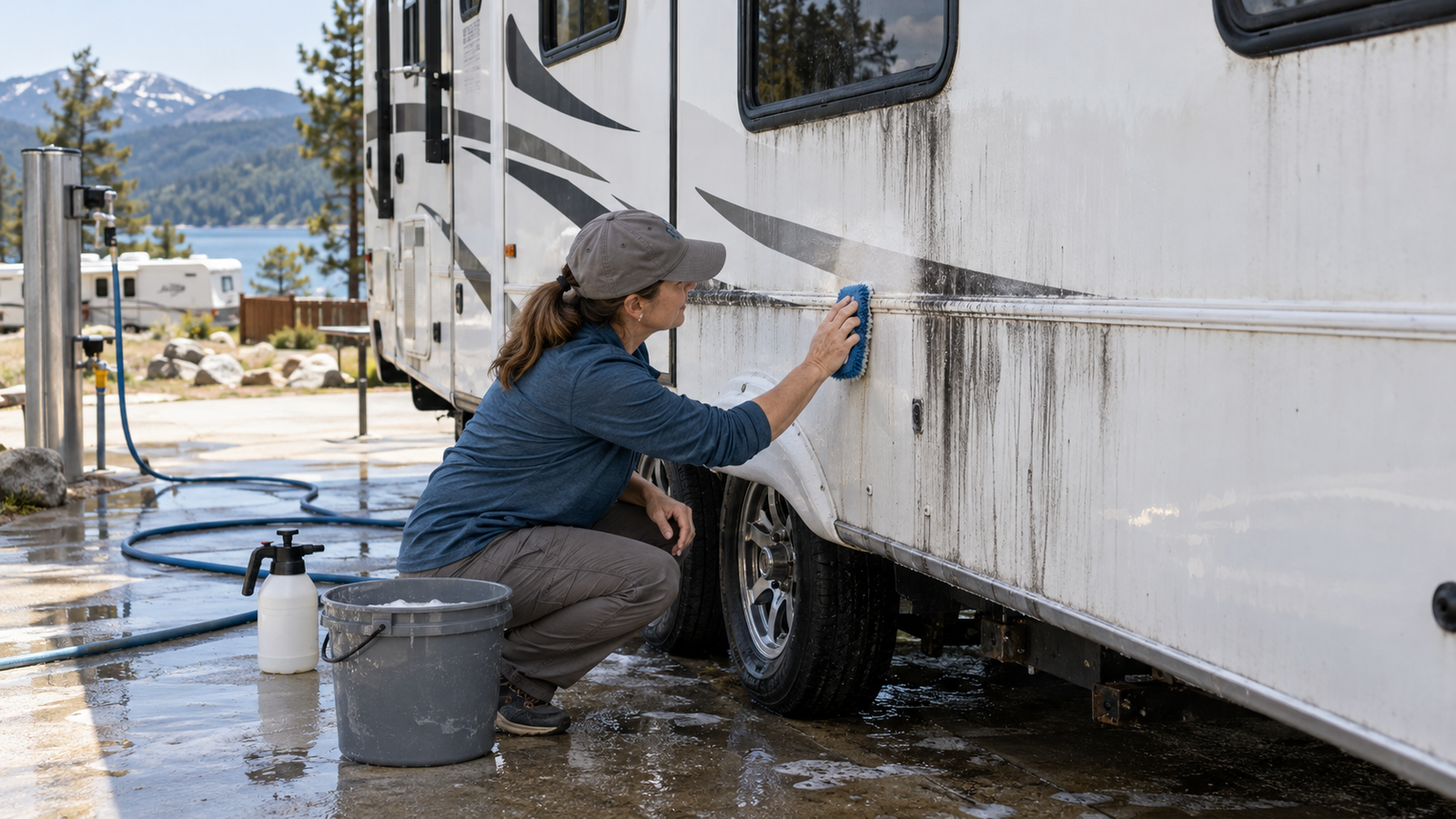
Commercial disclosure: Some links to Superior Products are affiliate links; we may earn a commission if you purchase through them.
Short answer: match Road Warrior to stubborn road film, not every wash day
Superior Products Road Warrior C46 is a concentrated, low-foam industrial soap/degreaser sold for black streaks and road film on RVs, trailers, buses and other large vehicles. It can make sense for a genuinely dirty, surface-compatible job—especially when you can control dilution and runoff. It is usually harder to justify for an ordinary weekly car wash or for an RV with unknown graphic, gelcoat or coating compatibility. The manufacturer’s broad “safe on surfaces” claims are not a substitute for your vehicle/finish manual or the product SDS.
Searching Road Warrior Superior Products often means one of three problems: black rain-runoff streaks on an RV, greasy film on a work vehicle, or a large wash job that is inconvenient with an ordinary foamy shampoo. Those are not necessarily the same soil or finish. First identify whether the mark is removable surface contamination, a stain embedded in a material, or a damaged/oxidized coating. A cleaner should not be sold as a repair for permanent finish damage.
What does Road Warrior C46 actually target?
Superior’s public cleaner catalog positions Road Warrior as a low-foam road-film and black-streak cleaner, while its product listing also promotes water-based use with pressure-washing equipment. The older C46 technical data sheet gives task-specific mixtures, while its text also uses unusually broad “safe on all surfaces” language and separately advises caution on uncoated wheels. Those statements are not a verified guarantee for aging decals, gelcoat, films, wax or coatings.
| The job | How Road Warrior is positioned | Decision-changing limitation |
|---|---|---|
| RV/trailer black runoff streaks | A core advertised task with a specific TDS black-streak treatment method. | Test adjacent paint, seals and decals; identify whether the streak is removable without aggressive scrubbing. |
| Heavy greasy fleet/tractor road film | Low foam and pressure-wash compatibility may simplify large-area rinse work. | High-pressure water, contaminated runoff and unknown finishes still require a controlled process. |
| Ordinary lightly dusty passenger car | Often more chemical and setup than necessary for maintenance. | A mild manufacturer-approved hand-wash shampoo better matches the job. |
| Oxidized gelcoat, peeling decals, dull paint | Road film removal is not physical restoration of a failing coating. | Stop and diagnose the substrate; cleaning alone cannot be assumed to reverse oxidation or decal deterioration. |
The purpose column reflects the manufacturer’s C46 positioning; poor-fit cases are editorial risk judgments, not performance test results. Protect vulnerable electrical openings, exposed edges and surrounding surfaces; consult the machine/vehicle instructions before applying any pressure-wash method.
Why the advertised 100:1 dilution is not a black-streak recipe
The Road Warrior technical sheet gives several very different workflows:
| Task in the older C46 TDS | Documented instruction | What it does not establish |
|---|---|---|
| Black-streak removal | A 50:50 mixture, spray, brush the area and rinse. | Not confirmation that that strong mixture is suitable for your decals/gelcoat or current bottle. |
| Heavy-duty vehicle wash | 3–5 fl oz per gallon of water, brush, then pressure-rinse. | Not a universal pressure-washer injection setting or permission to blast old graphics. |
| General-purpose cleaning | A published 4:1 dilution. | The sheet does not resolve every substrate or the ratio format on your current container. |
| Broad maximum dilution claim | May be diluted as far as 100:1, depending on severity. | Not evidence that 100:1 removes stubborn black streaks or gives the same result as 50:50. |
Those instructions appear in a technical sheet served from an older file path. Check the current C46 container label and ask the maker how to interpret a ratio where the water:concentrate order isn’t explicitly stated; don’t mix a stronger solution based on a guess. A small hidden-area test is essential on an older vehicle, and “let it dwell” is not a license to let cleaner dry onto paint or trim.
Decals, gelcoat, painted panels: three different risks
Treat broad decal-safe advertising as a claim—not a universal approval
Superior advertises Road Warrior as safe for exterior graphics, but even the manufacturer’s TDS cautions about uncoated wheel surfaces. Independently, 3M’s published wrap-film care guide favors hand washing and cautions that abrasive cleaning and brush car washes can damage film or lift its edges. That guide covers specified 3M films, not every RV decal or Road Warrior formula; it demonstrates why the graphics maker’s instructions must be checked before applying a stronger chemical or high-pressure process.
Painted panels: Inspect for a sound, intact finish, existing wax/coating and pressure-rinse restrictions. Use a mild cleaner when soil is light, and do not assume degreaser leaves prior protection unaffected.
Fiberglass/gelcoat: Determine whether the finish is coated or bare, glossy or oxidized, and follow the boat/RV manufacturer’s chemical and dwell instructions. The inspected C46 sources do not independently establish that concentrated Road Warrior preserves every gelcoat or wax layer; a brightened surface does not prove oxidation was safely removed.
Vinyl decals and graphics: Age, edge lift, adhesive condition and graphic-maker rules change risk. Avoid aggressive brushes and pressure spray at edges. Protect adjacent bare metal and uncoated wheels. If damage already exists, cleaning cannot restore adhesion.
Road Warrior versus a ready-to-use black-streak remover
A black-streak-only shopper need not buy an industrial gallon by default. Star brite Instant Black Streak Remover is a task-specific alternative with ready-to-apply directions: the manufacturer describes a short wait, wipe and rinse. It also expressly warns that inferior decals or painted stripes may discolor and advises hidden-area testing. Its claim that it does not remove wax is manufacturer positioning rather than a verified comparison against C46.
| Buying path | Where it can make sense | Main compromise |
|---|---|---|
| Road Warrior C46 concentrate | Repeated large-vehicle road-film work and a controlled washing setup. | Mixing, storage, safety precautions, runoff handling and substrate testing. |
| Star brite targeted remover | An occasional streak on a material allowed by its label. | Ready-to-use convenience may cost more per treated area; label still warns about vulnerable graphics. |
| Ordinary mild vehicle shampoo | Dust/light road soil and regular maintenance on approved finishes. | Might require a second targeted step for persistent oily streaks. |
Specific alternatives are supported by Star brite’s directions and decal warning and Superior’s C46 product/Dirt Buster maintenance-soap descriptions. No controlled test of removal speed, wax loss or dollar cost per square foot is asserted.
Safety: the low-foam label does not mean low-risk concentrate
The manufacturer-hosted Road Warrior SDS revised May 28, 2015 lists skin irritation and serious eye damage, with protective gloves and eye protection among its precautions. This older SDS cannot confirm the classification of a differently formulated current package. Obtain the current C46 SDS and follow its handling, storage and first-aid instructions. Avoid careless aerosolized overspray; work in a controlled area away from bystanders and pets.
Wash runoff may contain grease, road metals and detergents. The US EPA’s vehicle-washing advice emphasizes reducing soap usage and keeping runoff out of storm drains; local discharge rules and wash-site controls matter even if a soap is described as biodegradable. Washing a commercial fleet may have additional requirements that are outside this consumer buying guide.
Prepared-mixture cost is not the same as finished-job cost
A transparent dilution illustration
If a current label confirms that the relevant black-streak treatment is truly equal volumes of C46 and water, then 16 fl oz concentrate + 16 fl oz water = 32 fl oz prepared mix. This is arithmetic to help compare costs, not independent approval of that mixture for any surface.
Estimate (delivered concentrate cost + sprayer/brush/glove cost + realistic disposal costs) ÷ actual completed jobs. Include second passes, rinsing, protected surface area and waste. Comparing a gallon of diluted product with a ready-to-use 22-ounce bottle without measuring how much each job consumes is not a valid value comparison.
A buying decision that avoids irreversible mistakes
- Consider Road Warrior if you frequently wash large, genuinely dirty, clearly compatible vehicles; have the current C46 directions/SDS; can mix accurately and manage rinse water.
- Consider a labeled black-streak-specific ready-to-use alternative for one occasional streak, especially when concentrate storage and setup do not make sense.
- Use a mild approved car/RV shampoo instead when the mark is ordinary dirt and there is no heavy grease to remove.
- Do not choose either chemical first when gelcoat, paint or graphics already appear degraded, when the RV maker restricts chemicals or pressure washing, or when you cannot confirm material compatibility.
Check Road Warrior and other Superior cleaners (affiliate homepage)
Research scope: US product information reviewed October 13, 2026. C46 manufacturer TDS and SDS cited here are older publications; recheck the current exact-container label, finish-maker instructions and site-specific wash-water rules. Product descriptions and comparative suitability do not represent firsthand testing or a certified guarantee of decal/gelcoat compatibility.
Keep researching
More decision guides from the same topic area.
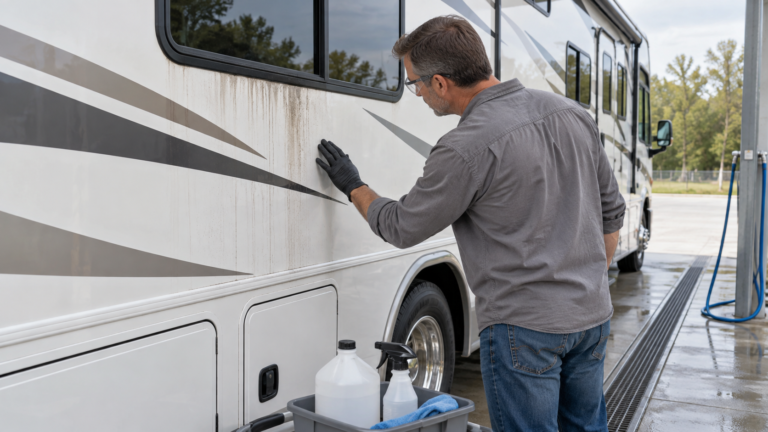
Road Warrior Superior Products: RV Streaks and Surface Fit
Use the soil and surface to decideRoad Warrior C46 is worth investigating for persistent road film or black streaks…
Read guide →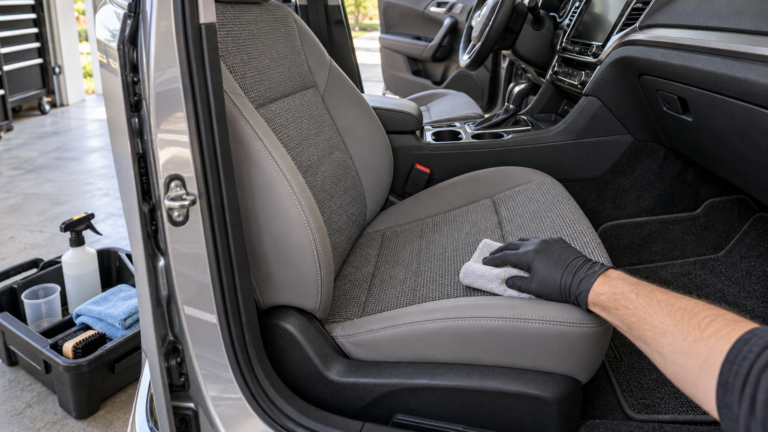
Superior Products Interior Cleaner: Match the Material
Choose the material and cleaning method firstGreen All is a multipurpose concentrate to consider for materials your vehicle maker…
Read guide →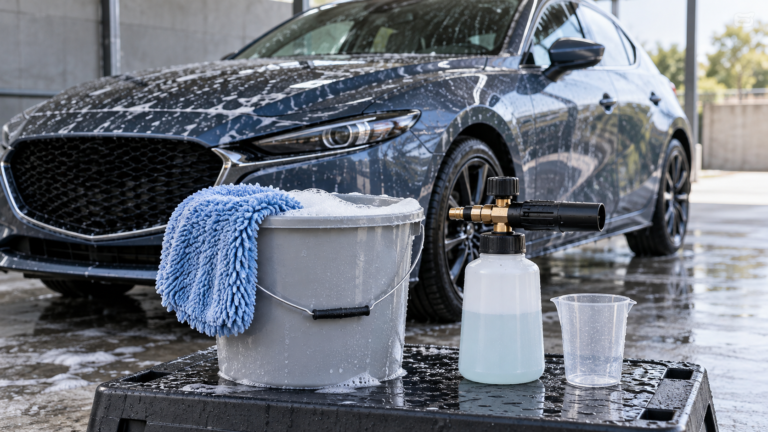
Superior Products Dirt Buster: Hand Wash or Cherry Foam?
Dirt Buster fits a conventional hand-wash decisionDirt Buster C60 is positioned for routine hand washing. Cherry Foam C62 is…
Read guide →