
Commercial disclosure: Some links to Superior Products are affiliate links; we may earn a commission if you purchase through them.
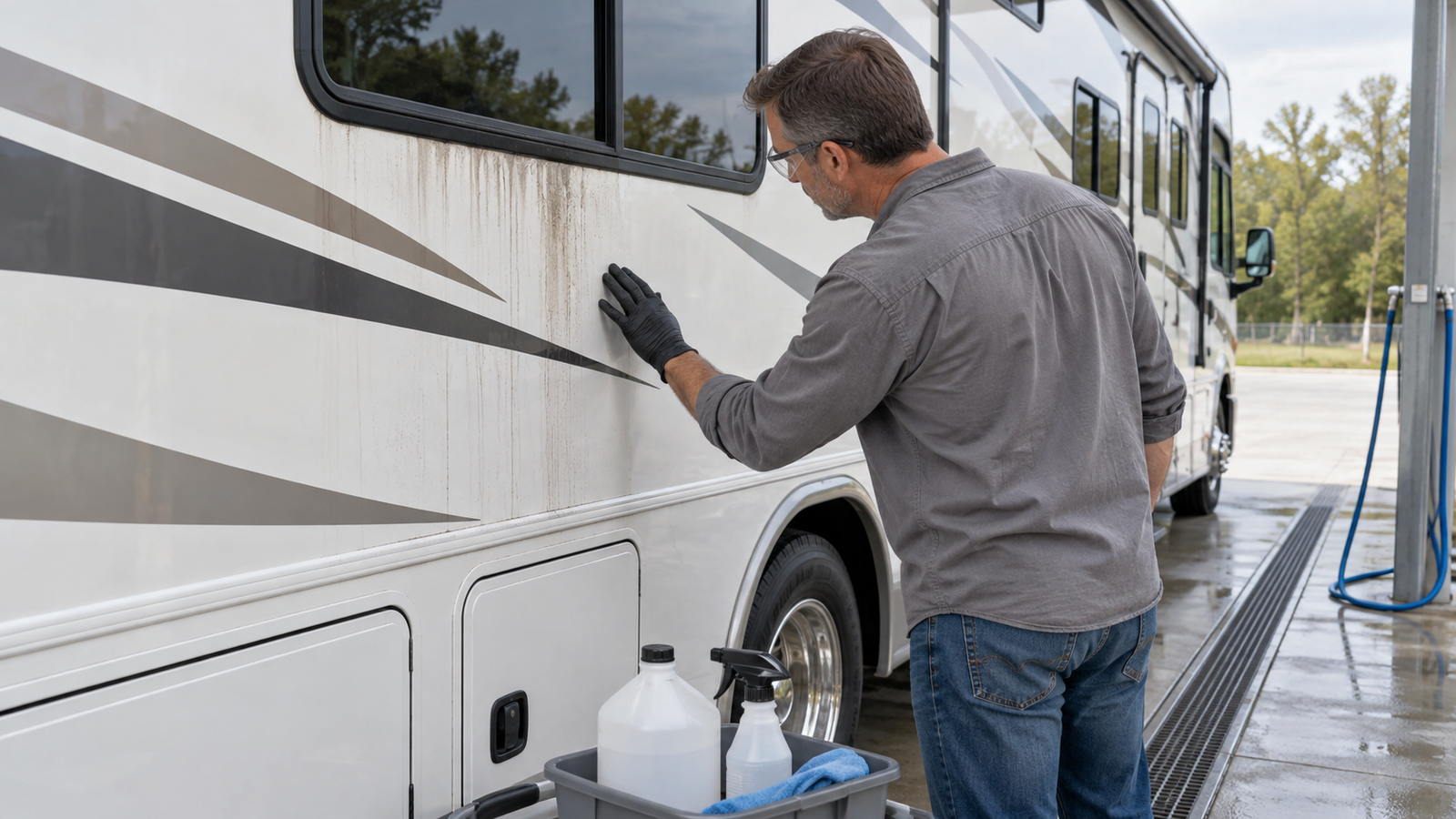
Road Warrior C46 is worth investigating for persistent road film or black streaks on a compatible RV, trailer or other large vehicle. For ordinary light dirt, start with the vehicle maker’s permitted mild wash. For damaged graphics, unidentified coatings or an unresolved chemical restriction, postpone the degreaser choice rather than making the mixture stronger.
A search for Road Warrior Superior Products often starts with a dark streak below an RV window or greasy film on a trailer. The first decision is whether you need stronger cleaning at all. A removable deposit, a stain within a material and a deteriorating finish are different problems; a cleaner is not a demonstrated repair for all three.
Three checks before considering C46
- Identify the finish. Record whether the affected area is painted, gelcoated, wrapped or decorated with decals, including the adjacent surfaces that runoff will touch. If you cannot identify the material, ask the vehicle or graphics supplier before selecting a chemical.
- Inspect the condition. Peeling edges, cracking, chalking or a fragile surface are reasons to seek material-specific care. Do not use apparent dirt as the explanation for every loss of gloss.
- Try the permitted maintenance route. If ordinary soil comes off with the maker’s approved mild wash, an industrial concentrate adds another product to store and another set of instructions to manage.
That is a buying sequence, not a diagnosis of a particular RV. 3M’s December 2024 graphics-maintenance bulletin likewise recommends beginning with the least aggressive suitable cleaning method. Its guidance applies to the specified 3M graphics; your own finish maker may set different limits.
Where Road Warrior’s documented role is strongest
Superior’s C46 listing positions Road Warrior as a water-based, low/non-sudsing soap and degreaser for large vehicles, road film and black streaks, including RV and trailer work. This gives it a clearer purchase rationale for repeated, compatible heavy-soil jobs than for a lightly dusty car.
The seller also makes broad decal and surface-safety claims. Those do not establish approval for an unknown or aged graphic. Its C46 technical sheet itself cautions about wheels without a clear coat, despite broader surface language elsewhere in the same document. Protect nearby materials according to their instructions; compatibility does not stop at the edge of the dirty patch.
3M’s bulletin, power-washing and Series 2080 sections explains that aggressive pressure can lift graphics and gives film-specific restrictions. The Series 2080 section also warns against scrubbing. A cleaner maker’s suggested brush or pressure-rinse method cannot override the graphics maker’s instructions. If the two methods conflict, choose a different approved process.
Why “up to 100:1” is not the black-streak recipe
| Documented task | What the sheet says |
|---|---|
| Black-streak treatment | 50:50 mixture, brush the treated area and rinse. |
| Heavy-duty washing | 3–5 oz per gallon, brush application and pressure rinse. |
| General cleaning | 4:1 is listed; the sheet also advertises dilution as far as 100:1 depending on the job. |
These are statements in the undated technical sheet, not a universal recipe for a current bottle or permission to scrub a wrap. Superior’s general FAQ organizes C46 ratios differently, by soil severity. The current container instructions, the material’s permitted process and the equipment requirements must agree before application.
Do not use the highest advertised dilution to promise a black-streak yield. Equally, do not select the strongest listed mixture because a first wash failed. Ask Superior to confirm the actual task, water-to-product order and bottle version when those are unclear. This guide does not assign a dwell time to an unidentified RV finish.
For an occasional streak, compare a direct-application option
Star brite Instant Black Streak Remover offers a different workflow: its current directions describe applying directly to the stain, allowing 30 seconds, wiping and rinsing, with a second application possible for severe staining. It also requires testing the intended area and places where product may drip.
That makes it worth comparing when one isolated permitted job does not justify storing and measuring a concentrate. The product still needs material approval; its direct-application format does not remove the risk to adjacent surfaces. Its wax-preservation language is a manufacturer claim, not evidence that it preserves more protection than C46 under identical conditions.
For routine dirt, a mild shampoo allowed by the vehicle maker is the more relevant comparison. The Dirt Buster hand-wash guide addresses that separate decision. A persistent mark after the approved process may need a material specialist’s assessment rather than another chemical purchase.
Plan the handling and rinse before buying the gallon
The Road Warrior SDS revised May 28, 2015 classifies the formulation described there as causing skin irritation and serious eye damage. It lists protective measures and a solvent ingredient even though the product is water-based. This historical document does not establish the exact composition of every bottle currently sold. Obtain the matching current label and SDS; water-based and low-foam are not substitutes for that information.
For a large vehicle, the practical question is whether you can complete the permitted application and rinse with controlled runoff. The US EPA’s household car-washing advice favors limiting soap and runoff and considering a commercial wash. That guidance is not approval for a particular degreasing discharge or commercial-fleet site. Choose a location whose wastewater arrangements fit the job.
If confirmed instructions for a permitted task require equal volumes of concentrate and water, 16 fl oz of each produces 32 fl oz of working mixture. This is a conditional yield calculation. It does not establish surface compatibility, coverage or the number of RVs that mixture will clean.
Compare the delivered product price plus the necessary sprayer, applicator, protective supplies and wash-site costs against the number of jobs actually completed. Allow for repeat treatment and unused concentrate. A ready-to-apply bottle can be the better purchase for infrequent use even if its price per fluid ounce is higher. No delivered-price or cost-per-square-foot winner is established here.
Who should proceed—and who should change the plan?
Investigate C46 when repeated heavy road-film work, known compatible materials and a controlled rinse setup justify a concentrate. Compare a targeted direct-application remover for an occasional compatible streak. Stay with a mild approved wash for ordinary dirt. Seek the finish maker’s advice first when there is damage, unidentified material or a conflict between chemical and surface instructions.
Explore Road Warrior and Superior cleaners — affiliate homepage
Sources and scope: US consumer RV/trailer buying guidance checked October 15, 2026. The C46 TDS has no printed revision date; the cited SDS is from 2015. No firsthand removal, gelcoat-restoration, wax-loss or decal-safety testing is claimed. Current exact-container and material-maker directions control use.
Keep researching
More decision guides from the same topic area.
Superior Products Dirt Buster: Hand Wash or Cherry Foam?
Dirt Buster fits a conventional hand-wash decisionDirt Buster C60 is positioned for routine hand washing. Cherry Foam C62 is…
Read guide →
Superior Products Interior Cleaner: Match the Material
Choose the material and cleaning method firstGreen All is a multipurpose concentrate to consider for materials your vehicle maker…
Read guide →
Superior Products Dark Fury: Wheel-Finish Buying Guide
The purchase decisionConsider Superior Products Dark Fury C66 only after identifying your wheel finish and confirming its cleaning instructions.…
Read guide →