
Commercial disclosure: We may earn a commission when you buy through certain links in this article. The equipment comparisons below are based on cited manufacturer and retailer documentation, not hands-on testing.
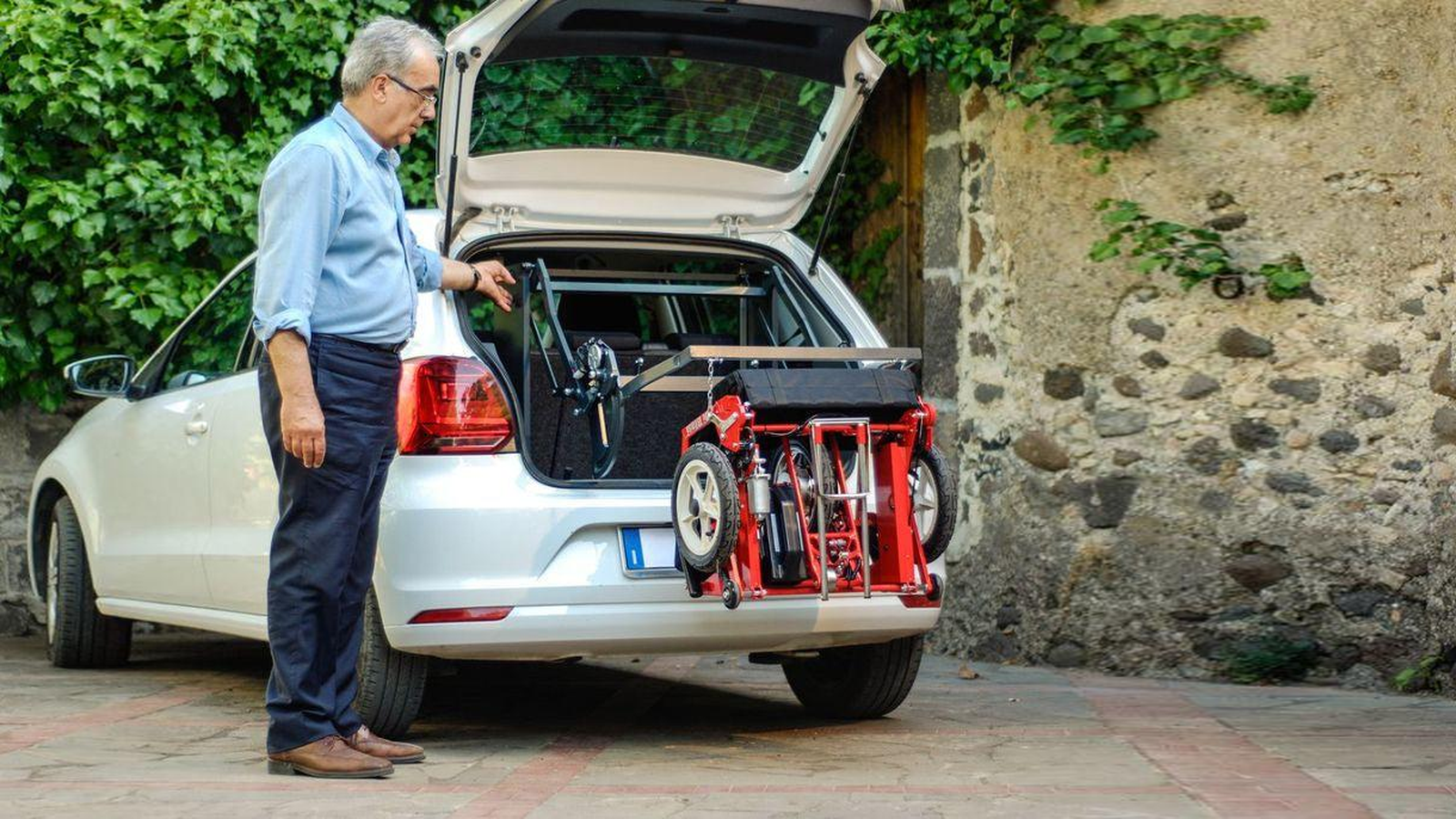
A foldable mobility scooter is a viable portable choice only when its real liftable weight, folded shape, rider fit, handling, and battery setup work for the person using and transporting it. “Automatic folding” means it can fold by a motorized mechanism; it does not mean the scooter loads itself into a vehicle. Compare manufacturer-defined weights on equal terms before choosing a model.
Portable scooters can reduce the space an assembled mobility device occupies, but the shopping labels “lightweight,” “folding,” and “travel” answer different questions. A scooter might fold small yet remain difficult to lift; another may separate into pieces but take more setup; a third may look compact and still have a wide turning circle. This US-oriented guide uses current manufacturer specifications checked October 14, 2026 and treats advertised ranges as controlled-test estimates, not personal-use guarantees.
The four measurements that decide whether portability is real
1. The weight someone actually has to lift
Ask for three separate numbers: assembled weight with the installed battery; weight without the battery; and the heaviest individual component if the seat or frame can be separated. When a product page says “35 lb,” that number may exclude a battery. A removable battery only helps if it is realistic for the user or caregiver to remove and handle it each time.
Think about the full lift: from floor to trunk sill, over the bumper, into the vehicle without twisting, then back out at the destination. An independent demonstration by the actual person who will lift it is more informative than a claimed lightweight category. Do not attempt a lift beyond your safe physical capability; discuss safer loading methods with an appropriate mobility professional or vehicle-access specialist.
2. Folded dimensions in the correct orientation
Record the scooter’s length, width and height after folding—not its driving footprint. Measure the narrowest usable opening in your car, not just the trunk’s interior dimensions. Also measure the shelf, hallway or closet where it will be stored. Some fold-flat systems achieve their smallest height only after removing the seat, which then needs separate storage.
3. Folding effort versus independent use
An automatic mechanism may help someone who finds manual folding awkward. But remote controls, hinges, battery removal and locking mechanisms still need to be operated reliably. If a caregiver handles transport, their lifting and assembly limits matter as much as the rider’s hand strength. Ask the seller for an exact-model video or in-person demonstration; don’t assume an automatic fold eliminates all handling steps.
4. Rider suitability and route conditions
Check seat dimensions, legroom, tiller reach, weight capacity, stability on the intended surfaces, ground clearance, slope limitations and turning radius. Manufacturer maximum range is usually established under favorable conditions; actual distance varies with rider load, terrain, temperature and battery condition. A scooter that is easy to carry but uncomfortable or unsafe to operate is not the right choice.
Three different portable scooter designs worth comparing
The following are documentation-based examples, not rankings or confirmed in-stock offers. The numbers come from the specific manufacturers’ current pages. Because the definition of weight varies, the table explicitly preserves that difference instead of comparing all headline pounds as though they were equivalent.
| Model / design | Documented lift or product weight | Folded package / rider capacity | Decision-relevant trade-off |
|---|---|---|---|
| Golden Buzzaround CarryOn GB120 Manual fold-flat / separable components |
47.5 lb heaviest piece (manufacturer definition; not the complete device) | 12 in folded height without seat; 300 lb user capacity | Lower-profile storage is attractive if a person can handle the heaviest piece and separately store the seat. |
| EV Rider Transport AF+ Remote automatic folding |
49 lb including battery per current model page | 30 × 16.5 × 17.7 in folded; 250 lb capacity | 31 in listed turning radius, but only a 3° maximum recommended climbing angle in manufacturer specs. |
| Monarch Mobility Smarti Plus Automatic folding |
35 lb without battery; 39 lb with battery | 16 × 16.9 × 27.2 in folded; 275 lb capacity | Lower battery-included lift weight than AF+, but 51 in listed turning radius makes maneuvering a separate consideration. |
Interpretation: A buyer needing a low-profile folded unit could find the GB120’s seat-off arrangement attractive. Someone prioritizing one-button folding and tighter turning may investigate the AF+, provided the lift and limited stated slope suitability work. The Smarti Plus illustrates why a lighter published weight does not automatically mean better indoor turning. None of these design differences substitutes for a user-specific handling or safety evaluation.
Golden Buzzaround CarryOn GB120: know what the 47.5 lb number means
Golden’s CarryOn comparison identifies the GB120’s heaviest component as 47.5 lb, its rated user capacity as 300 lb, and a 12-inch fold-flat height with the seat removed. Those values tell you a lot about how the scooter can be transported, but they do not describe the mass or dimensions of every part placed together in a trunk. Confirm whether the buyer can lift the single heaviest piece and where the detached seat and battery will go.
Golden also offers more heavy-duty folding options, but capacity alone does not establish fit: higher-rated equipment may require greater lift effort. This is a design comparison, not a recommendation to select equipment based solely on body weight.
EV Rider Transport AF+: automatic fold with a practical slope question
EV Rider’s Transport AF+ specification sheet lists a 49 lb product weight with battery, a 30-by-16.5-by-17.7-inch folded form, 250 lb capacity and a 31-inch turning radius. Importantly, its maximum recommended climbing angle is only 3 degrees. A buyer facing a steep driveway or regularly uneven surfaces should not treat a travel label as confirmation that this is suitable.
The product is also listed in DME Superstore’s catalog; do not infer today’s stock or shipping date from that page. For an expensive purchase, confirm the exact SKU and promised dispatch in writing. Fold/unfold controls and the safety lock are worth demonstrating before first use.
Monarch Smarti Plus: light weight with a larger turn
Monarch’s US Smarti Plus page makes the comparison more interesting: 35 lb excludes its battery, while the with-battery weight is 39 lb. Its listed folded footprint is 16 by 16.9 by 27.2 inches, and its turning radius is 51 inches. That is a meaningful contrast against the AF+’s smaller advertised turning radius, especially for a user navigating narrow rooms.
This does not mean the Smarti Plus performs worse for every buyer. Its tighter weight budget may matter far more to someone who can use it mainly outdoors and load it into a vehicle only with assistance. Confirm that the exact configuration and accessories are available from the intended seller; brand-level specifications are not a stock check.
Is an “airline approved” folding scooter automatically allowed on a flight?
No. “Airline friendly” is a manufacturer marketing description, not a promise that every airline will accept the scooter or its battery on every aircraft. The US Federal Aviation Administration’s PackSafe guidance distinguishes lithium batteries protected and installed by device design from batteries that must be removed. In the latter case it describes a 300 watt-hour limit and cabin-carry protections, as well as rules for spare batteries; individual airlines may be more restrictive.
Before air travel, send the airline the exact model, battery chemistry, watt-hour rating, battery-removal procedure, and folded size. Ask for written instructions about check-in timing, terminal handling and battery transport, and carry the manufacturer’s battery documentation. The FAA notes that an airline may not be able to accommodate a folded device in the passenger cabin even when transport is permitted.
A seller saying a scooter is 35 lb is not enough. Ask 35 lb in which state? With the battery, without the battery, or as the heaviest separated section? Then measure the folded object and verify how it is actually lifted. Incorrectly interpreting a weight claim can create a costly, nonreturnable fit problem.
Cost of ownership: the scooter is only one part
Build a delivered-and-used cost, rather than comparing promotional list prices: scooter with required battery and charger; extra or replacement battery; suitable vehicle lift or caregiver assistance; delivery or in-home setup; cover or storage; tires and other wear items; potential warranty service travel; and the cost of a return if the product is a poor fit.
For DME Superstore specifically, its detailed published return policy lists a 20% restocking fee for scooter returns and a 30-day window starting at purchase, subject to conditions. A separate return-policy page describes a general 15% fee instead. Because both pages were publicly accessible when checked, obtain a written SKU-specific answer. Return freight and packaging can be especially consequential for bulky equipment.
Its shipping terms distinguish freight from more involved delivery. If you cannot receive, carry or assemble the scooter independently, define the setup service and its price before you compare sellers. A scooter delivered curbside is not necessarily one that is usable inside the home on delivery day.
A five-minute pre-purchase fit worksheet
- Person lifting: who loads the scooter, and can that person safely handle the heaviest component at vehicle height?
- Vehicle dimensions: clear trunk opening and storage volume after accounting for seat, armrests and battery.
- Home dimensions: tightest practical turn, door opening, storage footprint and charging location.
- Use conditions: indoor corridors, permitted slopes, driveway, sidewalk surfaces and weather exposure.
- Rider fit: seating, posture, reach to tiller, foot placement, transfer ability and clinically relevant requirements.
- Air travel: lithium battery Wh, removal procedure and airline acceptance if flying matters.
- Service: who repairs the device locally, how quickly parts can be obtained, and whether the seller supports trial or return after assembly.
When not to buy a folding scooter
A folding model may be wrong if the rider cannot comfortably control its tiller, requires powered seating or specialized postural support, faces slopes or terrain beyond its tested limitations, or has no safe way to lift it. In those situations, discuss alternatives such as a professionally fitted power wheelchair, a transport solution that removes manual lifting, or a local equipment supplier willing to demonstrate multiple configurations. Portable does not mean universally appropriate.
For a shortlist after measuring the actual lift and fit constraints, browse DME Superstore’s mobility scooter catalog and request manufacturer manuals, precise configuration weights, a current written dispatch estimate, and return terms for any specific model. These checks should precede the purchase, not follow delivery.
Method and limits
Manufacturer weight, folded-size, capacity and turning figures are attributed to Golden Technologies, EV Rider, and Monarch Mobility. Air-battery interpretation is based on FAA guidance. Specifications, availability and policies were checked October 14, 2026 for US shopping context; we did not perform lifting trials, product testing, personalized clinical assessment, or real-time stock confirmation. Recheck the exact model revision and purchase terms before ordering.
Keep researching
More decision guides from the same topic area.
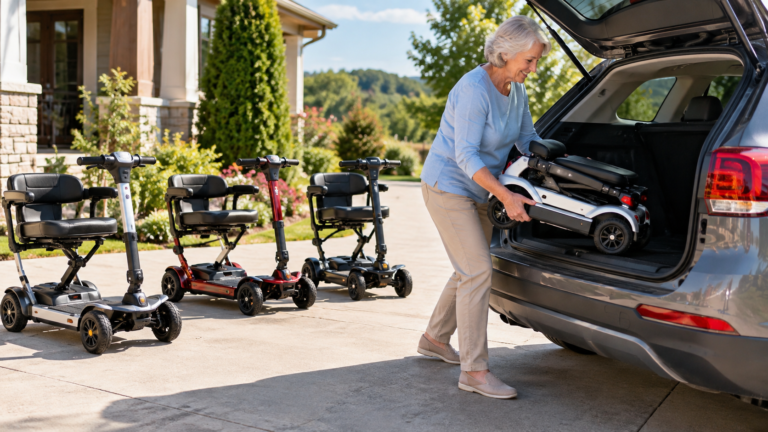
ScootNGo Lite Mobility Scooter: Fit vs Voyager, Flexi & Folo
The ScootNGo Lite is the brand’s relatively simple, key-operated folding model. Its decisive trade-off is not the marketing phrase…
Read guide →
DME Superstore Reviews: Return Risks, Service and Better Buying Choices
The short answer DME Superstore is an identifiable US-facing mobility-equipment retailer, but that alone does not make every purchase…
Read guide →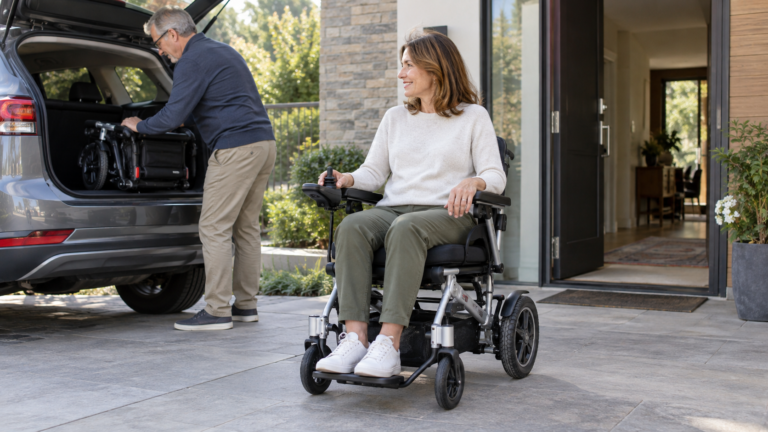
Lightweight Electric Wheelchairs: Compare Lift Weight, Seat Fit and Turning Space
Fit comes before the scale reading The right lightweight electric wheelchair is one the user can safely occupy and…
Read guide →