
Commercial disclosure: We may earn a commission if you purchase through certain links here. The product information is drawn from cited public documents and is not a hands-on or clinical evaluation.
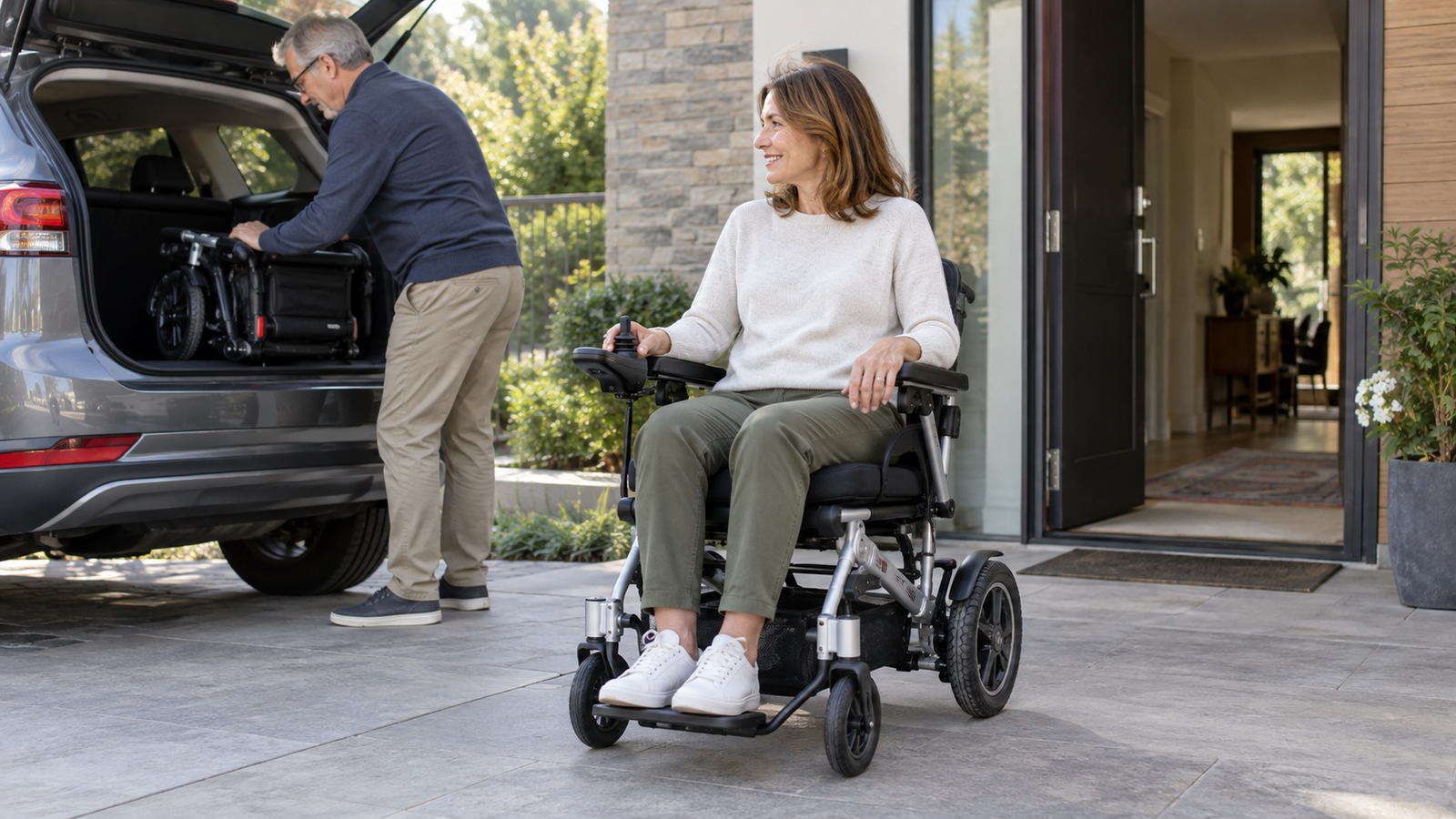
The right lightweight electric wheelchair is one the user can safely occupy and operate and the caregiver can realistically transport. Compare battery-free lifting weight, actual equipped weight, seat width and depth, overall width, turning space, and essential postural support. A folding travel chair can be convenient, but it is not automatically a substitute for a professionally fitted everyday power wheelchair.
“Lightweight electric wheelchair,” “portable power wheelchair,” and “carbon-fiber powerchair” are useful browsing categories, not medical-fit standards. A product can weigh less than a rival and still be the wrong fit because of seat geometry, shoulder position, trunk support, turning constraints or transfer needs. This US-focused guide examines particular manufacturer and retailer specifications checked on October 14, 2026, then turns them into a practical decision process.
First, distinguish three different weights
Weight claims for folding powered wheelchairs frequently refer to different configurations:
- Basic or transport weight: sometimes excludes the battery, cushion, cupholder and other removable items. This may help compare the lightest frame to lift, but only if removing those items is practical.
- Battery-free assembled weight: often includes more components than a bare-frame claim; still not necessarily the mass lifted each day.
- Fully equipped transport weight: what must be moved if the chair is folded as used, with its battery and accessories in place.
The exact manufacturer’s footnote determines which number is being quoted. A caregiver should ask for the weight in the actual configuration they intend to lift, the location of safe lifting points, and whether a loading aid would be preferable. Neither a 25 lb marketing headline nor a 40 lb motorized chair can be declared manageable for a specific person without a real-world handling assessment.
Three model cases show the trade-offs
These are documentation-based comparisons, not tested winners. The two Golden models illustrate different folding and transport-weight designs; the Pride example adds a substantially higher published user-capacity and different seat geometry. All numerical values below are model-specific and should be rechecked for the selected configuration.
| Model | Published transport weight definition | User capacity / seat | Footprint and likely trade-off |
|---|---|---|---|
| Golden Cricket LT Carbon GP309 | 25.8 lb without battery, cushion and cupholder (Golden); DME retailer lists 31.3 lb assembled with battery | 300 lb / 18 × 18 in retailer-listed seat | 24 in overall width and 29.5 in turning radius per retailer specification; side-fold model, but confirm equipped lift weight. |
| Golden Cricket Carbon GP302 | 33.2 lb without battery, cushion and cupholder (Golden) | 300 lb; confirm current seat measurements for exact GP302 configuration before comparing comfort | Top-fold rather than GP309 side-fold; a distinct storage action, not simply a heavier version of identical furniture. |
| Pride Jazzy Carbon HD | 32.2 lb without battery; listed battery weight 7.5 lb | 400 lb / 20 × 20 in standard seat | 26.4 in overall width, 36.4 in turning radius; folded 31.3 × 26.4 × 13 in per Pride. |
Do not sort this table from lightest to “best.” The GP309’s base weight is measured with more pieces removed than Pride’s “without batteries” figure, making a headline-only ranking misleading. The Jazzy Carbon HD offers a larger published standard seat and higher weight capacity, but its greater width and larger turn require home measurements. A chair can meet a capacity rating and still lack suitable pressure management or individual support.
Golden Cricket LT Carbon GP309: lighter published frame, smaller seat
Golden’s Cricket carbon collection specification calls the GP309 a side-fold model weighing 25.8 lb when the battery, cushion and cupholder are removed, with a 300 lb rated capacity. The DME Superstore listing for GP309 adds a useful distinction: it lists 31.3 lb assembled with battery, an 18-by-18-inch seat, 24-inch overall width and 29.5-inch turning radius. These are manufacturer and retailer claims, not our measurements.
Why consider it: the relatively light specified frame and compact width could be relevant when vehicle loading and narrower doorways are decisive. Why be cautious: a smaller standard seat is not suitable for every body shape; cushions, footrests, support and transfers may change the choice. Ask exactly what is included in the assembled-weight figure and demonstrate folding with the components the user will actually carry.
Golden Cricket Carbon GP302: a different fold, not just a different weight
The same Golden manufacturer comparison identifies the GP302 at 33.2 lb with battery, cushion and cupholder excluded, and describes a top-fold mechanism rather than the GP309’s side-fold design. A top-fold chair may suit a different storage shape or handling preference; decide using actual folded dimensions and a demonstration, not an assumption that either hinge orientation is universally superior.
The manufacturer’s common comparison lists a 300 lb rated capacity, but it does not validate the fit of a particular individual’s pelvis, trunk, shoulders or legs. Request the GP302’s exact current seat and transport dimensions separately instead of copying GP309 measurements across both models.
Pride Jazzy Carbon HD: greater published capacity, different space requirements
Pride Mobility’s model specification lists 400 lb maximum user capacity, a 20-by-20-inch standard seat, 26.4-inch overall width and 36.4-inch turning radius. It reports 32.2 lb without batteries and a 7.5 lb battery, and folded dimensions of 31.3 by 26.4 by 13 inches. The manufacturer also warns that published range depends on weight, terrain, battery and testing conditions. DME Superstore has a corresponding retailer listing; however, a listing is not a verified availability or delivery promise.
Why consider it: a higher listed capacity and larger standard seat may bring it into consideration for someone for whom narrower travel chairs are unsuitable. Why be cautious: wider chairs require larger clearances, may turn differently indoors, and still require an individual fit assessment. A higher capacity label does not establish that an individual needs a bariatric chair or that the seat is medically appropriate.
Seat and posture may rule out the lightest chair
If this will be the user’s main chair for long hours, begin with the user’s body, not vehicle logistics. Check seat width and depth, foot support, seat-to-floor height, arm support, trunk stability, pressure-relief needs, ability to shift weight independently, transfers, and safe joystick access. Measure how a suitable chair passes through doors, approaches a table and turns in bathrooms or corridors.
The Model Systems Knowledge Translation Center’s clinical information for power-wheelchair users with spinal-cord injury emphasizes that seating and positioning affect function, comfort, pressure protection and health. That guidance is specific to its spinal-cord-injury context; it is evidence for why individualized seating matters, not a diagnosis or one-size-fits-all fitting rule for every wheelchair user.
If the user has difficulty independently changing position, requires complex lateral or head support, needs pressure-management seating, uses special drive controls, or cannot transfer safely, ask a qualified wheelchair seating team, rehabilitation clinician, or occupational/physical therapist to assess the requirements. A lighter folding chair may be useful as a secondary transport option for some people, but should not replace needed medical seating without an appropriate assessment.
Indoor clearance: measure more than door width
A chair’s overall width tells you whether it can pass a straight doorway under ideal conditions. It does not show whether a person can turn into the doorway from a narrow hall, approach the toilet, reach a kitchen surface, or position for transfers. A manufacturer-stated turning radius is useful for early screening, but real layouts require additional maneuvering space. Measure door openings at their narrowest usable points, add the user’s arm/foot position, and consider the turning path and accessible controls.
For example, the cited GP309 retailer listing specifies 24 inches overall width and a 29.5-inch turn; Pride lists the Carbon HD at 26.4 inches wide and 36.4-inch turn. These differences may affect the shortlist, but neither number constitutes a guarantee of bathroom access. If the chair is medically necessary within the home, professional home-fit assessment is worth prioritizing before ordering.
Battery handling and travel claims need their own check
Portable chair listings commonly say “airline friendly.” The FAA PackSafe wheelchair guidance distinguishes batteries protected while installed from those requiring removal and terminal protection. Depending on that design, lithium-battery limits and cabin handling can differ; airlines may also apply stricter rules or have space constraints. Obtain the exact battery’s watt-hour figure, relevant safety documentation, and the airline’s instructions ahead of departure.
For vehicle use, check folded length, width and height with the chair fully configured, safe lift points, accessible trunk height, and whether a loading aid is needed. Portable does not mean every caregiver can safely handle the weight. Keep folding/locking and battery-removal instructions with the device so the same setup can be repeated reliably.
What ownership and return costs can change your decision?
A realistic comparison goes beyond the chair price: seat cushions or clinically needed supports, spare batteries, replacement charger, vehicle loading equipment, shipping and delivery assistance, repair availability, parts lead times, and any costs of reversing an unsuitable purchase. Have the manufacturer or servicing dealer explain battery exclusions, warranty labor and who handles an immobilized device.
For shoppers considering DME Superstore, its detailed refund policy currently describes a 20% restocking fee for power wheelchairs, subject to conditions, and a 30-day return clock starting at purchase. Yet a second live policy page mentions a general 15% fee. The applicable fee and treatment of an assembled or used chair should be confirmed for the exact model in writing. If the chair is required for daily living, even a permitted return may leave a time-consuming replacement gap.
In the US, do not automatically assume Medicare covers a direct online retail purchase. Medicare’s official wheelchair/scooter page describes medical necessity inside the home, a face-to-face examination and written prescription, along with supplier requirements. Check coverage and network participation before payment when reimbursement is part of the financial plan. Pride also explicitly cautions in its Carbon HD specification that an HCPCS listing does not guarantee reimbursement.
Use this selection sequence before ordering
- Define clinical and functional needs: daily duration, posture, pressure relief, controls, transfers, caregiver assistance and safe operating environment.
- Establish fit measurements: seat width/depth, support dimensions, foot position, overall width and the routes used most often at home.
- Shortlist real models: compare the exact manufacturer’s model/SKU, available seat sizes and documented fold design; do not substitute a similar-looking model’s numbers.
- Validate transport: ask for a weight breakdown by configuration, then test the actual loading motion and folded vehicle clearance with appropriate assistance.
- Validate service: confirm the named technician or support process for the user’s location and whether replacement parts are readily obtainable.
- Validate purchase exposure: get the delivered total, return exclusions, manufacturer warranty, and any insurance/supplier eligibility in writing.
After a qualified fit assessment and a measured transport shortlist, explore DME Superstore’s electric wheelchair listings and request the current manual and exact configuration for any specific candidate. A correct purchase decision is more important than a small difference in headline weight.
Sources, date and editorial limits
Model details are attributed to Golden Technologies, Pride Mobility and the retailer’s GP309 specification; suitability context is drawn from MSKTC, with US air transport from FAA and US payer context from Medicare. Sources checked October 14, 2026. No product was personally tested, fitted or independently weighed. Equipment suitability needs individualized professional judgment when medically significant, and all exact SKU specifications, inventory and terms should be checked again before purchase.
Keep researching
More decision guides from the same topic area.
ScootNGo Lite Mobility Scooter: Fit vs Voyager, Flexi & Folo
The ScootNGo Lite is the brand’s relatively simple, key-operated folding model. Its decisive trade-off is not the marketing phrase…
Read guide →
DME Superstore Reviews: Return Risks, Service and Better Buying Choices
The short answer DME Superstore is an identifiable US-facing mobility-equipment retailer, but that alone does not make every purchase…
Read guide →
Foldable Mobility Scooters: Which One Can You Actually Lift and Store?
Start with the lift, not the fold A foldable mobility scooter is a viable portable choice only when its…
Read guide →