
Commercial disclosure: Some links to Superior Products are affiliate links; we may earn a commission if you purchase through them.
Short answer: finish and formulation decide this comparison
Superior Products Cover All is the stronger candidate when you specifically want a conspicuous high-gloss tire appearance and accept its solvent-based, ready-to-use format. Aqua Gloss F78 is a more flexible choice when you want a water-based concentrate with adjustable shine and more control over the amount applied. Neither is universally “better”; the exact Cover All SKU, your state’s shipping eligibility and safe application surfaces can change the answer.
Looking up Superior Products Cover All can produce more than one product. The name spans aerosol, liquid and lower-VOC presentations, while Aqua Gloss is a separate water-based formula. Before comparing shine or price, identify the part number and package type on the shelf. A high-gloss claim on one variant does not verify an identical formula, shipping rule or safety sheet for all of them.
Cover All is a family of products, not one bottle
Superior’s published tire-and-interior dressing catalog and product listings identify different versions. This matters because “low VOC” is not another way of saying water-based.
| Product and part | Published formulation / format | Implication for the buyer |
|---|---|---|
| Cover All F96 | Solvent-based high-gloss aerosol, ready to use | Convenient spray, but overspray, aerosol hazards and state-specific shipping limits matter. |
| Cover All F88 | Solvent-based high-gloss liquid, ready to use | An applicator can give more placement control; the liquid is not a dilute-with-water concentrate. |
| Cover All Low VOC F91 | Low-VOC solvent-based dressing; multiple package presentations | Check the exact aerosol or liquid listing. Low VOC does not establish a water-based formulation or remove the need for label precautions. |
| Aqua Gloss F78 | Water-based silicone concentrate | Adjustable dilution/finish and different unit-cost math; still avoid surfaces where slipperiness is dangerous. |
Source basis: Superior Products’ F96 aerosol listing, F88 technical sheet, F91 liquid description and F78 Aqua Gloss technical sheet. These establish advertised formats, not independently measured performance.
Which tire finish are you actually trying to create?
A glossy tire is a preference, not proof of stronger protection. Standard Cover All is explicitly marketed for a conspicuous high-gloss appearance. Aqua Gloss can be mixed to adjust the finish: the manufacturer’s F78 directions describe dilution from 1:1 to 4:1 (water:concentrate), with less concentrated mixes used to manage finish and cost. At full strength, Superior claims Aqua Gloss can approach Cover All’s gloss, but that is a manufacturer comparison rather than controlled measurement.
Someone seeking a show-car, wet-look sidewall may prefer Cover All’s intended presentation; someone who dislikes very shiny tires is more likely to appreciate Aqua Gloss’s adjustability. For an independent alternative within the same water-based concentrate idea, CARPRO PERL is presented by its US distributor as a tunable water-based dressing with a satin tire mix option. No independent same-tire durability winner is established by those product pages.
The application mistake that changes the recommendation
Keep dressing where traction matters—and nowhere else
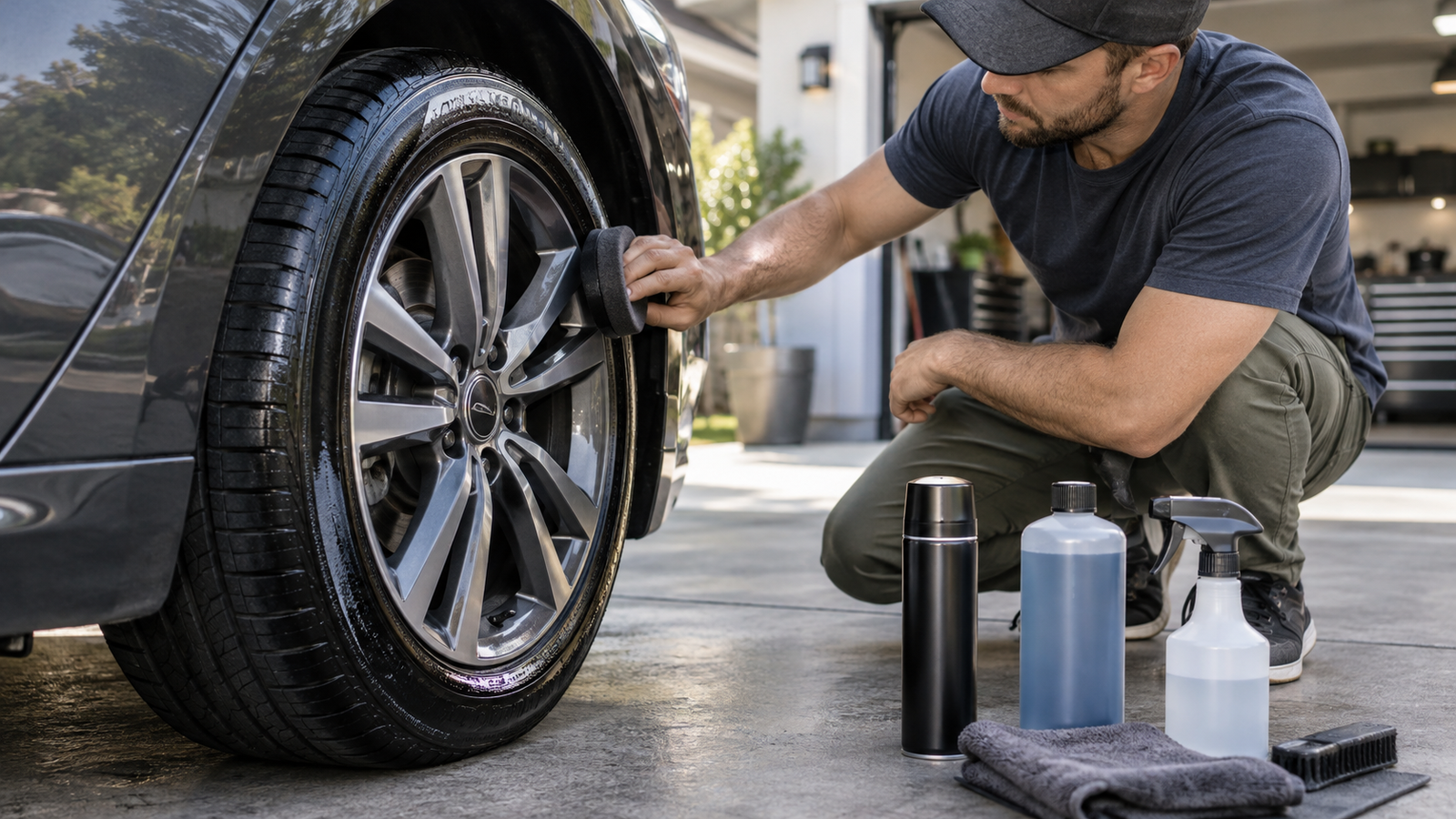
Focus on clean tire sidewalls using the exact product’s directions. Keep tire dressing off tread, brake hardware and surfaces that require grip; do not apply it to pedals, steering controls, floor mats, seats or motorcycle/cycle seats. The Aqua Gloss listing expressly warns against controls and floors where slipperiness is a hazard. For aerosols, pay special attention to wheel, bodywork and ground overspray rather than assuming a wide spray pattern is harmless.
For application precision, the liquid F88 or a controlled wipe-on F78 may be more suitable than an aerosol in cramped wheel arches or around freshly cleaned painted surfaces. That is a practical placement inference, not a test proving which formula slings less. The brand’s “no sling” or “lasts for weeks” statements should be read as claims whose results depend on preparation, amount, drying and conditions.
Check safety and shipping by the exact SKU
The manufacturer-linked F96 aerosol safety sheet, revised in 2019, classifies the aerosol as extremely flammable and documents further health precautions. Its age is material: it establishes what the 2019 formulation’s sheet said, not a verified current SDS for every can sold today. The older F88 liquid SDS likewise reports flammability and serious warnings. Consult the current matching label/SDS and use the stated ventilation, ignition-control and protective measures. These are products for which the precise variant matters.
Availability can also reverse the decision. An indexed version of the F96 checkout page reviewed October 13, 2026 lists states and Washington, DC, to which that SKU cannot be shipped, including California and New York. Live checkout eligibility was not independently confirmed. A separate F91 Low-VOC listing claims broader state compliance. Do not treat that statement as proof of stock, shipping eligibility or legal availability for an unselected package; verify your ZIP code and the exact cart option at checkout. A general Cover All landing page gives a shorter exclusion list than the F96 product detail, so rely on the specific current SKU/checkout restriction rather than the generic landing page.
What do you pay for a finished tire dressing?
Comparing the store’s advertised gallon prices without considering dilution is misleading. F88 is ready to use and its manufacturer sheet explicitly says it cannot be diluted. F78 is a water-based concentrate: its technical sheet says one gallon can make 2–5 gallons of prepared dressing at labeled ranges.
Compare like-for-like usable liquid, not label price
A 16 fl oz F78 concentrate would yield 32 fl oz at 1:1 water:product or 80 fl oz at 4:1, assuming the currently supplied label confirms those ratios. A 16 fl oz F88 ready-to-use liquid remains 16 fl oz.
Calculate delivered package cost ÷ prepared usable ounces. Then account for the different amount applied to each tire, an applicator or sprayer, wasted overspray and unfinished product. The aerosol’s package ounces are not a like-for-like measure of liquid coverage without reliable usage data.
Both claimed longevity and actual usage rates are too variable in the reviewed source material to generate a defensible “cost per tire-month.” An expensive product that delivers a satisfactory finish with less use could still be the more economical option—but there is no independent, identical-condition test available here to award that result.
What users disagree about
One contributor in a public AutoDetailing discussion describes Cover All’s look as extremely shiny and sticky and says that finish does not suit them. That first-person complaint is important because it illustrates a real preference mismatch; it is not evidence that every Cover All package is sticky or that its protective claims are false. Positive product testimonials on seller pages are likewise not controlled wear tests.
Choose by what would make you regret the purchase
- Choose Cover All F96/F88 only if a high-gloss finish is your priority, the exact SKU can be shipped to you, and its solvent/aerosol handling and application constraints are acceptable.
- Consider low-VOC F91 if the standard Cover All format is restricted in your state, but verify the precise package’s shipping rules and SDS. It is still solvent-based according to Superior.
- Choose Aqua Gloss F78 when controllable finish and concentrate economics matter; check labeling and avoid using any dressing on controls or slippery surfaces.
- Compare another water-based option such as CARPRO PERL if a less conspicuous or adjustable tire look is the main goal.
- Buy no dressing when a clean natural-black sidewall is already the appearance you prefer; a cosmetic shine product is optional.
Review Superior Products tire dressings (affiliate homepage)
US consumer-market research checked October 13, 2026. SKU, shipping and ingredient documents differ by package and some linked SDS revisions are older; obtain the current exact-container SDS before use. No independent durability or sling testing is claimed. This article compares tire sidewall dressings, not the separate “Cover All” ceramic coating products.
Keep researching
More decision guides from the same topic area.

Road Warrior Superior Products: RV Streaks and Surface Fit
Use the soil and surface to decideRoad Warrior C46 is worth investigating for persistent road film or black streaks…
Read guide →
Superior Products Interior Cleaner: Match the Material
Choose the material and cleaning method firstGreen All is a multipurpose concentrate to consider for materials your vehicle maker…
Read guide →
Superior Products Dirt Buster: Hand Wash or Cherry Foam?
Dirt Buster fits a conventional hand-wash decisionDirt Buster C60 is positioned for routine hand washing. Cherry Foam C62 is…
Read guide →