
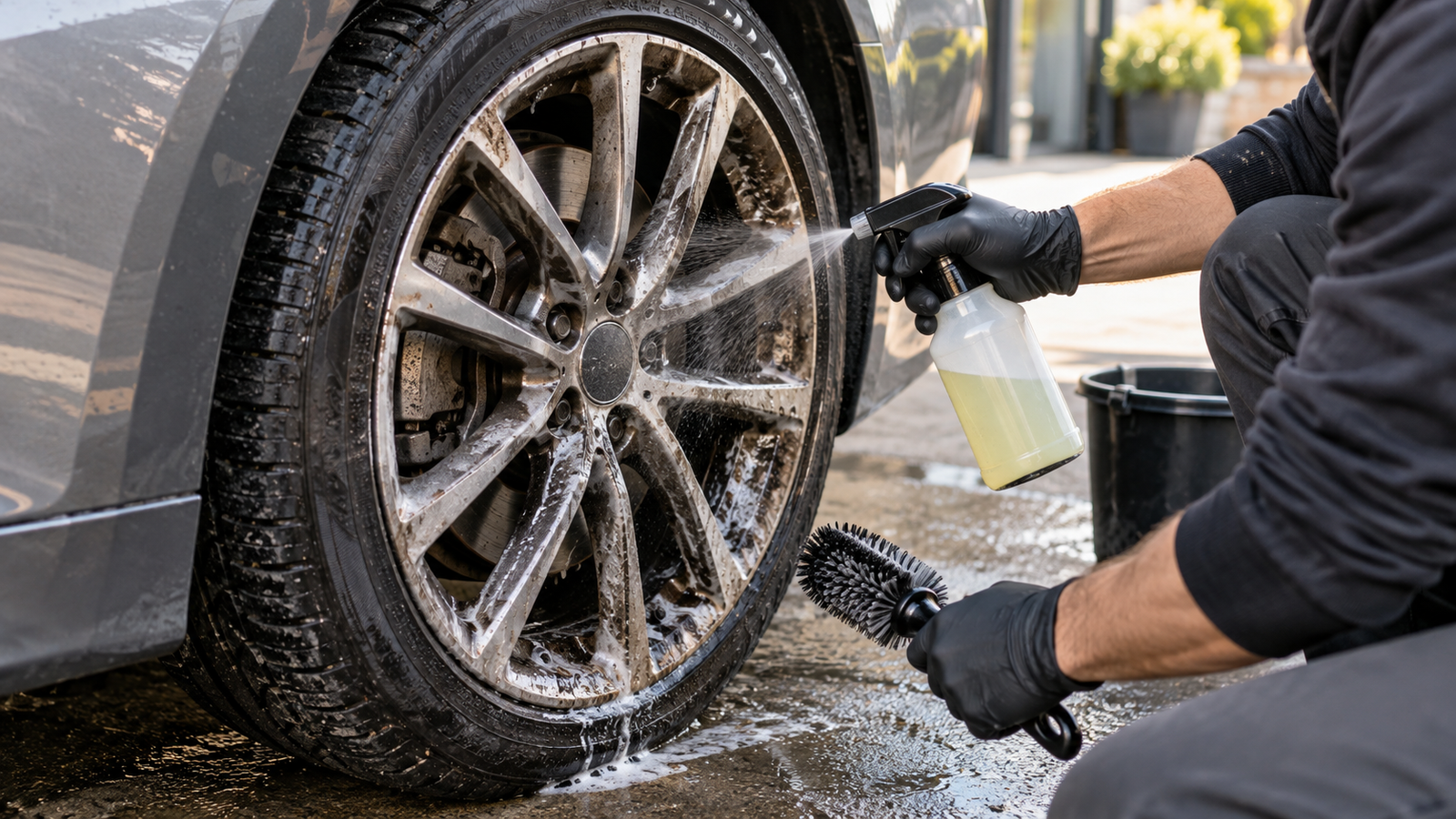
Commercial disclosure: Some links to Superior Products are affiliate links; we may earn a commission if you purchase through them.
The practical answer
Superior Products Dark Fury is worth considering for stubborn grime on confirmed factory-coated wheels when you are comfortable handling a high-alkalinity concentrate. It is not the default choice for unknown, damaged or uncoated polished-aluminum finishes, and it should not be confused with a specialist iron remover. Its non-acid formula is not a low-hazard formula.
If you searched for Superior Products Dark Fury, the important question is not simply whether it removes brake dust. It is whether a strong alkaline cleaner matches the finish on your actual wheels, the soil you are trying to remove and the protection you can realistically use while cleaning. Those three factors can turn an economical concentrate into the wrong purchase.
Start with the wheel finish, not the advertised cleaning power
Superior identifies Dark Fury as C66, a non-acid wheel, tire and bug cleaner. Its C66 technical data sheet describes high-pH cleaning and specifically excludes uncoated polished aluminum wheels. That narrower technical restriction matters more than broad statements elsewhere in the brand’s promotional copy suggesting broad metal compatibility.
| Your wheel / cleaning situation | Buying implication | What to verify |
|---|---|---|
| Factory clear-coated wheel, substantial road grime | Dark Fury may fit its documented use, subject to label directions and safe handling. | The wheel really is coated and the finish is intact. |
| Uncoated polished aluminum | Do not choose Dark Fury for that surface. | Manufacturer’s finish specification. |
| Aftermarket, refinished or visibly damaged coating | Pause; choose a less aggressive, finish-approved option if compatibility is uncertain. | Wheel-maker or refinisher’s chemical guidance. |
| Light routine dust on a known coated wheel | A gentler routine cleaner may be sufficient. | Whether heavy-duty alkalinity is needed at all. |
| Embedded iron fallout remaining after washing | Compare a specifically formulated iron-reactive product; Dark Fury’s dark runoff does not prove iron is dissolved. | Whether the problem is loose soil or bonded contamination. |
This is a finish-and-soil selection matrix, not a test result or promise that any chemical is universally safe. The finish restriction comes from the manufacturer’s technical directions; the purchase conclusions are editorial precautions.
Why “non-acid” does not mean gentle
Read the chemical safety information before you buy
A manufacturer-identified C66 Dark Fury Safety Data Sheet, revised March 18, 2026, classifies the mixture as causing severe skin burns and serious eye damage; it reports a pH of 14. These are concentrate hazard data, not a measured hazard classification of every prepared dilution. The document calls for chemical-resistant gloves, protective clothing and eye/face protection, together with appropriate ventilation and safe storage. Read the current label and matching SDS for the container supplied to you. If you cannot provide the required protection, choose a different cleaner.
A cleaner can be acid-free and still be caustic. That is the central trade-off with Dark Fury: a potent cleaner may reduce scrubbing on suitable surfaces, while inappropriate use can increase the risk to people and sensitive finishes. Do not let product marketing override the container label, wheel-maker instructions or safety sheet.
Concentrate, ready-to-use and the actual cost per cleaning
Superior’s Dark Fury product listing distinguishes the 32 fl oz ready-to-use bottle from concentrate sizes. Its technical sheet gives a 4:1 water-to-concentrate working ratio for concentrate. Under that specific documented scenario, a 1-US-gallon concentrate container yields approximately 5 gallons of prepared cleaner. This is a yield calculation, not an endorsement of stronger or weaker off-label mixes.
Compare the cost of a usable 32 fl oz portion
For a 1-gallon concentrate at the documented 4:1 ratio: 128 fl oz × 5 = 640 fl oz prepared, or 20 portions of 32 fl oz. Divide your actual delivered concentrate cost by 20, then add the cost of an appropriate labeled dispenser, protective gear, water, waste and any unused remainder.
Compare that result against the delivered cost of a ready-to-use 32 fl oz bottle. Do not apply the dilution multiplier to a bottle already labeled ready-to-use.
This calculation makes the purchasing question concrete. For occasional cleaning, the extra storage and safety handling of a gallon can outweigh a lower theoretical cost per ounce. For frequent cleaning on approved finishes, dilution yield can matter more—but only if the cleaner is appropriate for the job.
Dark Fury, a routine wheel cleaner or an iron remover?
Dark Fury C66: consider for substantial surface grime on compatible coated wheels, with the precautions above. P&S Brake Buster: a meaningful alternative when the goal is a wheel-specific brake-dust and grime cleaner; P&S describes its Brake Buster formula as a cleaning gel with corrosion inhibitors. That is a manufacturer description, not independent evidence that it is safer for every finish. A dedicated iron-reactive cleaner: a separate category to investigate if bonded ferrous fallout, rather than ordinary soil, is the remaining problem.
Do not infer that iron contamination is being removed merely because the runoff turns dark: Dark Fury itself is a dark-colored liquid, as the technical sheet documents. Likewise, there is no independently controlled, same-wheel test here establishing that Dark Fury outcleans the alternatives.
What actual users report—and what they cannot prove
In an r/AutoDetailing discussion, some contributors describe Dark Fury as useful for bugs and heavy wheel cleaning, while another says a small ready-to-use bottle did not impress them. A contributor also cautions about the comparatively harsh chemistry. These are individual reports, not laboratory comparisons, proof of finish compatibility or a representative customer survey.
A sensible pre-purchase checklist
- Identify the finish: factory-coated, raw polished, refinished or uncertain? If uncertain, obtain the wheel manufacturer’s guidance first.
- Identify the soil: washable grime versus embedded iron contamination may call for different chemistry.
- Confirm the exact package: ready-to-use and concentrate are not interchangeable. Follow the current container directions rather than internet mixing recipes.
- Check handling and storage: consult the current matching SDS for gloves, eye protection, ventilation and secure storage; keep concentrated chemicals away from children.
- Calculate total cost: actual delivered price, dispenser, protective supplies and expected amount used—not only the headline gallon price.
Bottom line: who should choose it?
Dark Fury makes the most sense for a buyer with known compatible, coated wheels, persistent grime, a reason to use a stronger product and the equipment to handle it safely. It makes less sense for delicate or unidentified finishes, infrequent mild cleaning, or anyone seeking a broadly gentle, foolproof product. If the problem is iron fallout, investigate the appropriate specialist chemistry instead of assuming a dark wheel cleaner does everything.
See Superior Products’ current range (affiliate homepage)
Product-document and source check: October 13, 2026. The 2026 C66 SDS was manufacturer-identified but hosted on a third-party document server; verify the newest safety document with Superior Products before using the product. No independent performance testing was performed for this guide. US consumer purchase context; stock, shipping and seller terms may change.
Keep researching
More decision guides from the same topic area.

Road Warrior Superior Products: RV Streaks and Surface Fit
Use the soil and surface to decideRoad Warrior C46 is worth investigating for persistent road film or black streaks…
Read guide →
Superior Products Interior Cleaner: Match the Material
Choose the material and cleaning method firstGreen All is a multipurpose concentrate to consider for materials your vehicle maker…
Read guide →
Superior Products Dirt Buster: Hand Wash or Cherry Foam?
Dirt Buster fits a conventional hand-wash decisionDirt Buster C60 is positioned for routine hand washing. Cherry Foam C62 is…
Read guide →