
Commercial disclosure: We may earn a commission if you start an eligible subscription through certain links on this page.
PostScan Mail and Anytime Mailbox can both handle incoming U.S. personal mail remotely, but their headline subscriptions conceal different fee rules and local-operator responsibilities. In one published Austin, Texas example, an Anytime Mailbox operator charges much less per open-and-scan request than the selected PostScan Mail plan. That makes scan frequency and the exact mail center more useful comparison criteria than network size or advertised starting price.
This comparison uses publicly visible schedules for two different Austin receiving addresses, plus each platform’s published terms. It is not a claim that the locations are equally convenient, a quote for all operators, or a firsthand service test.
Start with two real Austin locations—not national “from” prices
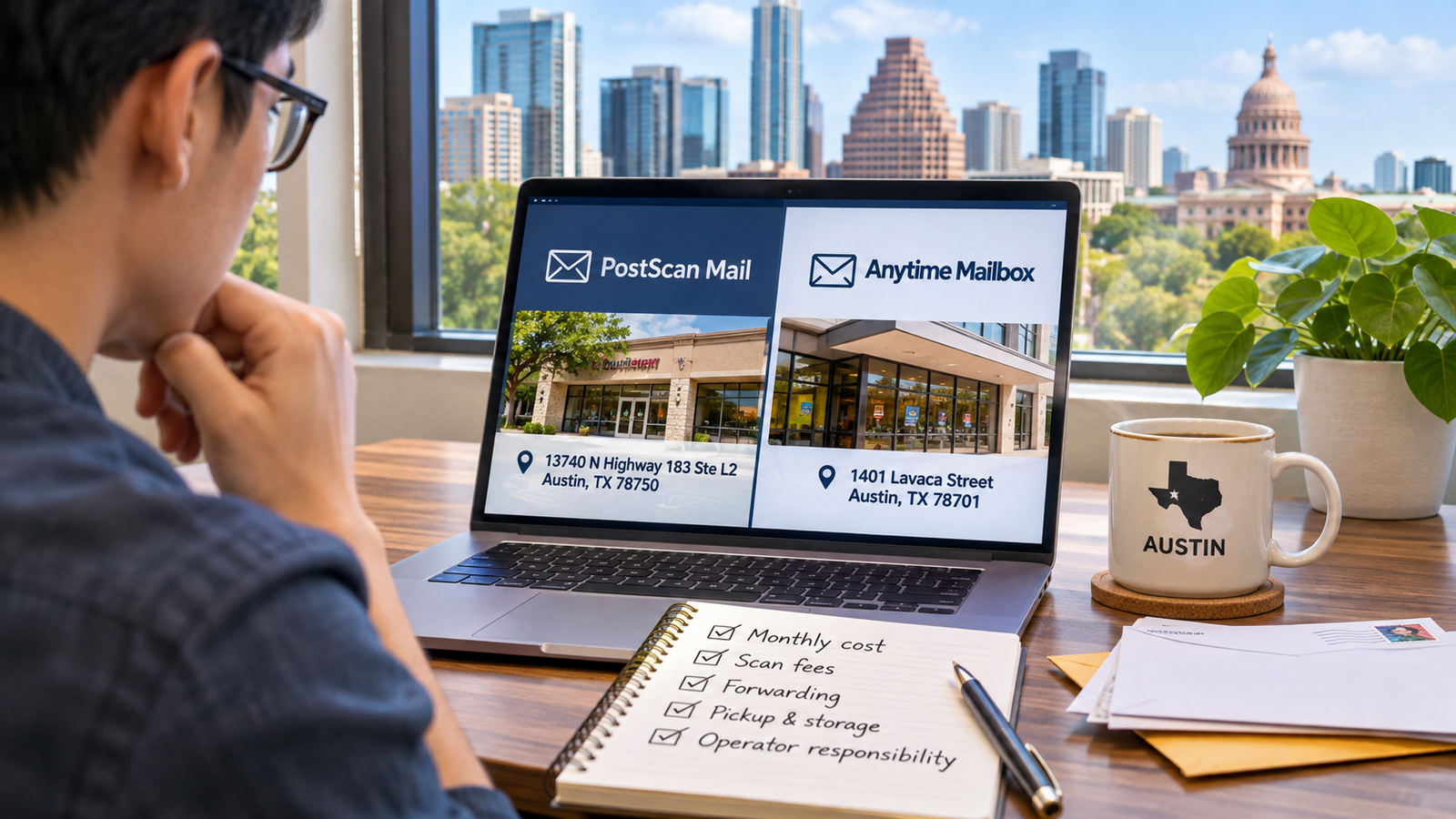
The PostScan Mail listing at 13740 N Highway 183 Ste L2, Austin, TX 78750 displayed a month-to-month Starter plan for $10 (30 incoming items, no free content scans) and Standard for $20 (60 items, five free open-and-scan requests) when inspected on November 9, 2026.
The Anytime Mailbox listing at 1401 Lavaca Street, Austin, TX 78701 identified its operator as PostNet TX234 and showed a Bronze plan for $14.99 monthly, 20 incoming items, two recipients, $0.50 per open-and-scan request and $5 for each forwarding shipping bundle. The location listing also advertises local pickup, although booking conditions and handling exceptions still require confirmation.
| Published offer | Monthly base / allowance | Content scan handling | Forwarding handling |
|---|---|---|---|
| PostScan Austin / Starter | $10 / 30 items | $2 per request up to 10 pages | $2 first item + $0.50 each additional item; carrier cost extra |
| PostScan Austin / Standard | $20 / 60 items | 5 requests included; then $2 each | Same published handling schedule; carrier cost extra |
| Anytime Austin / Bronze (PostNet TX234) | $14.99 / 20 items | $0.50 per request as listed | $5 per shipping bundle as listed; confirm carrier quote |
The two physical locations are in different parts of Austin; neither is a matched street-address substitute for someone who needs downtown pickup. Likewise, the PostScan per-scan price explicitly describes up to ten scanned pages and excess-page fees; the displayed Anytime Bronze listing does not establish every possible page-size charge. Before subscribing, open each operator-specific schedule and PostScan fee list and verify the actual checkout terms.
Where one operator can beat the other: three mail routines
To make the published schedules comparable, the examples below assume 10 arriving personal letters in a month, all within the displayed allowances, with one recipient, U.S. monthly billing, no long-term storage, no extra scan pages and no taxes. These are service subtotals—not observed bills.
| Same 10-letter routine | PostScan Austin | Anytime Austin / Bronze |
|---|---|---|
| 2 requested content scans; no shipment | Starter: $14 | $15.99 |
| 8 requested content scans; no shipment | Starter or Standard: $26 | $18.99 |
| 5 scans; one original forwarded alone | Starter or Standard: $22 + postage | $22.49 + carrier/postage quote |
These differences are math based on two specified listings, not a network-wide price ranking. The shipping example assumes a single item in a single shipment, so PostScan’s handling line is $2 rather than $2 plus an additional-item fee. It also treats Anytime’s listed $5 as a handling charge and leaves actual carrier postage out of both totals. If your chosen operator adds packing, insurance, a scan-page surcharge or pickup fees, the result changes.
The bigger risk: who is responsible when the envelope is missing?
Anytime Mailbox’s renter terms distinguish the digital platform (Bugo LLC) from the independent mail center operator actually receiving and processing physical correspondence. The agreement says the operator is the customer’s CMRA and emphasizes the renter’s responsibility to assess operator reliability and confirm offered services. Its terms are explicit that not every operator must provide every optional action.
PostScan Mail’s terms also recognize independent operators alongside company-managed operations, with limitations around operator handling and carrier handoff. Neither national service description can replace a conversation with the selected staff member who would have custody of your originals.
When a letter is marked delivered but does not appear in the dashboard, which business investigates the physical intake log? When a forwarding label is created but the carrier has no possession scan, which party provides proof of handoff? A good provider should give a concrete escalation process for its actual receiving location, not just an app support email.
USPS’s CMRA guidance makes the physical boundary plain: USPS delivers mail to the CMRA, while the agency is responsible for placing it in the customer’s mailbox or remailing it. The USPS also requires PS Form 1583 and two forms of ID. A virtual-mailbox subscription is not a substitute for identity verification, and no provider’s marketing claims authorize use of that street address as a personal residence or guaranteed bank-acceptable address.
Pickup and storage: two costs a price table cannot settle
Anytime’s Austin PostNet TX234 page lists local pickup, but a listing alone does not prove the pickup window, required advance notice or fee. PostScan states that not all of its locations offer pickup and some charge for it. For someone who routinely collects originals, visiting distance, parking, opening hours and exact counter procedure may outweigh the $7 difference in an eight-scan model.
The terms also require exit planning. Anytime’s published agreement describes how unacted-upon opened and scanned physical originals may create storage risk, and contains specific requirements around termination and post-closure forwarding instructions. PostScan’s contract discusses storage fees, renewal and post-closure mail. Save the operator’s written policy, tell senders the updated address, and arrange any stored originals before cancelling either service.
Choose based on your actual responsibility and cost profile
- PostScan may suit you better when its chosen receiving location is easier to access, the published plan covers your limited number of scans, or a verified higher-tier allowance makes more sense for many incoming items.
- The specific Anytime PostNet TX234 offer may suit you better when you expect frequent short content scans and can confirm that its published $0.50 per-request charge covers your type of documents.
- Neither is ready for important mail when the facility cannot explain Form 1583 approval, missed-item investigations, original retention, identity checks for pickup and the actual postage/handling total.
- Consider a conventional local mailbox when you mostly collect physical letters and do not need them opened or digitized remotely.
A location-level test before moving your senders
- Ask the exact operator to quote 10 letters, 8 short content scans, one forwarding bundle, storage for 20 days and one local pickup.
- Confirm whether open-and-scan pricing covers all pages and whether the selected site handles registered, signature-required, oversized or time-sensitive items.
- Request opening hours, direct location phone, response standard for a missing envelope and proof-of-handoff procedure for shipped originals.
- Obtain the Form 1583/ID process, subscription renewals, cancellation conditions and written terms governing remaining paper.
Review PostScan Mail’s available addresses and plans alongside the actual Anytime Mailbox operator listing. Choose only after confirming the quote and working routine for the particular location you will use.
Source and scope note: Two published Austin location offers, provider terms and USPS CMRA guidance reviewed November 9, 2026. The Anytime operator plan is a displayed listing, not a completed paid checkout. These illustrative U.S. dollars do not establish statewide or global prices, performance or market coverage.
Keep researching
More decision guides from the same topic area.
PostScan Mail Reviews: Real Costs, Local Risks, and Fit
PostScan Mail is worth considering if you want a U.S. receiving address, online envelope previews and a practical way…
Read guide →
PostScan Mail vs iPostal1: Compare Costs for the Same Mail
Which should you choose?PostScan Mail and iPostal1 both offer U.S. receiving addresses with online mail management, but a price…
Read guide →
Closed Captioning Services: What to Specify Before You Order
When hiring closed captioning services for prerecorded video, the deliverable is not simply a transcript with time codes. It…
Read guide →