
Commercial disclosure: We may earn a commission if you start an eligible subscription through certain links on this page.
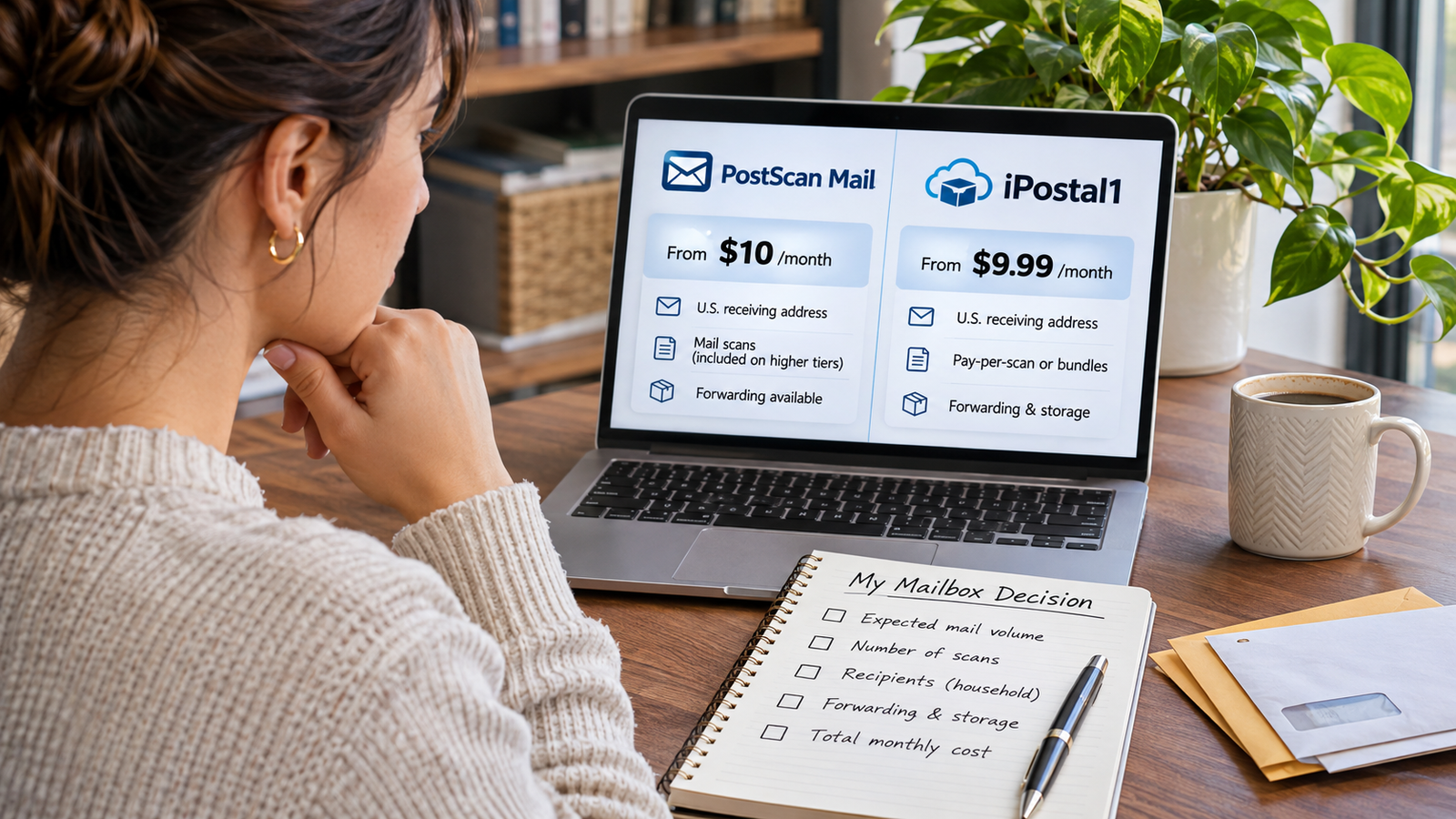
PostScan Mail and iPostal1 both offer U.S. receiving addresses with online mail management, but a price comparison only works after matching the number of arriving items, requested content scans, recipients and physical shipments. At the listed entry prices, neither wins every workload: PostScan Mail’s higher tiers include some scans, while iPostal1 sells individual scans and discounted prepaid bundles. Your exact location’s price and availability can reverse a national-rate example.
This is a source-based comparison of personal-use mailbox subscriptions, not a hands-on speed or reliability test. It focuses on people receiving U.S. personal correspondence—not registered-agent service, corporate office claims or shopping-package consolidation.
The two services are comparable only after you define the job
Both platforms provide a street-style receiving address and digital instructions for incoming mail. But three services frequently get conflated: an exterior image showing that an envelope arrived, an open-and-scan request to read the pages, and a physical forwarding shipment to recover the original. Paying for the first does not mean the other two are included.
In its U.S. price schedule, PostScan Mail distinguishes received-item allowances, included open-and-scan requests and forwarding handling fees. iPostal1’s personal pricing schedule separately lists mail-item allowances, a content-scan service rate and optional order bundles. Read the units, not simply the headline dollars.
A like-for-like monthly comparison
As reviewed on November 9, 2026, PostScan Mail advertised Starter from $10/month (30 items, no included content scans) and Standard from $20/month (60 items, five included open-and-scans). iPostal1 advertised personal Green from $9.99/month (30 items) and Blue from $14.99/month (60 items); its listed single content-scan order cost was $2.25 for up to 10 pages, with discounted nonrefundable advance bundles available. iPostal1 says address class can increase the base fee. Neither provider’s general rate is a verified checkout quote for an unselected location.
| Same illustrative month | PostScan Mail service subtotal | iPostal1 service subtotal |
|---|---|---|
| 20 incoming letters; 2 scans; no shipment | Starter: $14 ($10 + 2 × $2) | Green: $14.49 ($9.99 + 2 × $2.25) |
| 20 incoming letters; 5 scans; no shipment | Standard or Starter: $20 | Green: $21.24 with single orders; $19.99 if buying a $10 five-order bundle |
| 20 incoming letters; 10 scans; no shipment | Standard or Premium: $30 | Green: $32.49 with single orders; $27.99 with a $18 ten-order bundle |
Model limits: all requests in these examples are assumed to be for no more than 10 pages; only a single personal recipient is assumed; all incoming counts fit the displayed allowances; and no taxes, storage, address premium, verification charges or physical shipping are included. The iPostal1 bundle scenarios assume the entire prepaid allocation is purchased and used for the modelled requests; unused bundle value is still cash committed. These are arithmetic scenarios from the PostScan Mail and iPostal1 schedules, not sampled invoices.
Five paid scans can nearly erase the difference between two entry plans. But one expensive parcel shipment, a higher-priced address class, a second household recipient, or repeatedly storing originals can outweigh all the scan arithmetic. Request the actual location’s fee schedule before calling either plan cheaper.
Different trade-offs: incoming volume, recipients and original mail
Incoming volume. iPostal1’s advertised Blue plan covers 60 mail items from $14.99, compared with PostScan Standard’s 60 items from $20. That helps a reader who receives many envelopes but needs few content scans. For scan-heavy routine mail, PostScan’s included requests can matter; iPostal1’s prepaid bundle may still change the result.
Recipient names. PostScan’s U.S. monthly listing includes one recipient on Starter and two on Standard, with an additional-recipient charge on its fee schedule. iPostal1’s personal plan description includes up to six recipient names, but identities and authorization paperwork still matter. Verify how a spouse, child or other adult is processed; do not mistake a price-table recipient allowance for automatic USPS approval.
Getting originals back. PostScan Mail publishes a handling rate of $2 for the first item and $0.50 for each additional item consolidated into one forwarded shipment, plus carrier shipping. iPostal1 advertises carrier options and real-time shipment quotes, but a universally comparable forwarding total for your address and destination was not established from its national schedule. Its physical storage windows also vary by item size. The relevant question is: which center can return your particular original, by when, by which carrier and at what total price?
Location reliability, cancellation and the cost of moving addresses
These are not software-only purchases. PostScan Mail’s terms distinguish company operations from independent mail-center operators and limit the company’s responsibility for independent handling. iPostal1’s mailbox FAQ directs the renter through the chosen receiving center and its verification process. A branch that receives a document slowly can compromise an otherwise appealing monthly price. Verify staffed hours, item arrival logs, scanning turnaround, pickup rules and the escalation contact at both proposed physical addresses.
PostScan Mail describes automatic subscription renewal and generally nonrefundable incurred fees in its contract. iPostal1’s public FAQ describes month-to-month cancellation before the next billing date and a conditional unused-account refund within 30 days; review the contract version displayed at checkout as well. Do not move vital correspondence to either provider until PS Form 1583 and identity verification are ready. USPS explains that a CMRA must handle forwarding after termination and that USPS does not process a change-of-address request from the CMRA, which creates switching friction even if your subscription can be cancelled online.
When the comparison points one way or the other
- Lean toward PostScan Mail: an acceptable local PostScan facility is available and your expected included content scans make its chosen tier a better complete quote than the comparable iPostal1 tier.
- Lean toward iPostal1: you want high incoming-envelope capacity with little content scanning, or its verified recipient allowance and chosen address meet a household need at a better complete price.
- Choose neither yet: the facility cannot document pickup access, original-mail handling, identity verification or cost to forward important mail.
- Choose a simple local option: you only need a physical collection point and rarely need remote scans; a conventional PO Box or staffed private mailbox may reduce moving parts.
Our existing iPostal1 review looks more closely at that provider’s signup and ongoing-service risk; this comparison concentrates on the two-provider purchase decision, not another general iPostal1 profile.
Copy this comparison request to each address provider
- Quote one specific U.S. physical address and monthly or annual billing term, with all address-class premiums and taxes.
- Price 20 incoming envelopes, 5 scans of up to 10 pages, one two-item forwarded shipment and one late-stored package.
- Confirm authorized names, required documents, any separate verification charge and expected setup timing.
- Provide facility hours, pickup fee, accepted carrier services and handling rules for checks and signature-required items.
- Give renewal, cancellation, refunds and post-closure mail-routing policy in writing.
Once you have those two location-level quotes, check PostScan Mail’s address and plan options against iPostal1’s current personal-plan schedule. The correct choice is the one that meets your mail-handling needs after the known add-ons—not whichever homepage says “from” the smaller amount.
Source and scope note: U.S. consumer price pages, provider terms/FAQ and USPS guidance inspected November 9, 2026. No matched local iPostal1 checkout quote, test mailbox or measured handling-time dataset was available; figures are declared schedule-based illustrations and not promises of sitewide prices.
Keep researching
More decision guides from the same topic area.
PostScan Mail Reviews: Real Costs, Local Risks, and Fit
PostScan Mail is worth considering if you want a U.S. receiving address, online envelope previews and a practical way…
Read guide →
PostScan Mail vs Anytime Mailbox: An Austin Operator Comparison
The choice is more local than the brand names suggestPostScan Mail and Anytime Mailbox can both handle incoming U.S.…
Read guide →
Closed Captioning Services: What to Specify Before You Order
When hiring closed captioning services for prerecorded video, the deliverable is not simply a transcript with time codes. It…
Read guide →