

Commercial disclosure: HomeChoiceWorks may earn a commission if you purchase through certain links on this page. Editorial recommendations are based on the decision factors described here.
Font licensing explained for commercial use should start with the finished deliverable, not the font’s price tag. A logo exported as outlines, editable brand templates, live website text, and a mobile app may use the same letterforms but require very different permissions. The practical question is: who needs to use which font file, where, and for how long?
Choose the license for the actual use—not for the appearance of the typeface. For Fontfabric retail fonts, a Desktop license ordinarily addresses static logo/print design, while embedding live font files on a website calls for a Web license with domain and traffic conditions. The exact EULA and invoice control; a free font, a test-only trial, and a paid retail font are not interchangeable.
Start with the output: what permission are you buying?
Fontfabric’s license-type explanation and retail EULA distinguish the contexts below. This is a Fontfabric-specific purchase map, not a rule for every foundry.
| Your deliverable | Likely route to examine | The question that changes the answer |
|---|---|---|
| A logo, packaging artwork or fixed promotional image | Desktop license | How many people need the font installed? Will the client receive only final outlines/images or an editable file requiring the font? |
| Selectable text displayed by a live website | Webfont license | Which domain is covered, what monthly pageview tier applies, and is the term annual or perpetual? |
| A native app with font files embedded | App-specific license | Does the order cover this app and its distribution level? |
| Interactive personalized products generated on a server | Server or custom licensing review | Can outside users create editable text or products? A standard website license may not fit. |
| A video title, broadcast or dynamic digital advertisement | Check the relevant broadcasting/digital-ads terms | Is the text a static exported graphic or is font software being embedded in a separately regulated medium? |
The distinction between a static image and installed font software is easy to miss. Fontfabric says its Desktop license can produce static raster/vector images, but it does not automatically authorize embedding the retail font in a website or app. When a job crosses both activities, check both grants before assuming a single purchase covers the project. Source: Fontfabric’s detailed licensing guide.
Free, trial and paid: three different permission paths
Commercial-use free fonts
Fontfabric publishes a separate Commercial EULA for Free Fonts. It expressly describes permitted uses including logos, fixed artwork, webfont embedding and commercial design, with distinct restrictions on editing and redistributing the font files. The crucial qualifier is which exact downloaded files are covered by that free-font agreement. A free style in a family is not evidence that every paid style inherits the same terms.
Trial fonts
Fontfabric’s Non-Commercial Trial EULA permits internal evaluation but excludes commercial products and public/third-party font embedding without consent. It may be useful for checking a wordmark or interface concept privately, not for handing a finished brand asset to a paying client. Do not confuse a trial with a free file explicitly issued for commercial use.
Retail paid licenses
The paid retail EULA says the selected order form specifies the font, license type, restrictions, duration and other rights. Desktop is offered as perpetual; other types can have annual or perpetual choices, with the term reflected in the invoice. The overview page also contains broad wording about no recurring fees, so do not rely on a generic slogan to interpret a particular order. Read the actual selected term and invoice.
“Free to download” does not prove “free for any commercial use.” “I own the logo image” does not prove “I may transfer or redistribute the font software.” Both conclusions depend on the exact license and delivered files.
Who owns the license on a client project?
Suppose a freelance designer builds a new identity for a small business. There are three separate events: the designer installs the font, the designer exports brand artwork, and the client later edits templates or installs the font itself. Under Fontfabric’s client-use guidance, users who actually install or use its retail font software need appropriate rights, while delivery of outlined artwork alone can create a different situation. The retail agreement’s third-party clauses also address temporary contractors and recordkeeping; the exact order terms should govern any handoff.
Before buying, write down who the license owner will be, whose devices use the font, whether external collaborators need access, and what deliverables will be provided. A client who expects editable PowerPoint templates, live web text and a final logo may need more rights than a client who receives only flattened artwork. Do not assume you may email the font file to the next freelancer.
The four checks worth doing before checkout
- Identify the exact family, style and file. Record whether you selected a free commercial style, a trial or a retail edition. Save the version and source of the actual file.
- List every use. Desktop design, live site text, apps, advertisements, print-on-demand and client editing are distinct questions. If an intended use is missing from the EULA, ask for clarification.
- Match usage limits to the buyer. Count relevant desktop users, covered domains and anticipated pageviews where applicable. For a website, identify who is responsible for future traffic increases.
- Keep evidence. Save the EULA as supplied at purchase, the order form/invoice, licensed owner, font file identification and written clarifications. This makes later agency handoffs and redesigns easier to evaluate.
For retail webfonts, Fontfabric’s Webfont section says a domain must be named and traffic above the selected pageview limit for two consecutive months requires an upgrade or new license. That is different from assuming “one website” means unlimited reach.
When an open-license font is the better decision
If the project mainly needs a clean, usable typeface and the budget or handoff complexity is tight, start with a genuinely open-license alternative. The SIL Open Font License explicitly permits commercial logo, artwork and website uses for fonts released under its terms, subject to its conditions. Google Fonts also states its catalog fonts are open-source licensed for commercial projects. Check the individual font’s license file and language coverage; do not infer that every “free font” on the internet uses the OFL.
A paid Fontfabric family becomes more relevant when its exact drawing, particular styles or licensed deliverables add value you cannot obtain from a suitable alternative. That is a design and permission decision—not evidence that paid fonts are inherently clearer or more professional.
“We need [a static logo / editable templates / live website font], used by [number and type of users], for [named company and domain], in [countries/languages]. We want [specific family/styles] and expect [future handoffs or traffic growth]. Which exact license, term and owner details cover this?”
If the brief points to a Fontfabric retail family, compare the license options before paying rather than selecting the cheapest looking style in isolation.
Review Fontfabric font and license options
What can change after purchase?
A rebrand, new marketing channel, additional designer, domain migration or larger audience can change the rights needed. The cost is not necessarily just the first font purchase: include any additional license scope, new styles, staff access or renewals specified in the actual order. For uncertain client or high-volume uses, obtain written confirmation from Fontfabric rather than inferring permission from the homepage.
Bottom line: define the deliverable, read the agreement for the exact font file, and retain the purchase evidence. A commercial font license is a permission to use software in named ways—not an all-purpose ownership certificate.
Sources and scope: Fontfabric’s licensing help, retail/free/trial EULAs and detailed licensing guidance; the SIL OFL and Google Fonts documentation. Checked November 7, 2026. This guide explains purchase distinctions and is not individualized legal advice. Confirm any consequential rights against the agreement attached to your specific download or order.
Keep researching
More decision guides from the same topic area.

Fonts for Logos: How to Choose a Typeface Before Buying a Family
Good fonts for logos are not simply the ones that look most striking at poster size. A usable wordmark…
Read guide →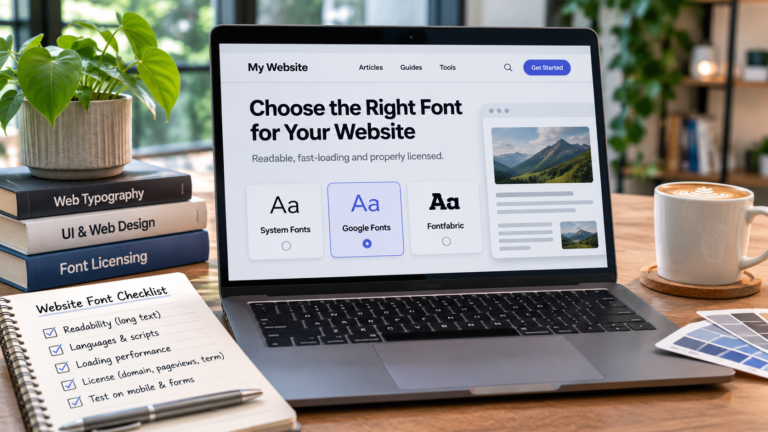
Best Fonts for a Website: Choose for Reading, Loading and License Cost
The best fonts for a website are the ones that keep its text readable, support the languages it publishes,…
Read guide →