Commercial disclosure: We may earn a commission if you subscribe to VirtualPostMail through our referral link.
Choose a conventional PO box when you can collect mail locally and mainly want a separate place for originals. Choose a virtual mailbox when the real problem is reading and managing mail remotely. Package acceptance, access hours and the cost of recovering originals can reverse that choice, so check the exact location and service rather than relying on the address label.
A virtual mailbox versus PO box comparison is mostly a comparison of routines. A physical box solves where mail waits. Remote handling adds decisions about what someone else may open, digitize, forward or destroy. Neither arrangement automatically solves every address-verification need.
The real difference: collecting paper or instructing someone remotely
USPS describes a PO box as a locked box at a Post Office. You or an authorized collector retrieve the paper. A virtual mailbox uses an online account to request work on mail held by a private provider. For example, VirtualPostMail’s FAQ describes remote access but excludes in-person pickup; originals must be shipped.
| Decision factor | Conventional USPS PO box | Virtual mailbox |
|---|---|---|
| Reading the contents | Collect and open the original yourself. | Request content scanning where the provider supports it; an exterior image is different. |
| Getting the paper | Plan a collection visit and check counter or locker access. | Verify pickup separately. VPM uses shipment-only access. |
| Away from the area | A collection or separate forwarding arrangement is still needed. | Remote instructions may suit the task, but originals need an onward route. |
| Private-carrier packages | Some locations offer qualifying Street Addressing service. | Verify the provider’s receiving and forwarding restrictions. |
| What drives cost | Local box size, rental period, and your collection routine. | Subscription plus requested processing and any onward shipment. |
The local-access and package distinctions above follow the USPS PO box guide and USPS premium-service agreement. VPM’s pickup limit is provider-specific; it should not be applied to every digital-mail service.
Do not dismiss PO boxes on an outdated package rule
A blanket claim that PO boxes cannot receive UPS or FedEx packages misses an important exception. The Street Addressing agreement allows qualifying private-carrier packages at participating Post Offices, subject to USPS mailing standards and other restrictions. The feature is not universal. Ask whether your chosen box qualifies, how to write the address and how oversized items are collected.
This can change the decision for a household whose main concern is receiving deliveries without showing a home address. If the Post Office already solves that task and is easy to visit, adding content scanning may offer little value. If the facility lacks the needed feature or counter access is impractical, consider a staffed private mailbox with explicitly confirmed pickup.
An online preview is not someone opening your letter
USPS Informed Delivery can show grayscale images of the address side of eligible letter mail. It does not digitize the enclosed document. If your goal is to recognize an expected envelope before a convenient collection trip, that narrower service may be sufficient. If you need the contents while away, it leaves the main task undone.
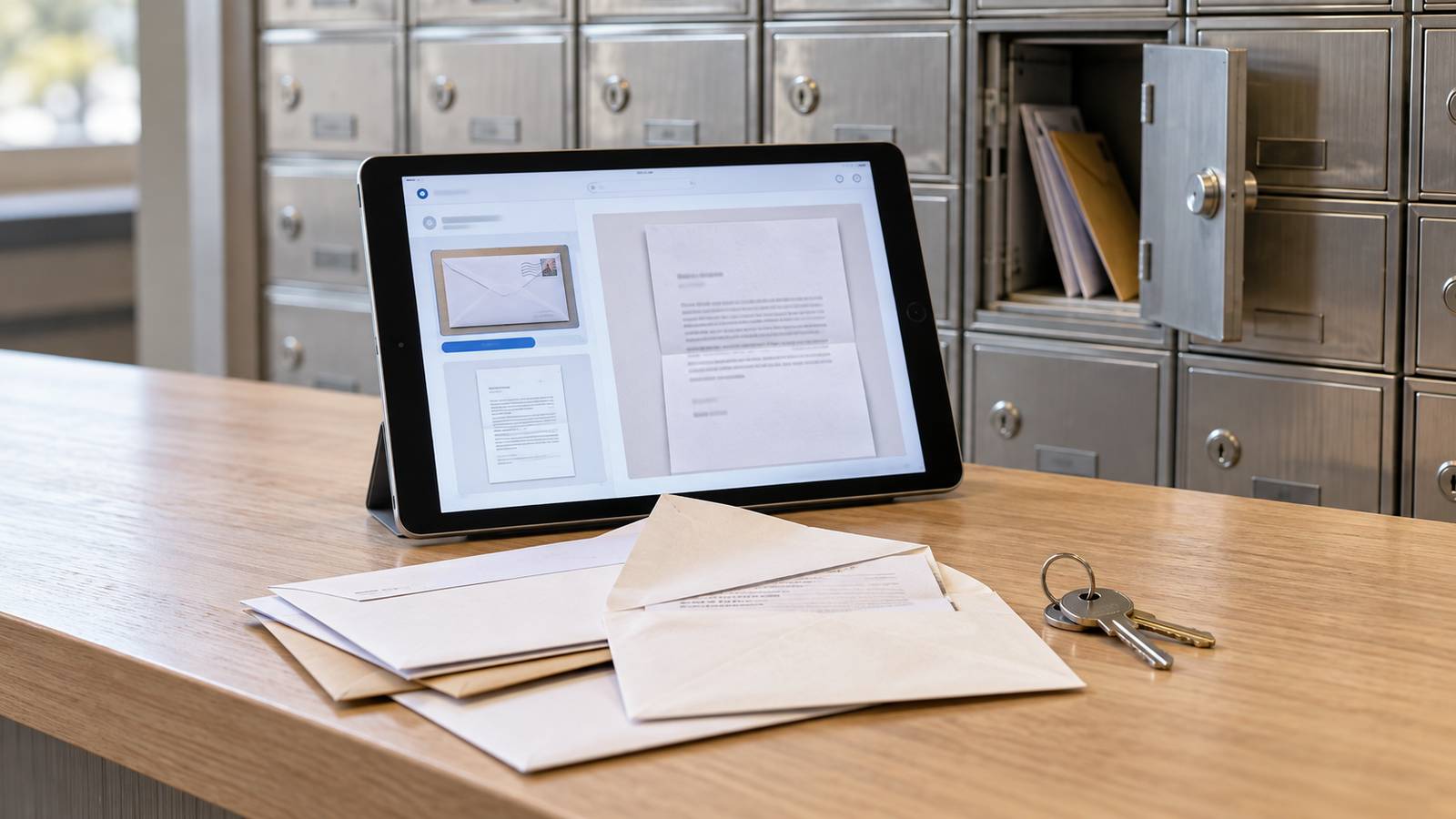
Likewise, an incoming-envelope image in a virtual mailbox is only a triage step. Ask how to request the contents, which documents are excluded and what happens to the paper afterward. Do not choose a subscription simply because the dashboard looks like it contains “all your mail.”
Price the route to the original, not just the rental
USPS fees vary by box size and fee group. In the Notice 123 price list effective October 4, 2026, a size-1 competitive box is $80 for six months in group C37 and $170 in C30. Those are fee-group examples, not quotes for a selected address. Their approximate monthly equivalents are $13.33 and $28.33; the listed charge is for a six-month period, not monthly billing.
For a useful comparison, obtain the actual local box quote, then add any extra journeys, paid collection help and separate forwarding. For remote service, obtain a quote for your incoming envelopes, documents to open, recipients and original shipments. VPM’s shipping explanation bills forwarding separately from the plan; do not assume a subscription covers getting paper back.
Consider two hypothetical routines. A weekly grocery trip already passes the Post Office: the extra effort of collection may be small. A monthly trip requires an hour-long detour: the nominal rental leaves out a substantial practical burden. Neither example proves one service cheaper; it shows which missing cost you need to estimate.
If you need most originals promptly, remote handling may create a second delivery leg for almost every important item. Compare that burden with local collection before choosing. If you only need occasional originals, scanning ordinary correspondence and shipping selectively may be more workable.
Check setup and address purpose separately
A PO box requires its own application and identity check: use USPS Form 1093 instructions. Private remote-mail services use a different authorization process. Do not follow a commercial mailbox tutorial as though it were the PO box application.
A street-looking mailing address is also not proof of residence. USPS’s Street Addressing agreement explicitly limits use as a physical residence or business location in legal documents. For any bank, licensing or other address requirement, ask that organization what it accepts; neither a seller’s description nor this service comparison guarantees acceptance.
Which routine fits your household?
- Local, original-heavy mail: start with the actual PO box or staffed-mailbox collection arrangement and check that access fits your schedule.
- Remote, information-heavy mail: investigate content scanning, original retention and a realistic shipment route before selecting a virtual mailbox.
- Mixed local and remote use: verify a service that offers both. For example, iPostal1 documents location-based pickup during business hours, with possible charges; confirm the exact center.
- Only a few recurring bills: first ask senders about direct electronic delivery. A new physical-mail subscription may be unnecessary.
If someone needs an original before a deadline, work backward from collection or delivery, rather than from when an envelope appears online. The carrier handles arrival; the mailbox operator handles intake and requested work; you remain responsible for monitoring instructions and deadlines. Keep those stages separate when seeking help.
VirtualPostMail is one option for the remote-handling side of this decision. Its shipment-only access makes it a poor answer to a walk-in collection problem. Compare the current service terms only after deciding that remote processing is the task you need.
Check VirtualPostMail’s remote-mail options
Sources checked October 15, 2026. U.S. service comparison; no location-specific quote, hands-on test, international shipping promise or residency guarantee. Fees and local features should be rechecked before applying.
Keep researching
More decision guides from the same topic area.

Academic Transcription Services: Choosing a Research-Safe Interview Workflow
Academic transcription services are not merely a way to save typing time. If an interview includes participants, a research…
Read guide →
Podcast Transcription Services: When Human Editing Is Worth Paying For
Most podcasts do not need an expensive transcription subscription just to put words beneath an episode. The real purchase…
Read guide →
iPostal1 Reviews: Costs, Mail Handling, and Who It Fits
iPostal1 is a plausible choice when you need a U.S. street-address mailbox with remote envelope previews and occasional instructions…
Read guide →