
Commercial disclosure: Some links on this page may earn HomeChoiceWorks a commission on qualifying purchases. Prices, delivery charges, and other terms are set by the seller.
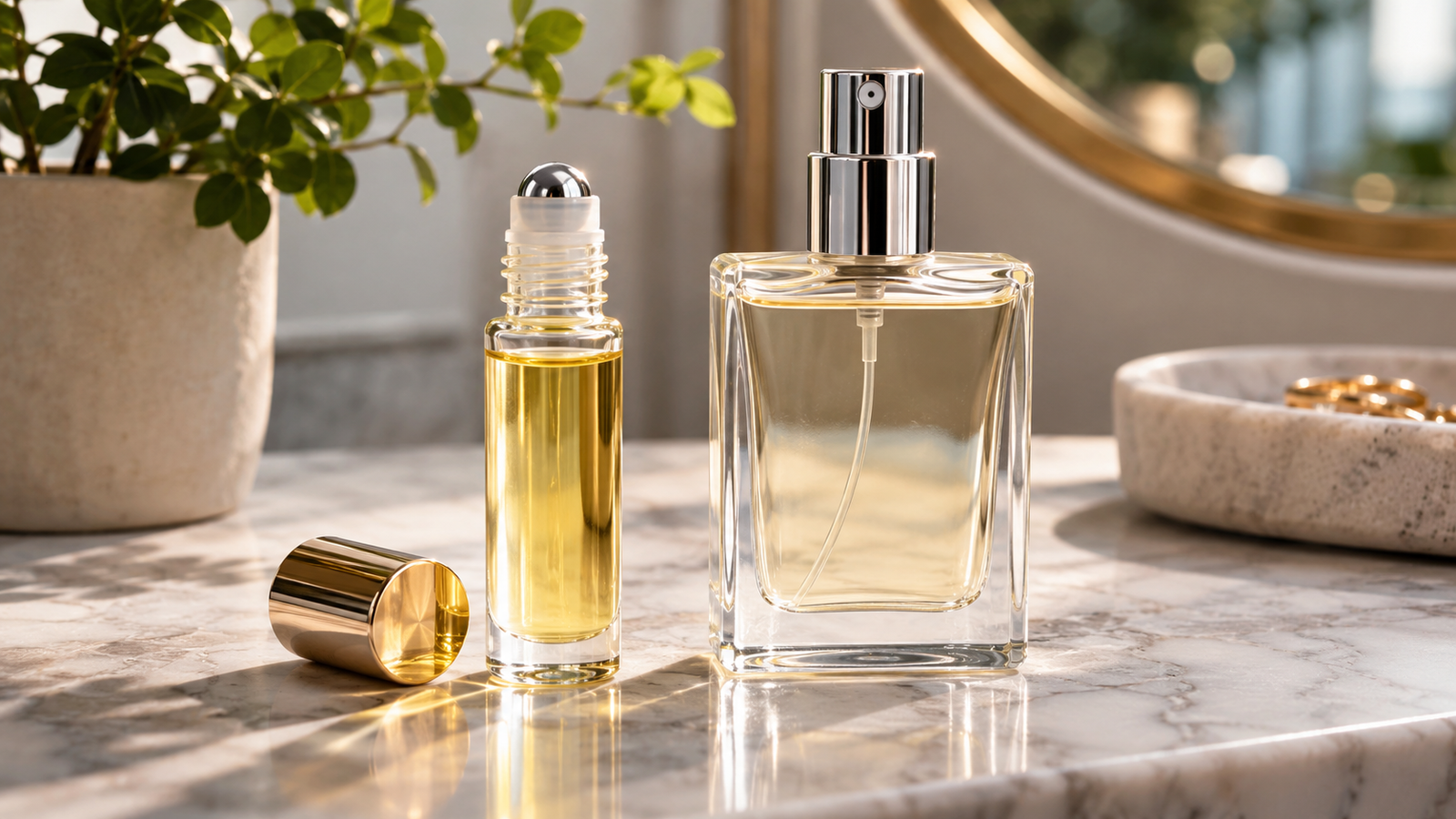
Choose a perfume oil roll-on if precise, close-to-skin placement is more important than spraying a mist. Choose a perfume spray if you want the familiar atomizer application and generally value wider initial scent reach. Neither format automatically wins on longevity: composition, dose, climate and your skin matter, and the same inspiration can behave differently in two finished products.
This guide compares everyday use, not the price of one particular designer fragrance. For a useful like-for-like illustration, Generic Perfumes offers both roll-on and spray selectors on its Santal 33-inspired A+ product page. These are its interpretations—not Le Labo’s original fragrance. Product options and availability were inspected November 9, 2026.
The format comparison that actually changes your routine
| Question | Roll-on perfume oil | Perfume spray |
|---|---|---|
| How is it applied? | Applicator deposits product on selected skin areas. | Atomizer distributes a mist; application is faster over a broader area. |
| Who controls the placement? | Useful when you want to apply a small amount very precisely. | Useful when you prefer a familiar, less targeted spray routine. |
| Will other people smell it? | Often a closer-wearing choice; still depends on formulation and how much is used. | A mist can create more immediate reach; not a guarantee of stronger all-day wear. |
| Fabric use? | Follow the oil’s skin-use directions; oil contact may stain clothing. | Check the exact spray instructions before fabric use; potential staining still depends on formula and fabric. |
| How to compare size? | Some Generic Perfumes roll-ons are listed in grams. | Sprays are listed in millilitres; do not assume equal numbers equal equal quantity. |
The seller’s own format FAQ says its oils have lower projection and sillage than its sprays, while describing both as long-wearing. Those are the retailer’s general statements, not comparative test results. They do not establish that all oils last longer than all sprays, or even that two specific scents will perform identically.
Projection and longevity are different questions
Projection is how far a fragrance seems to travel from the wearer. Longevity is how long a wearer can still detect it. You can prefer an intimate fragrance that remains noticeable near the skin for hours, or a spray with a more obvious early cloud but a different dry-down. A single “lasts 12 hours” advertisement does not answer both questions, and skin perception changes with environment and repeated exposure.
The method of delivery changes the application experience, but ingredients and the finished formula matter too. A spray made with fragrance and alcohol is not simply an oil diluted by an identical universal recipe. Generic Perfumes describes its spray formulation in its FAQ; the precise composition of your selected product should be checked with the seller if that affects a sensitivity or a buying decision.
A fair comparison uses the same scent reference and a normal day
If both formats of a scent are available, judge the actual two finished products you might wear—not an oil from one profile versus a completely different spray. You can make a simple personal trial without pretending it is a laboratory test:
- Pick the same named scent interpretation and the smallest available oil and spray sizes you can reasonably obtain.
- Use one format per comparable workday. Record your applied amount rather than assuming one roll equals one spray.
- Check the opening, after an hour, after a few hours and at the end of the day. Do not reapply during the comparison.
- Note whether your goal is personal enjoyment close to the skin or being noticed from a distance. These are different preferences.
- Repeat under another normal day if the result changes with temperature, activity, clothing or skin conditions.
This process can inform your own purchase, but it should not be presented as independent evidence for an entire product range. Generic Perfumes also recommends letting newly delivered oils rest in its FAQ; that is a manufacturer suggestion rather than a guaranteed performance improvement. Do not expect resting to correct an entirely wrong scent profile.
Travel, office and sensitive-skin considerations
A small sealed roll-on can be convenient for a targeted touch-up where spraying would be intrusive. A compact spray can be equally practical for a person who finds rollerballs inconvenient. Neither package is automatically leak-proof: cap security and the individual bottle matter more than the marketing name “travel.”
If fragrance on skin is a problem for you, neither oil nor spray is automatically safer. The FDA’s cosmetic-allergen guidance lists fragrance substances among common causes of allergic reactions. Review the actual formula label; avoid known triggers, and seek medical advice if you have a diagnosed fragrance allergy or significant irritation. Do not substitute perfume on clothing for a product-specific safety instruction.
Do not compare “2.5 g roll-on” with “2 ml spray” as equal volumes, and do not compare a fragrance concentrate’s price with a finished spray’s price without accounting for the actual retail format. Grams measure mass; millilitres measure volume. The meaningful cost is what you would spend for the format and size you will really wear.
Use a real catalog example, not an imaginary universal winner
The Generic Perfumes Santal 33-inspired A+ listing shows both Roll On and Perfume Spray as selectable product formats. The product selection interface also lists small roll-on package choices, including 2.5 g. These pages establish format availability at a catalog level; they do not establish controlled side-by-side scent performance or that every size is in stock after changing an option.
For U.S. readers, international shipping can change the economics of trying both. The merchant lists rates starting at $20 and warns of possible customs charges in its delivery terms and FAQ. A two-format trial only makes sense if the delivered price and return restrictions are acceptable; otherwise, first try one format or sample the original fragrance from a suitable U.S. source.
Choose by the task, not the slogan
- Choose oil first when you prefer a deliberately placed skin fragrance and do not need a wide scent cloud.
- Choose spray first when quick atomizer application and an airier first impression are central to your routine.
- Do not buy both yet when the scent itself is uncertain. A small authentic sample or a shop tester resolves a more important unknown.
- Reconsider either if a specific ingredient is unsuitable, the product’s format is mislabeled, or delivery costs dominate your budget.
Compare currently available oil and spray formats
Source note: Manufacturer-specific format statements are attributed to Generic Perfumes’ FAQ, not independent wear tests. Skin-sensitivity context: U.S. FDA. Checked November 9, 2026. No hands-on performance experiment was conducted.
Keep researching
More decision guides from the same topic area.
Generic Perfumes Review: What US Buyers Should Check First
Our assessment for U.S. first-time buyersGeneric Perfumes is a real Kuwait-based retailer offering its own designer-inspired fragrance oils and…
Read guide →
Perfume Oil Dupes: Compare Inspired Oils With the Real Scent
The decision before buying a designer-inspired oilThe right perfume oil dupe depends on what you are trying to learn.…
Read guide →
Hair Oil for Fine Hair: Choose a Formula Without Flattening Volume
Quick decision: For fine hair, start with no extra oil if conditioner already gives enough slip. For a few…
Read guide →