
Commercial disclosure: Some links on this page are affiliate links. We may receive a commission if you purchase through them; check the merchant’s final checkout terms.
NAD+ is an important cellular molecule, but that does not mean every older dog needs an NAD supplement. There is preliminary dog research on specific NAD-related interventions, not conclusive evidence that nicotinamide riboside (NR), NMN or a marketed multi-ingredient product increases lifespan. Compare the exact precursor, target condition, dose disclosure, companion ingredients and veterinary suitability before spending money.
“NAD for dogs” is really two decisions: whether there is a credible, dog-relevant reason to add a product, and, if so, which formulation can be evaluated without confusing mechanism with proven benefit. This US-oriented guide addresses adult and senior dogs, not dosing instructions or treatment of cognitive disease.
What NAD, NR and NMN mean for a dog owner
Nicotinamide adenine dinucleotide (NAD+) is involved in metabolism and cellular signaling. NR (nicotinamide riboside) and NMN (nicotinamide mononucleotide) are different precursor molecules; niacin and nicotinamide also participate in NAD-related pathways. A product described as “NAD+ support” may contain precursors rather than NAD+ itself. Do not compare products solely on a front-of-box NAD+ claim when their actual ingredients differ.
The biological hypothesis is interesting, but it is not the same as showing better walking, improved memory or longer life for a household dog. Animal age, underlying disease, concurrent medication and the exact intervention all matter.
What does dog-specific research actually demonstrate?
In a 2024 randomized, blinded trial published in Scientific Reports, 70 senior dogs with mild to moderate cognitive impairment were enrolled to evaluate LY-D6/2, a proprietary combination of an NAD+ precursor and a senolytic. At the three-month primary endpoint, owner-rated cognitive scores differed between treatment groups, with the full-dose group showing the largest improvement. But activity monitors and in-house cognitive measures did not show significant between-group differences; all groups improved on some measures, which the authors discuss as possible caregiver/placebo and study-participation effects. This was not an NR-alone study, and it was not a test of Hollywood Elixir.
Findings involving different NAD-related compounds or disease models must not be extrapolated to a routine for healthy senior dogs. The direct clinical question remains whether a specific finished product benefits a similar pet population.
These studies support investigation, not a blanket conclusion that NAD supplements can make dogs live longer. A human or laboratory NAD result cannot be transferred directly into a canine clinical outcome. Nor does an ingredient’s association with healthy aging prove that a finished multi-ingredient brand works.
| What a label says | What it can establish | What it cannot establish |
|---|---|---|
| “Contains NR” | The product declares a particular NAD precursor and, if quantified, a label amount. | NR itself improved a clinical endpoint in dogs at that dose. |
| “Contains NMN” | A different precursor is present. | The product is interchangeable with NR or provides the same canine evidence. |
| “Cellular energy / healthy aging” | The seller is stating an intended nutritional positioning. | Improved exercise capacity, cognition, disease prevention or lifespan in a pet. |
| “Third-party tested” | A specified lot may have been checked for listed analytes if a matching COA is available. | That biological benefit, long-term safety or treatment effectiveness is proven. |
Where Hollywood Elixir fits into this decision
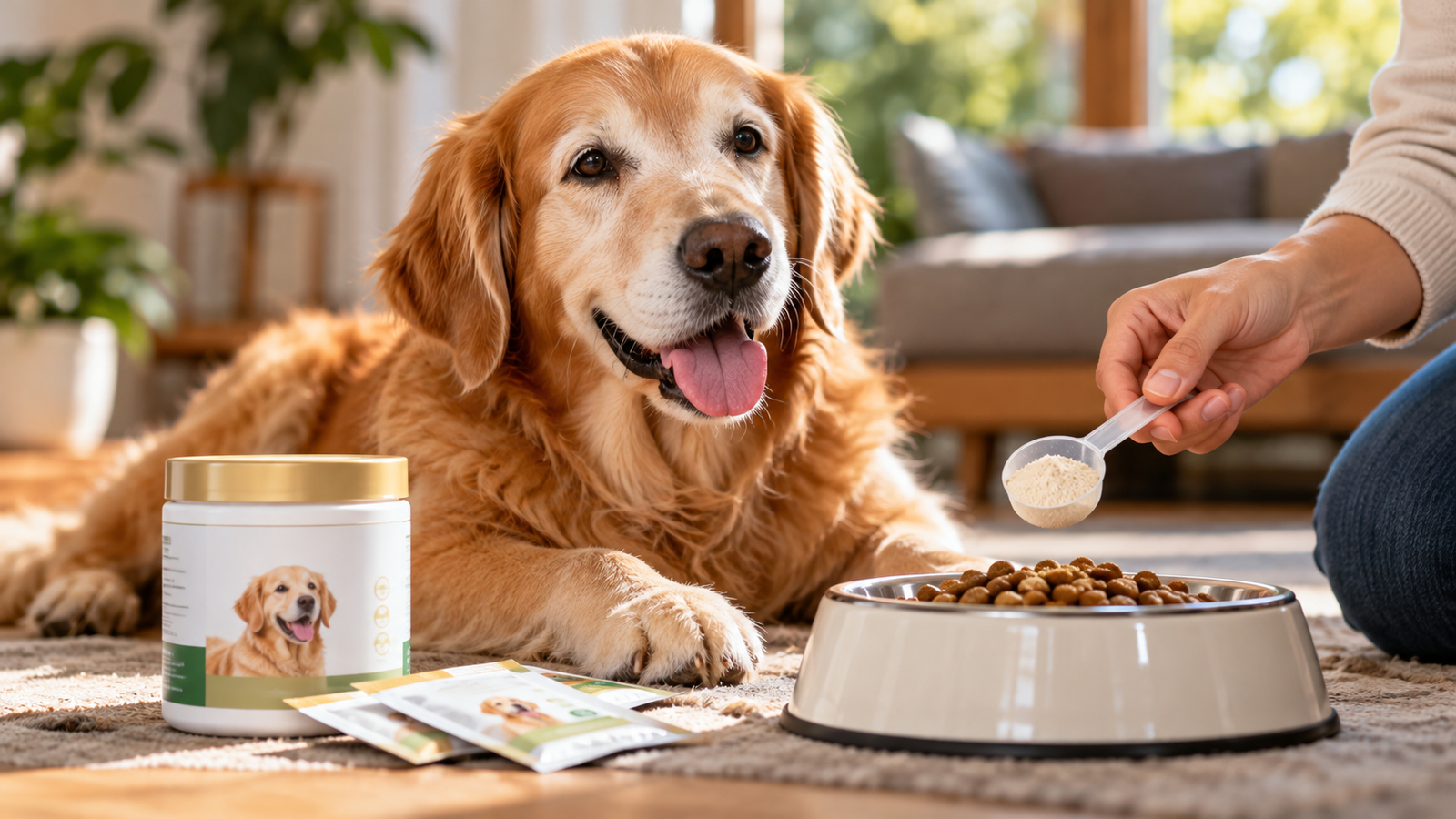
La Petite Labs Hollywood Elixir publishes a standard 2.5 g sachet containing 60 mg nicotinamide riboside and 2 mg niacin, alongside CoQ10 (40 mg), glutathione (50 mg), resveratrol (15 mg), quercetin (25 mg) and additional nutrients. These amounts are seller-declared, not independent evidence of an optimal clinical dose. The multi-ingredient design means it cannot be compared as though it were pure NR; even if an owner observes a change, it may be difficult to attribute that change to a specific ingredient.
The maker markets the powder for adult and senior dogs and cats and describes a weight-band routine: half a sachet under 7 lb, one sachet for 7–30 lb, and two for dogs over 30 lb. The product itself advises veterinary guidance for puppies/kittens and pregnant or nursing animals. This information is a description of the manufacturer’s directions, not a dosing recommendation from HomeChoiceWorks. Confirm with your veterinarian before starting, especially for dogs taking medication or being assessed for changes in behavior or mobility.
Why the cheaper or simpler option might win
First compare with the option of no added NAD supplement. If the actual concern is disorientation, sleep changes, difficulty walking, weight loss or diminished appetite, a veterinary examination and a targeted plan are more actionable than guessing which cellular pathway might be involved. A separately chosen, veterinarian-supported diet or disease-specific intervention can be easier to evaluate than a complex wellness blend.
If your veterinarian specifically wants to evaluate an NAD-related ingredient, request a product that discloses its exact chemical form, amount per relevant daily serving, all other actives, source and quality checks. A single-ingredient product may offer clearer attribution than a complex multi-ingredient powder; that is a monitoring advantage, not proof of superior effectiveness. Do not use human supplement labels to improvise canine doses.
A comparison checklist with no invented potency ranking
- Identity: NR, NMN, niacin, nicotinamide or another named compound? “NAD booster” alone is too vague.
- Evidence match: Does the claimed benefit come from a dog study using that compound and similar subjects—or from cells, rodents or humans?
- Formula complexity: Is it a clean single-ingredient trial or a blend in which multiple components are changing together?
- Label and species: Is the intended animal, body-weight band, age exclusion and other ingredient exposure visible?
- Monitoring plan: Which pet-centered outcome matters and who will evaluate it? A changing owner impression alone can be misleading.
- Money: Which box quantity and serving rate produce a genuine 30-day supply at the renewal price?
For US buyers, the FDA explains that animal food regulation does not equal pre-market approval of every packaged animal-food formulation. A company’s cGMP or batch-testing statement is not an FDA endorsement. La Petite Labs’ refund policy also excludes processed subscription renewals from the first-box money-back guarantee.
How to judge cost without pretending the clinical dose is known
The useful calculation is the actual purchase/renewal price ÷ days supplied at the manufacturer-described serving for your dog. Hollywood Elixir’s options include Lite, Standard and Double and 30- versus 90-sachet formats. One 30-sachet box can represent approximately 60, 30 or 15 days at half-, one- or two-sachet use. That arithmetic describes product consumption only; it does not select a therapeutic dose. Compare ongoing cost only after the veterinarian decides whether the product is appropriate at all.
What a defensible decision looks like
Reasonable to discuss: An adult or senior dog whose clinician understands its condition and medication list; an owner comfortable with uncertainty and with tracking a concrete, appropriate objective. Reason to defer: a dog with new symptoms, complex illnesses or multiple supplements, or a budget that would divert money from proven care. Reason to decline: choosing solely because “NAD+” sounds like an anti-aging guarantee.
If you still want to compare the disclosed NR-containing blend against simpler alternatives, consult the original ingredient panel, lot-level reports and renewal terms. The following commercial link leads to the brand homepage rather than a verified Hollywood Elixir deep link.
Review the disclosed La Petite Labs formula
Evidence boundary: Scientific study checked October 20, 2026; label and US terms checked the same date. Neither the randomized trial nor the canine muscular-dystrophy model is a direct efficacy trial of Hollywood Elixir. This is purchasing information, not a diagnosis, prescription or individualized dose recommendation.
Keep researching
More decision guides from the same topic area.
Dog Training Cost: Online Courses, Group Classes and Private Help
For a U.S. owner choosing dog training, the useful number is the total cost to receive enough relevant feedback—not…
Read guide →
Online Puppy Training: What Videos Teach and What Puppies Still Need
Online puppy training is useful for teaching owners a consistent reward-based home routine, but it does not replace safe,…
Read guide →
Does Online Dog Training Work? Video, Live Coaching and In-Person Help
Yes—online dog training can be a useful way for an owner to learn, practice and get coaching for routine…
Read guide →