
Commercial disclosure: We may earn a commission if you purchase through certain links on this page.
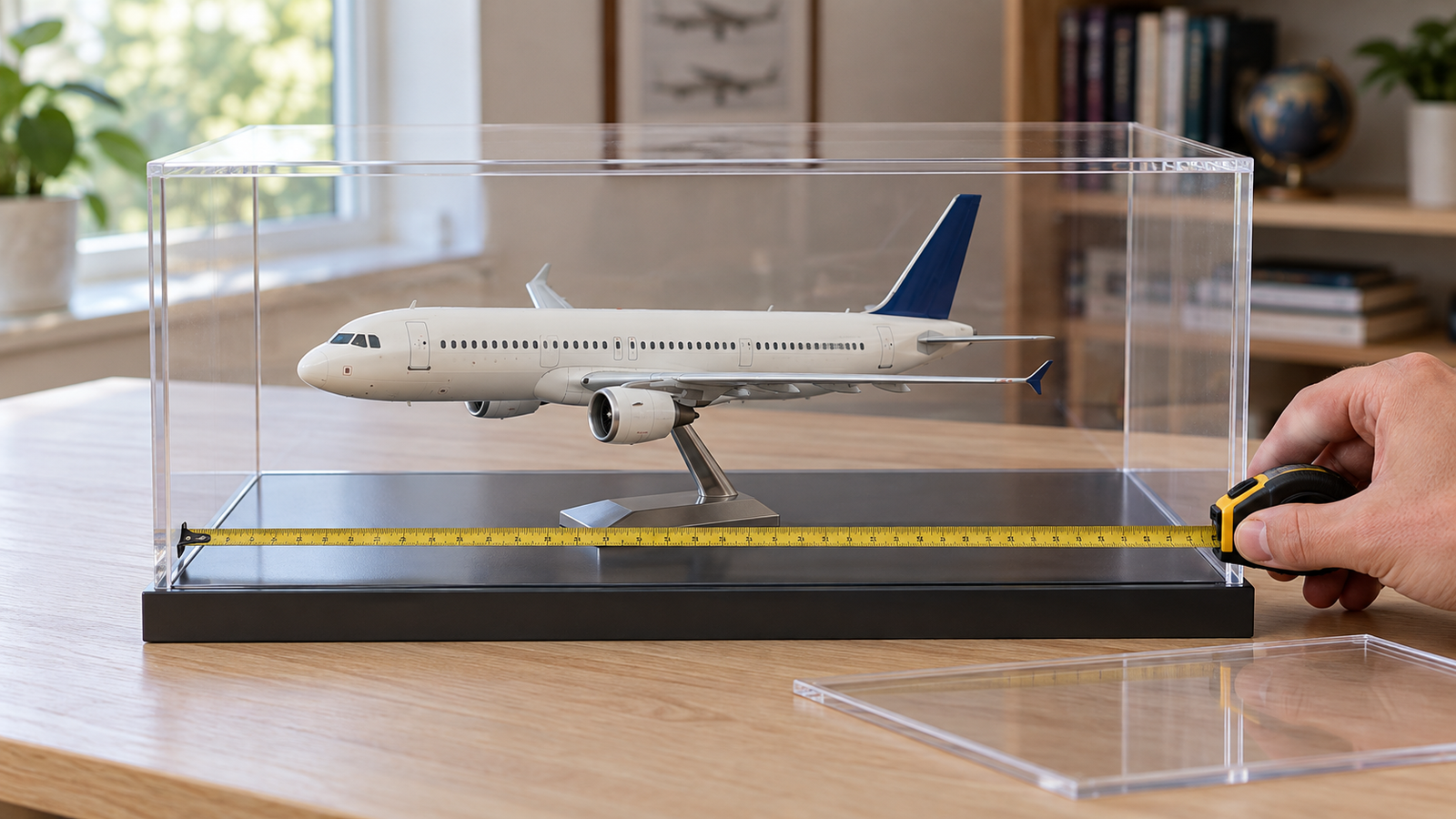
Buy a model airplane display case by its usable inside length, depth, height and door/cover access—not the “1/200” or “1/400” label alone. Measure the aircraft as displayed, including stand, tail, wings and fragile protrusions. A seller’s outside measurements can be materially larger than the space that actually holds the model.
Scope and freshness: This US-oriented fitting guide compares enclosed tabletop aircraft cases, not open diorama mats. Case dimensions and catalog examples were checked on 17 October 2026. Actual owner measurements, stand height, case shelf-load limits and product availability for a specific US delivery address were not independently tested.
The measurement worksheet: five dimensions, not one scale number
Take measurements with the model in the position you intend to display. Write them in centimeters or inches, and compare to the case’s inside dimensions in the same units.
- Length: nose to rearmost tail, including a protruding refueling probe or antenna if present.
- Width: wingtip to wingtip—or rotor-blade sweep when displaying a helicopter.
- Installed height: from shelf/base to the highest tail, rotor or antenna with the actual stand or landing gear installed.
- Base footprint: the stand’s length and width; a pedestal can be wider than a narrow fuselage.
- Access path: whether the aircraft can pass through the door opening or be placed before the cover is lowered without hitting wing tips.
One workable planning allowance is 2 cm (about 0.8 in) of free space on each horizontal side of the aircraft, with additional clearance above the highest point. This is an editorial example—not a manufacturer specification or universal conservation rule. Fragile antennas, a hinged door’s sweep and a removable cover’s approach may require more. Check the case floor and shelf dimensions separately when there is a raised base or internal shelf.
Required usable width = measured wingspan + left clearance + right clearance. For a 19.5 cm wingspan with 2 cm on each side, plan for at least 23.5 cm usable width. Recalculate length and height independently. The case’s exterior width is not a substitute.
What real case dimensions tell you
The US retailer Better Display Cases publishes inside and outside dimensions for individual acrylic case options. For example, its A030B outer 12 × 12 × 4 in case is listed with 11.75 × 11.75 × 3.75 in inside (approximately 29.85 × 29.85 × 9.53 cm); option A071 is advertised with an inner 19.75 × 13.75 × 5.75 in (approximately 50.17 × 34.93 × 14.61 cm). Their numbers are retailer specifications, not our physical measurements. Check that the option code and dimensions still match at checkout.
| Model + cited measurements | Case example + cited inner dimensions | Fit conclusion under 2 cm side clearance |
|---|---|---|
| AirModels Air China 747 1/350: 18 cm long × 19.5 cm span; stand included. | A030B: about 29.85 × 29.85 × 9.53 cm inside. | Horizontal footprint looks feasible: 22 × 23.5 cm including example side clearance. Overall fit unconfirmed until stand-installed height, base and cover access are measured. |
| AirModels XL ANA 747 1/150: 47 cm long × 44 cm span; metal display stand. | A071: about 50.17 × 34.93 × 14.61 cm inside. | Not suitable in the straightforward nose-to-tail alignment: 44 cm wingspan exceeds 34.93 cm inside depth, even without clearance. Rotation should not be assumed to solve the problem. |
| Small or medium 1/72 fighter—dimensions vary by exact subject and stand. | Luxcase LCFM001 at The Flying Mule: inner 9.5 × 9.5 × 5.25 in (about 24.13 × 24.13 × 13.34 cm). | Conditional only. Its listing suggests many fighter types; only the exact assembled model and clearance check can settle fit. Listing shows a November 2026 restock, not immediate dispatch. |
The table is deliberately not a universal scale-to-case chart. Two 1/72 military planes can have different wingspans; two 1/200 airliners may be completely different physical sizes. Further, a case’s outside length can fit your furniture while the inside cannot fit the model, or vice versa.
Single dome, shelf cabinet or custom enclosure?
One removable acrylic cover
A clear cover over a base is a sensible choice for one showpiece if you can safely lower and lift it. It reduces casual dust and touch exposure. The trade-off is access: lifting a large cover over a delicate model may be awkward, and a low lid may strike a tail or stand. Verify how the base attaches, the cover clearance and the weight you must lift.
A multi-level cabinet
A cabinet may suit several small 1/400 aircraft, but the count advertised on a product photograph is not a capacity guarantee. Measure usable space on each shelf, spacing between shelves, door opening and whether a stand makes adjacent aircraft interfere. Confirm shelf-load ratings from the cabinet maker. We did not find substantiated load ratings for the named example cases above, so no safe maximum mass can be stated.
A custom-made enclosure
Consider custom dimensions when a large wingspan, a tall pedestal, wall mounting or a valuable collection cannot be served by stock case options. Supply the fabricator a dimensioned footprint and clearance diagram, and ask for the internal dimensions after base trim, lid overlap and glazing thickness. Custom work may cost more and be harder to return, so obtain a dimensional drawing before ordering.
What does a case actually protect?
A cover can reduce dust and casual handling; it does not automatically make the inside humidity controlled, airtight or UV-filtered. Museums Galleries Scotland’s display-case guidance distinguishes ordinary display cases from conservation-grade cases, which require specific materials, environmental and pollutant controls. This is museum-sector preventive-care guidance—not evidence that an ordinary hobby case meets conservation standards.
Similarly, Gaylord Archival’s exhibition-preservation guidance recommends managing light, dust and environmental swings. It notes that even UV-filtered illumination does not eliminate all light-related risks. For painted plastic, decals and resin, a practical low-risk default is to avoid direct window sun and unstable humid/hot positions. No individual model finish was tested here; ask the case seller for a genuine UV-filtering specification if it matters.
- Cleaning: ask how the case material should be cleaned; acrylic can mark if scrubbed with unsuitable material. Dust the enclosure, not a fragile antenna or undercarriage.
- Support: confirm a stable flat shelf and manufacturer load rating, especially for glass cabinets or wall mounting. Do not stack heavy cases unless the maker authorizes it.
- Long-term storage: preserve the original shipping box and molded supports when practical. A display cover is not necessarily a shipping container.
Does AirModels sell the enclosure?
AirModels’ inspected Military Air Force Tarmac Display Mat is a 30 × 20 cm decorative mat. The listing explicitly says the model airplanes pictured are sold separately. It is not an enclosed dust cover or a case with stated internal height or shelf rating. Although AirModels advertises display accessories, we could not verify a qualifying enclosed case in the inspected merchant catalog. Do not infer that the affiliate retailer sells the case you need; compare enclosure sellers separately.
Before buying a case, collect the model’s exact specifications. If you are still choosing the aircraft itself, AirModels provides listed dimensions for particular replicas—but you should validate stand-installed height and full US delivered cost independently.
Use the model listing to identify its stated length, wingspan and included stand. Then select a separate case using measured interior clearance. This link is to aircraft models, not a verified case product.
Print this case-purchase checklist
- Model measured length, width and height as displayed; stand footprint and clearance noted.
- Case’s actual interior length, depth and height confirmed for the selected variant.
- Door or removable cover opening checked against the aircraft’s widest cross section.
- Shelf/base load rating and mounting instructions verified if required.
- UV/light, humidity, dust and cleaning claims understood, rather than assumed.
- Shipping protection, damage-reporting deadline and return exclusions checked with the actual case seller.
Method note: The dimensional examples combine two sellers’ published specifications and transparent arithmetic; they are not a physical test fit. The missing stand and access measurements are intentional reasons to pause a case purchase until confirmed.
Keep researching
More decision guides from the same topic area.
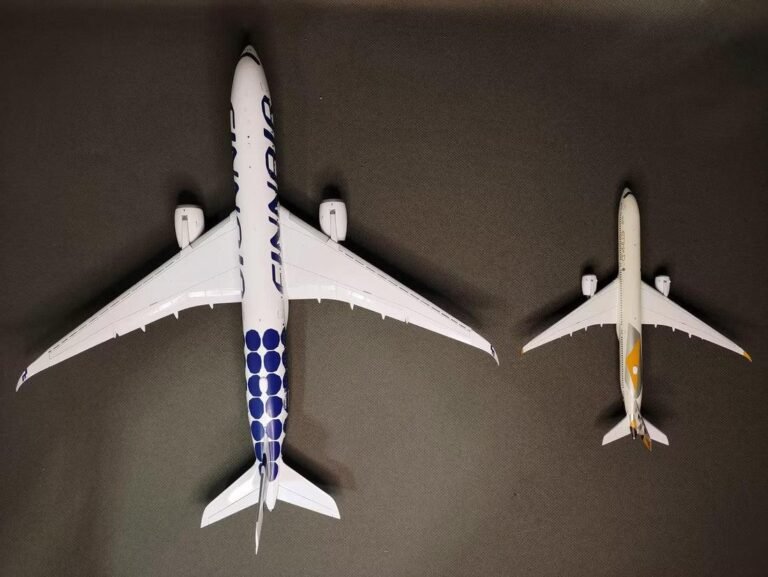
Model Airplane Scales Explained: 1/200 vs 1/400 and Shelf Size
Model airplane scales: the practical answerFor the same aircraft, a 1/200 model is twice as long and twice as…
Read guide →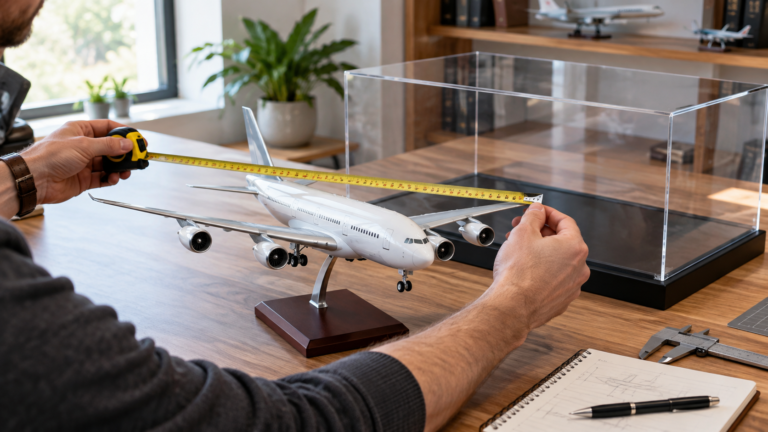
Model Airplane Display Case: Measure the Inside Before You Buy
Model airplane display case: the fit ruleChoose a protective case by the usable internal length, depth, height and access…
Read guide →
Gifts for Aviation Enthusiasts: When a Model Airplane Makes Sense
Gifts for aviation enthusiasts: first choose the kind of giftGive a finished airplane model only if you know which…
Read guide →