
Commercial disclosure: We may earn a commission if you purchase through certain links on this page.
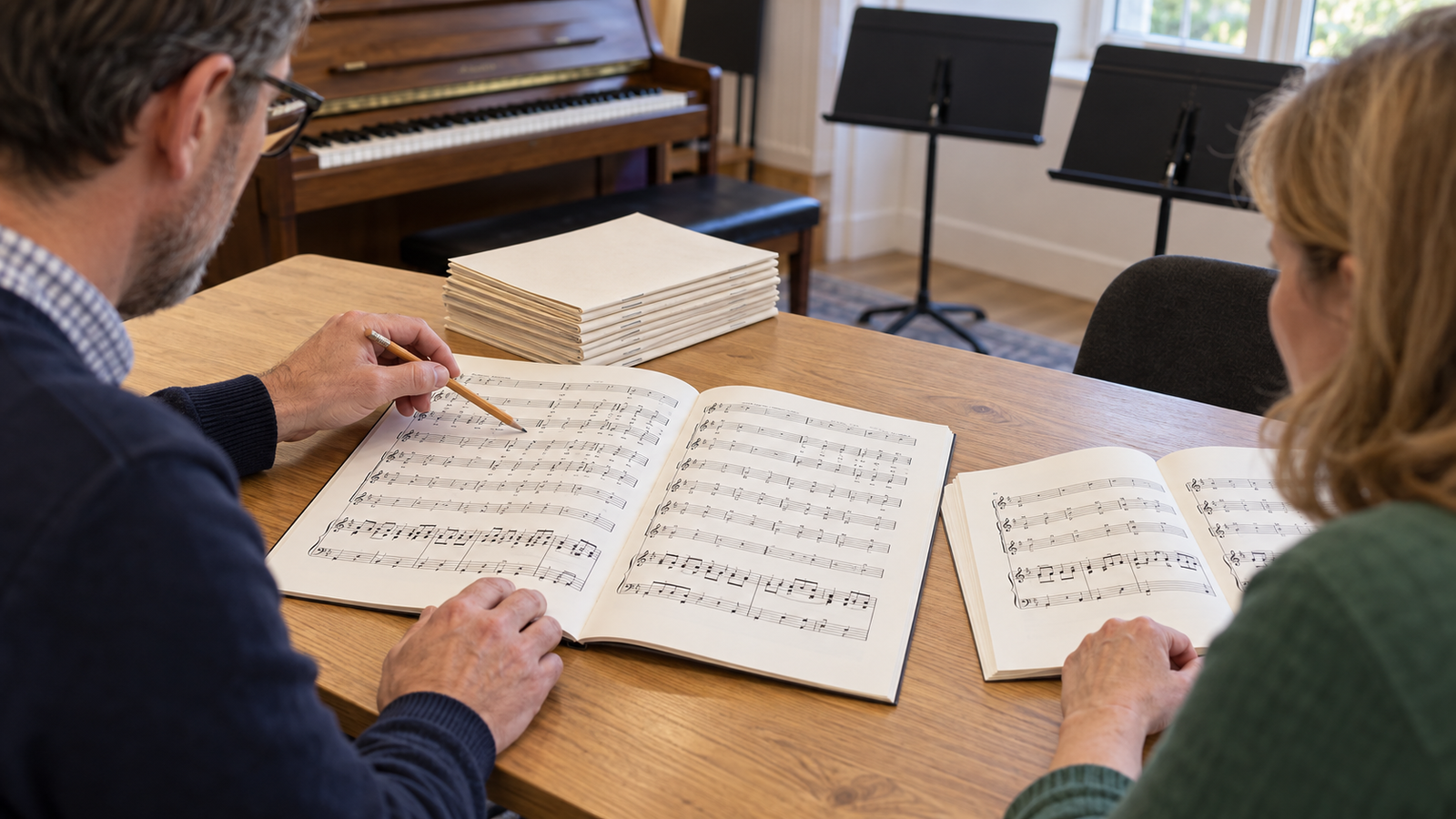
Buying choir sheet music is a group decision disguised as a one-title purchase. A piece may sound right in a recording and still be the wrong edition for your singers: an unavailable tenor section, a high tessitura, an essential piano part you cannot provide, or insufficiently clear rights for the copies your choir needs. The cost is rarely just the number printed beside the download button.
Shortlist an edition only when you can answer four questions: (1) Can the singers cover the actual parts and comfortable ranges? (2) Do you have the accompaniment and rehearsal capacity it requires? (3) Does the publisher offer the number of authorized copies you need? (4) Are rehearsal, copying and any planned public performance covered by the relevant permissions? If the copy/license answer remains ambiguous, pause the order, even if the music looks ideal.
Start with the voices you actually have—not the familiar song title
Vocal scoring is a constraint, not a popularity label. A choral repertoire-selection session published by ACDA Michigan advises conductors to know their ensemble’s vocal range, keep selections generally comfortable, and consider accompanied and a cappella repertoire. That provides a stronger test than a retailer’s genre or difficulty badge.
| Voicing | Practical match | Potential deal-breaker |
|---|---|---|
| SATB — soprano, alto, tenor, bass | Four reliable sections, including a workable tenor line; a common mixed-choir option. | Too few secure tenors or basses, repeated exposed entrances or unmanageable part splitting (divisi). |
| SAB — soprano, alto, baritone | Three-part mixed setting when a separate tenor section is impractical. | The baritone tessitura or leaps still exceed the actual lower-voice singers; three parts do not automatically mean easy. |
| SSA / SSAA — treble parts | Ensembles comfortable in two or more upper-register parts; inspect exactly how lines are distributed. | Insufficient lower-alto support, sustained high lines or four-part independence beyond rehearsal time. |
| TTBB — two tenor and two bass parts | Lower-voice ensemble with enough singers to sustain separate tenor and bass lines. | Divisi or tessitura places persistent strain on either upper or lower group. |
| Unison / two-part | Developing choir or an ensemble for which independent four-part singing is not a sensible first aim. | Part range or rhythm still exceeds the group’s skills, regardless of the smaller part count. |
These are editorial suitability rules, not universal ability rankings. The existence of different catalog families is independently checkable: NotenDownload’s mixed choir, treble/SSA and male/TTBB sections, and J.W. Pepper’s choral voicing and accompaniment filters, show these are meaningful buying categories. The letters alone cannot tell you whether your ensemble can perform a specific edition.
Use the score preview as a five-point rehearsal-risk test
A seller description can identify scoring, key, publisher, length and sometimes a difficulty level; it cannot substitute for your conductor’s reading of the notation. Before buying parts for everyone, check a sample or request the right pages from the publisher.
- Range versus tessitura: note the highest and lowest pitch for each part, then look for where each section spends most of the piece. One isolated note may be manageable while a repeatedly sustained high passage is not. Compare this with your singers, not generic vocal-range charts.
- Actual part density: look for divided sections (SATB with divisi can require more than four lines), difficult independent entrances, exposed solo passages and unfamiliar chordal writing. Count the truly independent lines your rehearsal roster must support.
- Rhythm and language: preview syncopation, meter changes, fast text and pronunciation. A fluent recording can mask substantial practice time for inexperienced singers or a group new to the language.
- Accompaniment: determine whether it is a cappella, piano/organ, guitar, orchestral parts or a licensed backing track. Check whether the product contains the playable part you need—or whether it is a separate purchase.
- Preview completeness: can you see a representative difficult passage and vocal/keyboard scoring, or only a cover? If the seller has no usable preview, request more information before a large group order.
The ACDA Michigan guidance treats comfortable range and accompaniment as repertoire-selection factors. No full edition was purchased or rehearsed for this article; the product examples below are based on the retailers’ publicly displayed listings and available gallery information. Their exact note-by-note ranges have not been independently measured.
Three real listings reveal why identical search terms lead to different purchases
The following are illustrative listings checked October 14, 2026, not independently tested performance recommendations. Euro prices and minimum quantities are merchant-displayed and may change; each link opens the specific informational product page, not an affiliate deep link.
| Edition and listed scoring | Displayed order facts | Your pre-purchase question |
|---|---|---|
| “Thank You for the Music” (Ralph Allwood/Lora Sansun arrangement)
SATB with piano; Hal Leonard; nine-page listing. |
€3.49 each, minimum 10 items displayed; the minimum-price arithmetic is €34.90 before any payment/currency effects. | Can your tenor/bass sections sustain the four-part setting, and exactly how are multiple licensed copies delivered? |
| “New Day” (Niko Schlenker)
SAB with piano/chord notation; Zebe Publishing; English; ten pages, publisher-marked Medium. |
€1.49 each, minimum 15 items displayed; minimum-price arithmetic €22.35. | Can your baritones sing the actual line, and does the delivered accompaniment serve your rehearsal and performance format? |
| “O Come, All Ye Faithful” (Gert Walter setting)
Three-part mixed choir; listing names piano and guitar; one page. |
€3.99 shown; no minimum quantity displayed in the inspected page text. | Does the absence of a stated minimum mean anything about choir-copy permissions? No—ask before making copies. |
These examples demonstrate a scoring and purchasing difference, not a quality winner. The first two have explicit minimum items, but neither public product excerpt establishes how many recipient prints a customer may make from one downloaded file. The third does not show a minimum in the inspected text, which is not evidence of unlimited copying rights.
Price the number of authorized parts—not one PDF file
Count who genuinely needs to read from a score: each singer, the conductor and any accompanist who needs that edition. J.W. Pepper’s explanation of choral ePrint minimums explicitly describes purchasing for singers, accompanist and director. It is that retailer’s policy explanation, not proof of another retailer’s contractual rights.
24 singers + 1 conductor + 1 pianist who each need a licensed score = 26 recipient copies. If the seller confirms a per-recipient license at the listed unit price, the arithmetic only would be 26 × €3.49 = €90.74 for the displayed SATB listing, or 26 × €1.49 = €38.74 for the displayed SAB listing. They are different musical works, not interchangeable price quotes.
Those figures exclude any separately charged accompaniment, currency conversion or bank fees, applicable checkout changes and licensing that is not covered by ordinary item quantity. Do not pay on the assumption that 26 item units automatically grant 26 distributable PDF printouts. Obtain the seller’s permission structure first.
A five-copy or ten-copy minimum is a floor on an order, not a guarantee that a choir of 26 has the copies it needs. Conversely, a low unit price may not save money if the requested edition has extra parts, different music, or a policy that does not fit your workflow. For a US buyer, NotenDownload’s digital-delivery page explicitly includes the USA; it does not confirm checkout for every title. Its price listings use euros, so verify the final charge through your actual payment method.
The licensing trap: minimum order quantity is not a sharing license
Its FAQ, “Usage Rights & License”, says the default purchase permits one personal-use print, prohibits distributing a PDF or printing additional copies for others, and directs group-license questions to customer service. Yet General Terms and Conditions §6.1 (version dated June 25, 2026) describe non-exclusive private and commercial use unless the product description states otherwise, while §6.2 still restricts transfer/copies to third parties. Those statements are not sufficient to establish which exact choir activities are licensed. We have not obtained written clarification or inspected a post-purchase title-specific grant. Do not treat either page as blanket permission to print, email or project unlimited parts.
For the exact title and publisher, ask the merchant or rightsholder in writing:
- Does buying the listed minimum quantity grant one authorized singer copy per item, and how are those individual copies delivered or documented?
- May the conductor retain a reference score, and does the pianist need an additional purchased copy or separate accompaniment edition?
- May purchased parts be printed again if misplaced, shared via rehearsal folders, uploaded to a restricted choir drive, or displayed on singer tablets? Under precisely what conditions?
- Do the usage rules differ for a school, church, community concert, ticketed event or recorded/live-streamed performance?
- Can the specific title be purchased and licensed for the United States, including the intended format and quantity?
This is a real deal-breaker for time-sensitive choir leaders. If the merchant cannot answer in a way your organization can document, move to a provider with a clearer group-licensing workflow rather than assuming an exception applies.
Buying the music and clearing a public performance are separate questions
The U.S. Copyright Office lists reproduction and public performance of musical works among distinct exclusive rights, subject to applicable statutory limitations. Therefore a downloaded score should not be interpreted as automatic permission for every public concert, livestream or recording. Which authorization or exception applies may depend on the music, venue, nonprofit/religious or educational circumstances and type of use. Have the organization or venue confirm the applicable public-performance and recording permissions separately; this guide is not legal advice.
When another route is the better buy
Choose a choir-oriented retailer with clear per-copy ordering when an ensemble needs a straightforward school, church or community choir ordering process. J.W. Pepper’s ePrint catalogue offers voice and accompaniment filters, and its support FAQ explains print/download functionality. Its choral quantity policy explains why some editions have minimum copy counts. This is a more directly documented comparison point for a US choir, although permissions, availability and prices remain product-specific.
Use a verified public-domain score when an older work and the exact edition meet your programming needs and rights checks. IMSLP’s disclaimer warns that copyright status is jurisdiction-specific and that its determinations can be wrong. Free access is not a universal license for a newly edited arrangement, translation, rehearsal distribution or performance outside the relevant exceptions.
Ask a publisher or composer directly when you need a special voicing, explicit digital distribution rights, choir pack, permission to arrange/transpose, or a particular recording or livestream use. Their written answer can be more useful than a generic download description. An authorized printed octavo set may also be preferable when a singer group cannot reliably use digital PDFs or the available file license is unclear.
A practical purchase sequence for choir directors
- Write the ensemble brief: actual voice-part numbers, comfortable ranges, rehearsal weeks, performance context and the languages your singers can manage.
- Reject mismatched editions: use SATB/SAB/SSA/TTBB filters, then inspect difficult preview passages and the real accompaniment—not only the label.
- Count required readers: singer parts, director score, pianist and any separate optional instrumental parts.
- Confirm the licensing chain: product minimum, number of paid/authorized copies, print/tablet use, distribution, and separate performance or recording rights as applicable.
- Calculate the delivered total: quantity × verified current unit cost + genuinely required extras, then check payment currency and the exact US title’s availability.
- Retain the receipt and permission response: file them with the repertoire plan, so a replacement conductor can understand what was purchased and which uses are permitted.
Considering NotenDownload for an arrangement? Use the catalogue to shortlist the right voicing and inspect a specific listing. Before placing a choir order, ask the seller to confirm the quantity and copying rights in writing.
Bottom line: the right choir score is the one your singers can rehearse, your accompanist can support and your organization can obtain with clear permissions for every required copy. Use catalog labels to find candidates; use notation previews and explicit license terms to decide. Source pages checked October 14, 2026, for a US-focused English-language buying guide. No checkout, purchase, full-score rehearsal, group-license approval or affiliate-conversion test was conducted.
Keep researching
More decision guides from the same topic area.

Online Dog Trainer Courses: Compare Practical Feedback & Cost
Online dog trainer courses can be a useful part of preparing for professional work, but the course label tells…
Read guide →
Dog Walking Courses: Skills, Costs & Safe Career Preparation
Thinking of becoming a professional dog walker? Dog walking courses range from introductory recorded lessons to specialist certification programs.…
Read guide →
How to Become a Dog Trainer: A Practical Career Path
Thinking about working with dogs professionally? The most important early decision is not which certificate to buy. It is…
Read guide →